1When man began to multiply on the face of the land and daughters were born to them, 2the sons of God saw that the daughters of man were attractive. And they took as their wives any they chose. 3Then the Lord said, “My Spirit shall not abide ina man forever, for he is flesh: his days shall be 120 years.” 4The Nephilimb were on the earth in those days, and also afterward, when the sons of God came in to the daughters of man and they bore children to them. These were the mighty men who were of old, the men of renown.
5The Lord saw that the wickedness of man was great in the earth, and that every intention of the thoughts of his heart was only evil continually. 6And the Lord regretted that he had made man on the earth, and it grieved him to his heart. 7So the Lord said, “I will blot out man whom I have created from the face of the land, man and animals and creeping things and birds of the heavens, for I am sorry that I have made them.” 8But Noah found favor in the eyes of the Lord.
TEN POINTS TO PONDER
Not everything that looks good is good for us. Sin often follows the same pattern: we see something we want, and we take it—even when God has told us not to.
You don’t have to take everything you want. Self-control and sacrifice are signs of spiritual growth. Sometimes following Jesus means saying no to something that looks good.
Sin has a way of getting worse with every generation. In Genesis 3, Adam and Eve ate forbidden fruit. One generation later, Cain murdered his brother. By Genesis 6, the world was filled with wickedness.
Satan loves to counterfeit and corrupt God’s plan. He takes the good things God created and twists them into something destructive. He’s been doing it since the Garden of Eden.
We don’t have to agree about everything to agree about the most important things. Christians can disagree about the Nephilim without disagreeing about Jesus, salvation, or the character of God.
God’s children should be noticeably different from the world. We are called to live in the world, but differently from the world, so we can influence the world for good.
We all want to live in a world where justice is served. God’s judgment may be difficult to understand, but a good God cannot simply ignore evil forever.
Before judgment, God showed mercy. God gave humanity time to repent. His patience wasn’t a sign that sin didn’t matter. It was an opportunity to turn back to Him.
Before judgment, God showed grief. God wasn’t surprised by humanity’s wickedness, but He was grieved by it. Our sin doesn’t just break God’s commands; it grieves His heart.
Before judgment, God showed grace. Noah found favor in the eyes of the Lord. Even in the most evil of times, God was still good—and He still is today.
WHATEVER YOU LOOK AT IS WHAT YOU WILL SEE
Genesis 6 paints a disturbing picture of humanity. Wickedness had become so widespread that every intention of the human heart was continually evil. It’s difficult to imagine a darker description of the world.
But perhaps the most important thing about this passage isn’t what it tells us about humanity. It’s what it tells us about God.
Even in the midst of overwhelming evil, God was still good.
Before judgment, He demonstrated mercy. Before destruction, He expressed grief. And in the middle of a world that had turned against Him, He extended grace to Noah.
We live in a world where it’s easy to become consumed by everything that’s wrong. Every day brings another reminder of violence, corruption, selfishness, and suffering. When we constantly focus on the darkness around us, it’s easy to become anxious, angry, cynical, or judgmental.
But what if we intentionally changed our focus?
What if, instead of constantly looking for evidence of how bad the world has become, we started looking for evidence of how good God continues to be?
We would begin noticing His patience when we fail, His provision when we have needs, His compassion when we suffer, and His grace when we least deserve it.
That doesn’t mean ignoring evil or pretending suffering doesn’t exist. It means choosing to interpret the world through the unchanging character of God.
The world was terribly broken in Noah’s day. Yet God was still good.
Our world is terribly broken today. And God is still good.
THIS WEEK’S CHALLENGE: Every evening, identify and write down one specific example of God’s goodness that you experienced or witnessed that day. At the end of the week, review your list and consider how intentionally looking for God’s goodness has influenced your perspective.
Click on the image to download the DiscipleQuest PDF
Use these seven passages for this week’s daily verse studies. They will help you to focus more on God’s mercy and grace.
Exodus 34:6-7
Psalm 103:10-12
Micah 7:18-19
Titus 3:5
2 Peter 3:9
Romans 5:20-21
Ephesians 1:7-8
Use these questions as journal prompts or as conversation starters with a group of friends or a Bible study group:
Why do you think God included difficult passages like Genesis 6 in the Bible? What can we gain from studying passages we may never fully understand?
How can Christians demonstrate both conviction and humility when discussing biblical passages that have multiple reasonable interpretations?
In Genesis 3 and Genesis 6, people saw something desirable and took it. Why do you think this pattern is so common in human behavior?
What’s the difference between something being desirable and something being good for us? How can we learn to recognize that difference?
Do self-control and self-sacrifice come easy to you? Why or why not? Where have you experienced growth in these areas? Where do you still struggle?
Where in our culture can you see Satan’s work to counterfeit and corrupt the good gifts of God? How can we recognize the difference between God’s good gifts and their counterfeits?
How would you respond to someone who says that God’s decision to send the flood seems cruel or unjust?
Do you think that the flood may have been an act of preservation as well as judgment? How does that possibility influence your understanding of God’s actions?
Genesis 6:3 reveals God’s patience before judgment. Why is it sometimes difficult to recognize God’s patience as an expression of His goodness?
Genesis 6:6 says that humanity’s wickedness grieved God’s heart. How does knowing that God grieves over sin and suffering influence the way you understand His character?
Noah found grace in God’s eyes before he was obedient to God. Why is that order important for understanding our relationship with God?
What would change in your daily life if you intentionally focused more on God’s goodness? What is one practical step you can take this week to develop that perspective?
18 Then the LORD God said, “It is not good that the man should be alone; I will make him a helper fit for him.” 19 Now out of the ground the LORD God had formed every beast of the field and every bird of the heavens and brought them to the man to see what he would call them. And whatever the man called every living creature, that was its name. 20 The man gave names to all livestock and to the birds of the heavens and to every beast of the field. But for Adam there was not found a helper fit for him. 21 So the LORD God caused a deep sleep to fall upon the man, and while he slept took one of his ribs and closed up its place with flesh. 22 And the rib that the LORD God had taken from the man he made into a woman and brought her to the man. 23 Then the man said,
“This at last is bone of my bones
and flesh of my flesh;
she shall be called Woman,
because she was taken out of Man.”
24 Therefore a man shall leave his father and his mother and hold fast to his wife, and they shall become one flesh. 25 And the man and his wife were both naked and were not ashamed.
TEN POINTS TO PONDER
God knew about Adam’s problem before Adam did, and God solved Adam’s problem in a way that Adam never could have. We can trust Him because He knows better than we do what we really need.
Adam had everything. He was safe and secure, he had meaningful work, he even had a relationship with God. But God said there was something missing. We can have it all, but it all means nothing if we are on our own.
Humanity has created many “new” designs for what marriage can be, but only God’s design is capable of multiplying healthy families and building healthy communities.
God’s design for marriage is simply one man and one woman who are committed to one another for life.
Adam and Eve’s sin wrecked everything. Nothing in this world works the way it should, which means that marriages are impacted, relationships are impacted, sexuality is impacted, and much more. We should never be surprised when people don’t act the way we think they should. Sin’s impact doesn’t make sense.
In a world full of broken relationships, marriage isn’t always the pathway to being fully known. But when life doesn’t go as we hoped, Jesus meets us in the spaces where connections are lacking.
Sometimes connection requires separation. In Genesis 2:24, the man must leave his parents in order to become one with his wife. Sometimes, in our pursuit of godly connection, we must be willing to let go of past hurts and future expectations.
Spiritual connection requires us to be open with others so that we can experience grace and acceptance from them. Correspondingly, we must be gracious and accepting so that others will be open with us.
Even though we were designed to connect with other humans, because of sin, human connection will always fail us. But there is a friend who sticks closer than a brother.
Jesus models the exact type of grace and forgiveness that is necessary for every relationship to thrive. If He could forgive the people who were killing Him, there is nothing that we cannot forgive.
CONNECTED CHRISTIANS GIVE GRACE BECAUSE THEY HAVE RECEIVED GRACE
But because of his great love for us, God, who is rich in mercy, made us alive with Christ even when we were dead in transgressions—it is by grace you have been saved.
Why do you need grace?
If you are married, you likely need grace from your spouse at least once a day. If you are a parent, you likely need grace from your children once a day. If you are an employee, you probably need grace from your boss on a regular basis.
We all have times in our lives when we our errors or mistakes leave us in need of grace from someone.
The first three verses of this passage describe us as being formerly (before Christ) disobedient, full of wrath and immature. Our lifelessness in the past simply means we were completely unable to make ourselves right with God (spiritual life).
“But God, being rich in mercy…by grace you have been saved.”
Despite the sad state we were in, God extended his gift of grace to change our lives forever. He did not have to offer His son for our sins. He did not have to give us eternal life. He did not have to provide a means for us to be reconciled to Him. He chose to do all this, because He is a gracious God and Father.
Verse 10 suggests the result of God’s grace in our life is a new-found ability to accomplish good things. He has shown us grace so we can show grace to others.
God’s grace changes our life.
Consider how you have been made alive by God’s grace in your life. Consider how God has shown you grace even when you didn’t deserve it. What can you do to pass that gift along?
Today: Take five minutes and give thanks to God for His grace in your life. Consider how you can pass that grace along to others.
Click on the image to download the DiscipleQuest PDF
The DiscipleQuest PDF includes 7 days of verse study prompts. You can use these seven studies to dig deeper into what the Bible teaches about our relationships with others (this week we’ll focus mainly on what Proverbs says about “brothers”):
Proverbs 6:19
Proverbs 17:17
Proverbs 18:19
Proverbs 16:28
Proverbs 27:10
Proverbs 18:24
Proverbs 27:6
Use these questions as journal prompts or as conversation starters with a group of friends or a Bible study group:
Make a list of the world’s best “combination foods”. (any food that successfully combines two or more key ingredients. Examples would be Oreos or Reece’s)
Make a list of food combinations that don’t work.
It seems people are often like food. Some people work well together and others seem to be like water and oil. What are some characteristics of a good relationship (marriage, friendship, job, etc.)? What are some characteristics of a bad relationship?
What do you think are the greatest struggles that most married couples face (if you’re in a “non-married” group, talk about the relational struggles people deal with most often)?
Read Genesis 2:20-25. Then read Genesis 3:8-13. Notice the difference in relationship when Adam and Eve were focused on one another (Gen.2) and when they were focusing on themselves (Gen.3).
What keeps people from being open with others? What keeps people from being gracious and accepting of others?
How does self-centeredness impact a relationship?
How can you do a better job of focusing your attention on your others?
How do you think Adam and Eve’s relationship with God impacted their relationship with each other?
In your experience, can husbands and wives (or friends) deepen their relationship with each other by deepening their relationship with God? How would you suggest they do this?
What changes do you need to make in your life this week? How can this group help you?
Then God said, “Let us make man in our image, after our likeness. And let them have dominion over the fish of the sea and over the birds of the heavens and over the livestock and over all the earth and over every creeping thing that creeps on the earth.” So God created man in his own image, in the image of God he created him; male and female he created them. And God blessed them. And God said to them, “Be fruitful and multiply and fill the earth and subdue it, and have dominion over the fish of the sea and over the birds of the heavens and over every living thing that moves on the earth.” And God said, “Behold, I have given you every plant yielding seed that is on the face of all the earth, and every tree with seed in its fruit. You shall have them for food. And to every beast of the earth and to every bird of the heavens and to everything that creeps on the earth, everything that has the breath of life, I have given every green plant for food.” And it was so. And God saw everything that he had made, and behold, it was very good. And there was evening and there was morning, the sixth day.
Genesis 2:15-25
The LORD God took the man and put him in the garden of Eden to work it and keep it. And the LORD God commanded the man, saying, “You may surely eat of every tree of the garden, but of the tree of the knowledge of good and evil you shall not eat, for in the day that you eat of it you shall surely die.” Then the LORD God said, “It is not good that the man should be alone; I will make him a helper fit for him.” Now out of the ground the LORD God had formed every beast of the field and every bird of the heavens and brought them to the man to see what he would call them. And whatever the man called every living creature, that was its name. The man gave names to all livestock and to the birds of the heavens and to every beast of the field. But for Adam there was not found a helper fit for him. So the LORD God caused a deep sleep to fall upon the man, and while he slept took one of his ribs and closed up its place with flesh. And the rib that the LORD God had taken from the man he made into a woman and brought her to the man. Then the man said, “This at last is bone of my bones and flesh of my flesh; she shall be called Woman, because she was taken out of Man.” Therefore a man shall leave his father and his mother and hold fast to his wife, and they shall become one flesh. And the man and his wife were both naked and were not ashamed.
TEN POINTS TO PONDER
Much of the creative work in Genesis 1 is separating, categorizing, and gathering. God is an unbelievable artist, AND He is highly organized.
All of the living creatures in Genesis 1 were created “according to their kind.” This simple phrase flies in the face of naturalistic evolution.
Although they are living creatures, God gave no commands or instructions to the plants or animals (this implies something important about will). This is one more critical distinction between humanity and all other life forms on earth.
After completing creation, God invited Adam to freely indulge in his abundant generosity. The same invitation extends to us. When we focus on what God has already provided, we will be far less likely to worry about what He hasn’t given us.
In chapter 3, Adam and Eve’s reluctance to acknowledge or fill themselves with God’s abundant supply ultimately leads them into sin.
Don’t be controlled by your urges. Don’t be controlled by the words or behaviors of other people. Don’t be controlled by fear or anger. You cannot rule over creation if you cannot rule over yourself.
Your appetites can be controlled. Appetites can be suppressed, developed, and even eliminated. But if the wrong appetites are indulged, they will often become addiction.
Your life will be formed by whatever you fill it with.
We all need people in our lives with whom we can have no secrets and feel no shame.
You are constantly multiplying something in the lives of people around you. You must choose whether you are multiplying light or whether you are multiplying darkness.
7 EASY QUESTIONS TO HELP YOU ALIGN YOUR LIFE WITH GOD’S PLAN
I love Staples. (the store, not the small metal fastening device)
I love it because I have an unhealthy obsession with personal organization tools. I could stand in the “planner section” of Staples for hours and browse the different notebooks, forms, tools, etc. which are available. It’s a sickness.
I’ve read all the important books about planning. I’ve been a fan of Stephen Covey since I was a child. I had a Franklin planner before Franklin and Covey merged. I know GTD inside and out. And I know that this paragraph makes 0 sense to most people. I apologize.
I love planning.
James 4:13-15 says, Now listen, you who say, “Today or tomorrow we will go to this or that city, spend a year there, carry on business and make money.” Why, you do not even know what will happen tomorrow. What is your life? You are a mist that appears for a little while and then vanishes. Instead, you ought to say, “If it is the Lord’s will, we will live and do this or that.”
When I make plans, if I don’t align my plans with God’s purpose; I’ve missed the mark. My plans are like a mist, but God’s purposes last forever.
Proverbs 19:21 says, Many are the plans in the mind of a man, but it is the purpose of the LORD that will stand.
So how can I include God in my plans (it would be better to say, “How do I submit my plans to Him?”)? Here are 7 questions I can ask each night before I make my plans for tomorrow. Think about these questions for yourself. Or maybe, create your own questions that will help you align your future plans with the purposes of God:
How might I demonstrate my love for God tomorrow (with my heart, my mind, my strength, or my soul)?
How might I contribute to the body of Christ tomorrow (by using the resources which God has given me)?
How might I demonstrate Christ’s love to those around me tomorrow?
How might I influence someone else to do good tomorrow?
What roles has God ordained for me to fill during this stage of my life?
What actions might I take thatwill further God’s kingdom rather than my own?
What might I do to live out the truths I’ve been learning from God’s Word?
That was easy.
Click on the image to download the DiscipleQuest PDF
The DiscipleQuest PDF includes 7 days of verse study prompts. You can use these seven studies to dig deeper into what the Bible teaches about living on purpose:
1 Corinthians 10:31
Acts 20:24
Micah 6:8
Hebrews 12:1-2
Proverbs 4:25-27
1 Timothy 4:7
Colossians 3:23-24
Use these questions as journal prompts or as conversation starters with a group of friends or a Bible study group:
Read Genesis 1:26-28.
Why does it matter that humans were the only living beings made “in the image of God”?
Using only 5 words or less (in a sentence or a list), how would you describe the purpose for which God created humanity?
How can a person be “fruitful and multiply” other than by having children?
Read Genesis 2:15-17.
What can you learn about God from these verses? What can you learn about humanity?
God gave humanity the freedom to eat from every tree but one. Yet they ate from the one. Why are humans so likely to focus on what they can’t have instead of focusing on how much they already have?
Have everyone name one good thing that God has filled their life with.
Read Genesis 2:18-22.
What can you learn about God from these verses? What can you learn about humanity?
Is it still true that “it is not good for man to be alone”? Why or why not? What are the dangers of being alone?
Who are some of the people God has placed in your life to help you focus on Him? How can you make healthy investments into those relationships? How can you multiply God’s goodness in their lives?
What is one thing you are going to do this week to live within the purposes that God created you for?
1 In the beginning, God created the heavens and the earth. 2 The earth was without form and void, and darkness was over the face of the deep. And the Spirit of God was hovering over the face of the waters. 3 And God said, “Let there be light,” and there was light. 4 And God saw that the light was good. And God separated the light from the darkness. 5 God called the light Day, and the darkness he called Night. And there was evening and there was morning, the first day.
TEN POINTS TO PONDER
The question of “beginnings” is not a science or history question because it was not observed and cannot be replicated. It is, then, a logical question.
Our goal when thinking about origins should be to discover the most reasonable explanation for the existence of everything. Is it more likely that this all came from something else or from nothing?
It is possible for someone to love Jesus and still disagree with you about the manner or timeline in which God created the world. Do not call unclean what God has made clean.
In Mark 10:6, Jesus quoted Genesis 1. In doing so, He revealed His belief that Genesis 1 is authoritative. If Jesus believed Genesis 1 was a true record of creation, we should believe the same.
Some Christians struggle with the idea of creation because they find it hard to believe, but if God raised Jesus from the dead, it’s no big deal for Him to have created the world in 6 days.
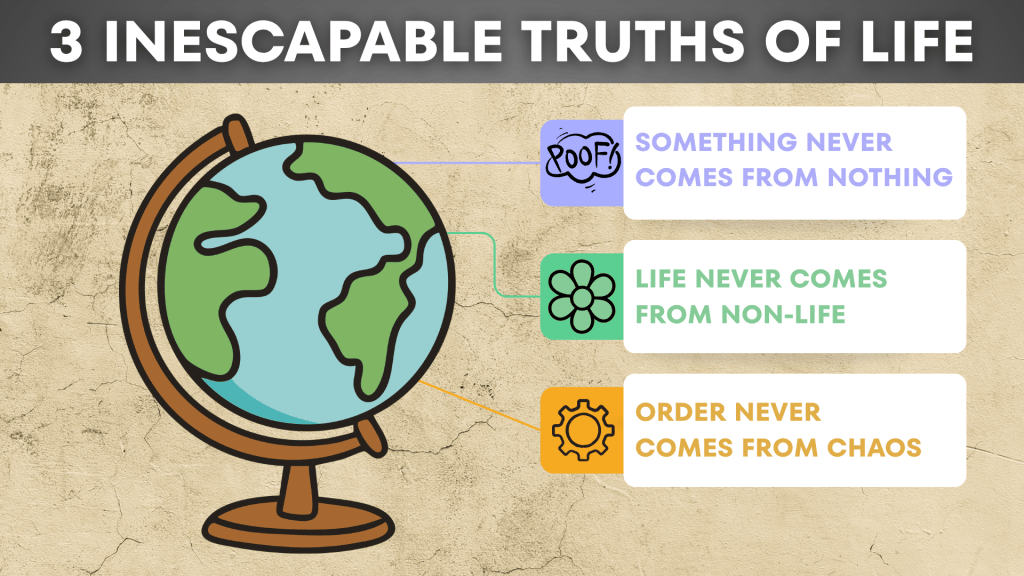
Three impossible beliefs that every naturalist must rely on:
Something came from nothing.
Life came from non-life
Order came from chaos
Just as God brought order from chaos in creation, He loves to bring order from chaos in our lives (if we’ll let Him).
Because the universe is created, we are responsible and accountable to the Creator. He knows best how life is to be lived, and we ought to pay attention.
Because we were purposefully created, we should live with purpose. God’s purposes for our lives will always be best.
Your value does not come from what you have or what you have accomplished or what people think of you. You are valuable because you have been created in the image of God!
Nothing Comes From Nothing
One of the most important questions any person can ask is deceptively simple: How did all of this begin? Genesis opens with a bold declaration—“In the beginning, God created…”—and that single sentence confronts every worldview with a choice. Either there is Something More behind the universe, or there is Nothing Else. Naturalism insists that matter and energy simply exist, without cause or intention. But that explanation collapses under its own weight. Something never comes from nothing. Life never comes from non‑life. Order never emerges from chaos. These are not theological statements; they are logical ones.
When we acknowledge that the universe requires a first cause, we begin to see the fingerprints of intention everywhere. The fine‑tuning of our world, the precision of rotation, the delicate balance of oxygen, the staggering complexity of the human body—none of these sit comfortably under the banner of “it just happened.” The first cause must be eternal, intelligent, and intentional. And Scripture names that cause: Yahweh, the God who speaks light into existence and breathes life into dust. The resurrection of Jesus becomes the ultimate validation that the God who begins creation is also the God who renews it.
Why does this matter? Because if there is Something More, then we are not accidents. We are creations. And created things have purpose. In a world where so many feel aimless and adrift, the doctrine of creation anchors us in meaning. You are here because God wanted you here. You are valuable because He says you are valuable. And that truth reshapes not only how we see the world—but how we live within it.
Click on the image to download the DiscipleQuest PDF
The DiscipleQuest PDF includes 7 days of verse study prompts. You can use these seven studies to dig deeper into what the Bible teaches about creation:
Exodus 20:11
John 1:3
Nehemiah 9:6
Romans 1:20
Psalm 19:1
Colossians 1:16
Isaiah 45:12
Use these questions as journal prompts or as conversation starters with a group of friends or a Bible study group:
OPTION ONE: Creation, the Creator, and Culture
This study is based on Romans 1:18-25. It is important to understand and move toward the understanding that God is the Creator and is not to be confused with the creation in any way! This is a foundational thought for all Biblical understanding.
FOUR THOUGHTS ABOUT “CREATION”:
It was made by God
It points to God
It is a resource, not a source
It is incapable of receiving worship or service
20 Questions
Are men really ungodly and righteous? Why or why not?
By whose standards are these judgments made?
What makes someone ungodly or unrighteous?
What truths about God do people suppress? Why?
What are the attributes of God that are clear to everyone?
How can creation point us to God?
Does it matter that God is immortal?
If God is the creator, what –if any– is our responsibility to him?
Why wouldn’t someone want to believe that God is the creator?
What do you think it means to “worship the creature”? Do people worship the creature today?
How does suppressing God’s truth make it easier for people to claim “wisdom”?
Do people prefer “black and white” wisdom or “gray”? Why? Does God see in black and white?
Why does God consider man’s wisdom to be “futile thinking”? Can you think of an example of this?
In what way are men’s hearts darkened and foolish? Does this apply to everyone? Why or why not?
How are people “without excuse”? For what? To whom?
Why is God wrathful?
Who is in danger of facing God’s wrath?
How is God’s wrath evident today?
How will it be evident in the future?
What is the solution to God’s wrath?
OPTION TWO: Meeting God in Creation
Read Genesis 1:1-5. Which word in these verses is the most important? Why?
Do you find it difficult or easy to hold faith and science together? What experiences have shaped that tension?
What do the words “without form and void” suggest about the condition of creation in Genesis 1:2?
How does the movement from darkness and disorder toward light and order reveal God’s character?
Does it matter whether or not God created the world? Does it matter whether or not He did it in six days? Why?
Why can conversations about creation become divisive, even among Christians who agree on the gospel?
Which questions about creation do you consider essential to the Christian faith, and which allow room for gracious disagreement?
What difference does it make that humans are created in the image of God? How does it change the way you think about yourself? How should it change the way you think about others?
How would your priorities change if you consistently remembered that you are accountable to the One who made you?
What is one concrete step you can take this week to live as someone who was created on purpose, for a purpose?
14Yet it was kind of you to share my trouble. 15And you Philippians yourselves know that in the beginning of the gospel, when I left Macedonia, no church entered into partnership with me in giving and receiving, except you only. 16Even in Thessalonica you sent me help for my needs once and again. 17Not that I seek the gift, but I seek the fruit that increases to your credit. 18I have received full payment, and more. I am well supplied, having received from Epaphroditus the gifts you sent, a fragrant offering, a sacrifice acceptable and pleasing to God. 19And my God will supply every need of yours according to his riches in glory in Christ Jesus. 20To our God and Father be glory forever and ever. Amen.
21Greet every saint in Christ Jesus. The brothers who are with me greet you. 22All the saints greet you, especially those of Caesar’s household.
23The grace of the Lord Jesus Christ be with your spirit.
LUKE 12:13-21
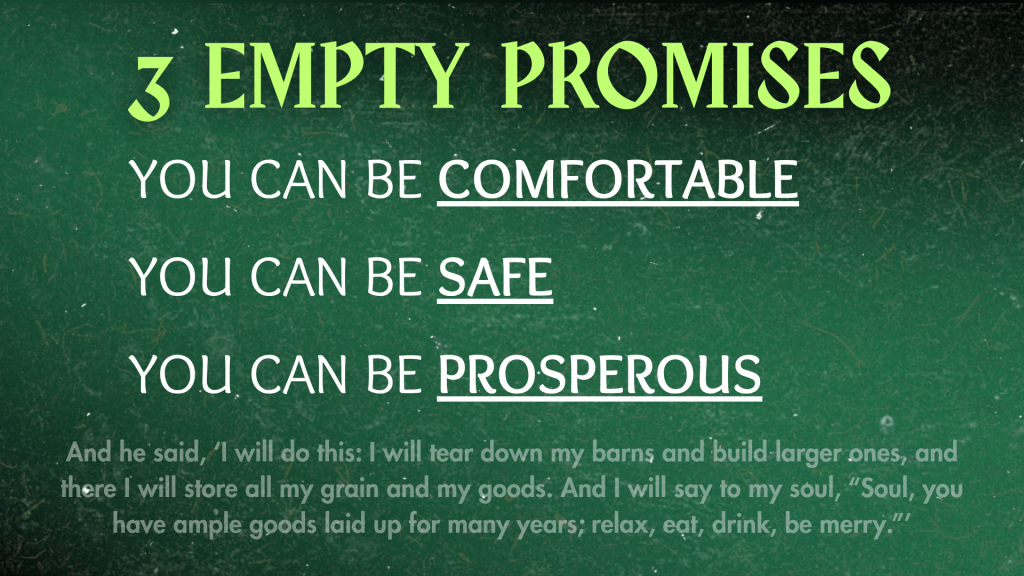
13Someone in the crowd said to him, “Teacher, tell my brother to divide the inheritance with me.” 14But he said to him, “Man, who made me a judge or arbitrator over you?” 15And he said to them, “Take care, and be on your guard against all covetousness, for one’s life does not consist in the abundance of his possessions.” 16And he told them a parable, saying, “The land of a rich man produced plentifully, 17and he thought to himself, ‘What shall I do, for I have nowhere to store my crops?’ 18And he said, ‘I will do this: I will tear down my barns and build larger ones, and there I will store all my grain and my goods. 19And I will say to my soul, “Soul, you have ample goods laid up for many years; relax, eat, drink, be merry.”’ 20But God said to him, ‘Fool! This night your soul is required of you, and the things you have prepared, whose will they be?’ 21So is the one who lays up treasure for himself and is not rich toward God.”
TEN POINTS TO PONDER
Just 10 verses earlier, Paul was confronting the church and challenging them to stop feuding. Now he is commending them for their kindness. This is how grace works. He began the book by talking about it, and now he’s ending the book by demonstrating it.
These verses are about generosity, both the Philippians generosity to Paul and God’s generosity to Paul. When God has been generous to us, we should be generous to others.
Paul was grateful for everything the Philippians had done for him because he realized that they had been a conduit for God’s glorious provision.
When we are generous to other people, not only are we partnering with them, but we are partnering with what God is doing in their life.
Generosity helps us release our grip on what we hold most tightly. And when we loosen our grip on those things, those things loosen their grip on us.
When I think about what I most need, or truly need, it’s helpful to think about the future. How important will this “thing” be in 5 months or 5 years? Will it even last that long?
If one of your problems is that you have so much stuff you don’t know what to do with it all, then you probably don’t really need a whole lot more!
Most of what I think I need, I actually just want. The one thing I truly need is eternal life. If I don’t have that, nothing else matters.
God’s riches are vast. He owns everything that exists. But all of that pales in comparison to His riches in Christ. And those riches are extended to us!
In verse 21, as in most of his letters, Paul makes it clear that he never does ministry alone. He relies on the people around him as much as he relies on the churches that support him. None of us are in this alone. If we aren’t relying on others, we’re missing out on the abundant life.
16 REASONS TO BE GRATEFUL TO GOD
Give thanks because of who God is:
Creator — even in its broken state, creation still trumpets the goodness of God.
Sustainer — if He ever removed His hands, all would fall apart.
Provider — He provides all our needs (not necessarily our wants)
Healer — every earthly healing is a small taste of the eternal healing that waits for us all
Savior — history is full of stories recounting God’s saving action on behalf of His people
Redeemer — He spared no expense to buy us back from our rebellion
Give thanks because of what God has done:
He chose Abraham — from Abraham he launched a new nation and inaugurated a redemptive plan
He rescued His people — by humbling the world’s superpower, God displayed His power
He delivered a remnant — in the midst of judgment and destruction, God saved a few to carry on His plan
He sent His Son — Jesus came to do for us what we could never do for ourselves
He sent His Spirit — a comforter, a guide, a counselor, a convictor, He is with us forever
He launched His church — a global community, united by love for Christ and the experience of salvation
Give thanks because of what God has promised:
An inheritance — reserved for us by God. We have hope that this life is NOT all there is
Complete salvation — in the future we will experience salvation from the power & presence of sin
Eternal life — death is not the end. On the other side of the grave is a brilliant, exhilarating & perfect life
All things new — no more sorrow or pain or death. Eden Restored!
Click on the image to download the DiscipleQuest PDF
The DiscipleQuest PDF includes 7 days of verse study prompts. You can use these seven studies to dig deeper into what the Bible teaches about God’s provision (remember to check out surrounding verses if you need more context):
Genesis 22:13-14
Psalm 23:1
Ephesians 1:3
Psalm 37:25
John 6:35
Matthew 7:9-11
Romans 8:31-32
Use these questions as journal prompts or as conversation starters with a group of friends or a Bible study group:
Do you generally think you have too much or too little? Why?
Read Luke 12:13-21. Have a few people try to summarize this parable with just one word.
Jesus used a question from the crowd to launch this parable, but He made it clear that it was a bad question. What was wrong with the question (or the attitude behind the question) in verses 13-15?
In verses 15, Jesus warned against all kinds of greed or covetousness. What are some different ways that greed can creep into our mind?
Notice how often the rich man used words like, “I”, “me” or “my”. What does that tell you about him?
If the rich man had been focused on gratitude, how might he have expressed gratitude to God in this story?
From the outside looking in, most people would have thought the rich man was highly successful. Why is it so easy for us to develop the wrong mindset about success in life?
The rich man’s life was full of safety, security, comfort, and convenience. How can these four things distract us from our relationship with God? How are you tempted to place too high a value on these things?
If you could give one piece of advice to the rich man, what would it be?
How does the story of the rich man challenge you? What is something you need to change in the way you think or the way you act? How will you take a step in this direction this week?
PHILIPPIANS: Line by line
Philippians 4:14-23: All your needs
14. Yet it was kind of you to share my trouble.
Even though much in his life was not going well, Paul never stopped being others-focused. He expressed gratitude and encourages the Philippians. Even though they were far away, they hadn’t left him alone, and he appreciated their concern and their provision.
15. And you Philippians yourselves know that in the beginning of the gospel, when I left Macedonia, no church entered into partnership with me in giving and receiving, except you only.
Paul’s special relationship with the church dated back to the beginning of their time together. During his early missionary journeys, they were one of the only churches who supported him. He uses the word partnership to make sure they understand that all of his Gospel work is only possibly because of their support. Because they shared in the work, they also get to share in the credit. Those who were saved through Paul’s ministry were saved in part because of the Philippians generosity.
16. Even in Thessalonica you sent me help for my needs once and again.
When Paul left Philippi, after starting the church there, he went to Thessalonica. It was right around the corner. And that quickly, the church in Philippi began supporting his work. They didn’t wait, they didn’t need to “grow more mature” or become more stable financially. They immediately started sacrificing so that they could contribute to the Kingdom mission.
17. Not that I seek the gift, but I seek the fruit that increases to your credit.
Paul is essentially saying, “I don’t want something FROM you. I want something FOR you.” The gifts he received were useful for him, but even more so the gifts were good for the Philippians. By sacrificing and being generous, Paul knew they would grow to be more Christlike and that their trust in God’s provision would be strengthened.
18a. I have received full payment, and more. I am well supplied, having received from Epaphroditus the gifts you sent,
Paul is assuring them that Epaphroditus was a trustworthy messenger and that he had indeed delivered everything they had sent. Even more importantly, it was plenty. Paul had everything he needed and more, thanks to them.
18b.a fragrant offering, a sacrifice acceptable and pleasing to God.
This verse sounds like Romans 12:1. Our lives should be offered as sacrifice that is pleasing to God. When we make personal sacrifices so that we can be generous to others, God is pleased.
19a. And my God
Paul’s dependance on God is the result of his relationship with God. To him, God is not an impersonal force or an unknowable deity. God is Paul’s God, they have a relationship. He is intimately acquainted with God’s presence.
19b. will supply every need of yours
It’s easy to get this verse wrong. The promise is not that all of our desires will be supplied, but that all of our needs will be supplied. We should never be surprised, confused, or disappointed that God hasn’t given us what we want. He never promised He would. And if He doesn’t give us something, it’s because He knows we don’t need it and He knows it wouldn’t be best for us.
19c.according to his riches in glory in Christ Jesus.
The manner of provision helps us understand the nature of the needs. That Jesus is the provision means that the need is sin. Only Jesus can provide salvation and forgiveness, and there is nothing we need more than that. If were given everything we ever wanted in life, but didn’t receive Jesus, it would all mean nothing at the end. If we receive nothing in life, but have Jesus at the end, it will mean everything.
20. To our God and Father be glory forever and ever. Amen.
When we understand that God has already met our most important (and only) need through Christ, we are left with nothing to do but to worship and glorify Him.
21-22. Greet every saint in Christ Jesus. The brothers who are with me greet you. All the saints greet you, especially those of Caesar’s household.
Everything was relational to Paul. He wanted the church in Philippians to know that they were not alone. He wanted to remind them that they were working together with people they didn’t know and who they would likely never meet. The kingdom of God is much larger than any one person or any one Church.
23. The grace of the Lord Jesus Christ be with your spirit.
Paul ends where he began. With the grace of God. We are at peace with God because He extended grace to us in the life, death, and resurrection of Jesus. In the same way, we can be at peace with others if we are willing to extend grace to them. Where peace is lacking, grace is likely missing. Where grace is not given, peace will not grow. If you want to live at peace, be a person who extends grace.
10I rejoiced in the Lord greatly that now at length you have revived your concern for me. You were indeed concerned for me, but you had no opportunity. 11Not that I am speaking of being in need, for I have learned in whatever situation I am to be content. 12I know how to be brought low, and I know how to abound. In any and every circumstance, I have learned the secret of facing plenty and hunger, abundance and need. 13I can do all things through him who strengthens me.
Matthew 6:25-33
“Therefore I tell you, do not be anxious about your life, what you will eat or what you will drink, nor about your body, what you will put on. Is not life more than food, and the body more than clothing? 26Look at the birds of the air: they neither sow nor reap nor gather into barns, and yet your heavenly Father feeds them. Are you not of more value than they? 27And which of you by being anxious can add a single hour to his span of life?g28And why are you anxious about clothing? Consider the lilies of the field, how they grow: they neither toil nor spin, 29yet I tell you, even Solomon in all his glory was not arrayed like one of these. 30But if God so clothes the grass of the field, which today is alive and tomorrow is thrown into the oven, will he not much more clothe you, O you of little faith? 31Therefore do not be anxious, saying, ‘What shall we eat?’ or ‘What shall we drink?’ or ‘What shall we wear?’ 32For the Gentiles seek after all these things, and your heavenly Father knows that you need them all. 33But seek first the kingdom of God and his righteousness, and all these things will be added to you.
TEN POINTS TO PONDER
If Paul had to learn contentment, I should not be surprised when it doesn’t come naturally to me. Conversion makes me new immediately; learning to live like the new person Christ has made me takes time.
I can be content even when I don’t get what I want. Paul didn’t learn to change his circumstances, he learned to be content in every circumstance.
We don’t only struggle with contentment when we are in need. Paul said he had to learn to be content even when he had an abundance. Sometimes, the more we have the more we want.
Philippians 4:13 is not a promise that we will always succeed or always get what we want. It is a promise that no matter what we get, we will get through.
Sometimes God takes me through a tough situation and sometimes God takes me out of a tough situation (sometimes He takes His children home!).
The Bible never teaches that we won’t sometimes find ourselves in need. It always teaches that our needs will be met.
Worry is the killer of contentment. It is rooted in what might happen whereas contentment is rooted in what has happened. Worry feeds on fear, contentment grows from trust.
Contentment is choosing to focus on what God has already done and has already given rather than looking at what I don’t have and what hasn’t happened.
It’s hard to be content when my expectations run ahead of God’s promises.
It’s okay to pray, “God change this.” It’s even better to pray, “God change me through this.”
Contentment from the Commandments
Contentment and gratitude go hand in hand. The more I practice gratitude, the more I’ll experience contentment. Consider how the 10 commandments can help you express more gratitude.
Gratitude is a powerful tool for fighting anxiety, fear, and selfishness. It also promotes contentment, generosity, peace, and trust. I am always looking for new methods to develop more gratitude in my life. Here is an idea I have to use the 10 commandments as a jumping-off point for gratitude. Consider praying through these commands and using each one to express thanksgiving to God.
1. Have no other gods before Me.
Thank you for being all-powerful, all-present, always in control, and still caring about me.
2. Make no false idols.
Thank you for being everything I need so that I never need to look elsewhere for provision.
3. Do not take the name of the LORD in vain.
Thank you for the privilege of calling on your name through prayer. Thank you for hearing my prayers.
4. Remember the Sabbath.
Thank you for all of creation and for building healthy rhythms into creation as an example for how to live my life.
5. Honor your father and mother.
Thank you for my family and for the people in my life who are like family to me.
6. You shall not kill.
Thank you for life and all you do to sustain me. 7. You shall not commit adultery.
Thank you for relationships and for love and for the gift of marriage. Thank you for your faithfulness to me.
8. You shall not steal.
Thank you for entrusting me with so many gifts. Thank you for giving me far more than I ever needed.
9. You shall not bear false witness against your neighbor.
Thank you for truth. Thank you that Jesus is the truth and the life. Thank you for you Word which is truth for life.
10. You shall not covet.
Thank you for providing all my needs. Thank you for your promise to always give me everything I need.
Click on the image to download the DiscipleQuest PDF
The DiscipleQuest PDF includes 7 days of verse study prompts. You can use these seven studies to dig deeper into what the Bible teaches about contentment:
1 Timothy 6:6-8
Hebrews 13:5-6
Proverbs 15:16
Matthew 6:31-33
Psalm 23:1
2 Corinthians 12:9-10
Proverbs 30:8-9
Use these questions as journal prompts or as conversation starters with a group of friends or a Bible study group:
Read Philippians 4:10-13. Have a few people summarize the passage in one sentence.
Discuss what the 4-5 most important words are in this passage.
Paul says he had “learned” to be content. What does that word tell us about contentment? Why might contentment need to be learned rather than simply chosen?
Compare Philippians 4:11–13 with Matthew 6:25–33. What similarities do you see between Paul’s contentment and Jesus’ teaching about worry?
Jesus says, “Your heavenly Father knows that you need them all.” How does knowing that God knows our needs help us understand Paul’s contentment?
Why do you think comparison is such a powerful enemy of contentment? Where are we most tempted to compare ourselves with others?
How do our expectations contribute to discontentment? What’s the difference between something God has promised us and something we simply expected him to give us?
Paul learned contentment through experience. What difficult circumstance has God used in your past to teach you something about his faithfulness?
Finish this sentence: “I would be more content if only __________.” What does your answer reveal about where you’re looking for satisfaction?
What is one specific practice you could begin this week that would help you learn contentment rather than simply wishing you were more content?
PHILIPPIANS: Line by line
Philippians 4:10-13: The Secret of contentment
10. I rejoiced in the Lord greatly that now at length you have revived your concern for me. You were indeed concerned for me, but you had no opportunity.
Paul and the Philippians had a long-standing relationship in which the Philippian Church had supported him in his ministry. Due to circumstances, they had been unable to send support to him for a period of time, but now, their most recent gift was delivered to Paul by Epaphroditus. Paul expressed to them how grateful he was. And then used their gift as an opportunity to remind them of the importance of contentment.
11a. Not that I am speaking of being in need,
The Philippians gift was generous and needed, but Paul also knew that if it hadn’t arrived, God would have provided another way. Even though he had needs, Paul never considered himself “in need”, because he knew God would provide.
11b. for I have learned…
Contentment didn’t come naturally for Paul. He had to learn it. It doesn’t come naturally to any of us. If we are not intentional about developing contentment, we will not be content.
11c. in whatever situation I am to be content.
The nature of contentment is that it is not dependent on circumstances. Contentment flows from something greater than our current situation. Therefore, true contentment can exist anywhere at any time.
12. I know how to be brought low, and I know how to abound. In any and every circumstance, I have learned the secret of facing plenty and hunger, abundance and need.
Paul was content whether things were good or bad, whether he had everything he wanted or nothing he desired. He had experienced all of life and had learned that nothing in life can bring contentment. Something beyond what life offers is needed.
13a. I can do all things…
This is not a promise that we can have success or victory in every situation and it is not a promise that we can attain or achieve everything we hope for. All things is a reference to verse 12, the highs and lows of life and the much and the little of life.
13b. through him who strengthens me.
God’s strength is the secret of contentment. Because He can do anything, and because He’ll always do what is best for me, I can be content no matter what I have and no matter what is happening. In every situation of life, I know that I’ll get through because God is with me.
1 Blessed is everyone who fears the LORD, who walks in his ways! 2 You shall eat the fruit of the labor of your hands; you shall be blessed, and it shall be well with you. 3 Your wife will be like a fruitful vine within your house; your children will be like olive shoots around your table. 4 Behold, thus shall the man be blessed who fears the LORD. 5 The LORD bless you from Zion! May you see the prosperity of Jerusalem all the days of your life! 6 May you see your children’s children! Peace be upon Israel!
10 POINTS TO PONDER
The better life begins in your heart, becomes externalized in your actions, slowly spreads to those closest to you, and ultimately impacts anyone in your circles of influence.
The first biblical example of fearing the LORD happened in Genesis 3 when Adam and Eve hid from God. They were afraid because of feelings of guilt and inadequacy. This is NOT the proper example. Our fear of the LORD is not terror, but is rather honor, respect, admiration, and submission.
When God is the first priority of my heart, my life will be characterized by obedience to Him and imitation of Him.
The “blessed life” is not a cliché meaning we get everything we desire; rather, it is an inversion of what our sinful soul pursues, and it is a recalibration of what we hope for in life.
When you fear the LORD and walk in His ways, you will experience the rolling back of sins curse. What was once a difficulty will become a joy. What once caused dread will now be anticipated.
When a husband cultivates his relationship with his wife by being attentive, consistent, tender, and patient, she will bring joy and fruitfulness to their home.
We may not see the benefit of our parenting for years. Some children take a long time to mature. However, the more intentional we are in their younger years, the more likely it is that they will bring us great joy in our older years.
Nations are blessed when their cities are blessed. Cities are blessed when their families are blessed. Families are blessed when their parents walk with God.
No one has ever fully feared the LORD or completely walked in His ways. That’s why we’ve never really experienced the blessings described in this Psalm. This is why we need Jesus!
You can either have Jesus or prosperity. Or you can have Jesus’ version of prosperity, which is death.
ONE DAY, AMERICA WILL FALL
Jeremiah wrote from a place of unimaginable despair. The world he knew had come to an end. His grief and agony bleed across every page of Lamentations. The glorious city of Jerusalem lay in ruins, and from Jeremiah’s perspective there seemed to be no hope of rebuilding or restoration.
Yet there is hope.
Jerusalem was not the first great city to fall, and it would not be the last. History is filled with the ruins of kingdoms that once seemed invincible. Today we can walk through the remains of the Mayans, the Incas, the Romans, the Persians, and countless others. Every empire eventually crumbles. No earthly kingdom lasts forever.
That may not sound hopeful at first, but it is.
America is still a young nation. At 250 years old, it has existed for only a fraction of the time that Israel or Judah endured. Yet one day Washington will fall. New York will fade. Los Angeles will become another chapter in history. It may not happen in our lifetime, but it will happen. Someday someone could write these same words over our nation:
“How lonely sits the city that was full of people! How like a widow has she become, she who was great among the nations!”
Do you see the hope now?
The same principle applies to every one of us. You may live seventy or eighty years if God grants it. Then your life on earth will end. Your accomplishments will be forgotten. Your possessions will decay. Your reputation will fade. Everything you build in this world will eventually crumble.
Yet there is hope.
Peter reminds us that those who belong to Christ “have been born again to a living hope… to an inheritance that is imperishable, undefiled, and unfading, kept in heaven for you” (1 Peter 1:3–4).
If your hope is in yourself, you will eventually be disappointed.
If your hope is in your abilities, your achievements, or your wealth, they will fail you.
If your hope is in your country, it will one day disappoint you.
If your hope is in a politician, a pastor, a leader, or a celebrity, they will eventually let you down.
Everything ends.
Except the kingdom of God.
So place your hope where it can never be shaken. Invest your time, your talent, and your treasure in the kingdom that will never fall. Live for what lasts forever.
Click on the image to download the DiscipleQuest PDF
The DiscipleQuest PDF includes 7 days of verse study prompts. You can use these seven studies to dig deeper into what the Bible teaches about fearing the Lord:
Proverbs 1:7
Deuteronomy 10:12
Proverbs 8:13
2 Corinthians 7:1
Psalm 34:9
Proverbs 15:16
Ecclesiastes 12:13
Use these questions as journal prompts or as conversation starters with a group of friends or a Bible study group:
Discussion Questions – Matthew 6:19–34
Who in your life needs to be reminded that God is faithful? How can you encourage them this week?
What are some of your favorite keepsakes? Why are they so meaningful to you? How would you feel if you lost them?
Why is it so difficult to let go of the things we love?
Read Matthew 6:19–34. Which two or three sentences stand out to you the most? Why do they resonate with you?
Jesus talks about storing up treasure in two different places. What are those two places, and what makes them so different?
Do you know someone who has lost an earthly treasure—a possession, investment, or accomplishment that meant a great deal to them? What happened, and what did you learn from their experience?
In verses 25–32, Jesus tells His followers not to be anxious. What specific things does He mention? Why do you think people worry so much about them?
Jesus commands us to “seek first the kingdom of God.” What do you think that means? What would it look like for someone to live as though God is truly their King?
Jesus also tells us to seek God’s righteousness. What do you think that looks like in everyday life?
God has entrusted each of us with different treasures—our time, abilities, relationships, opportunities, finances, and influence. Which treasures has He entrusted to you? How do you think He wants you to invest them?
What causes you the most anxiety? What are you most afraid of losing? How do verses 27–30 speak into those fears?
Is there anything God may be asking you to let go of? Is there something He is calling you to pursue more intentionally?
What is one practical way you can remind yourself of God’s faithful provision this week?
1 Unless the LORD builds the house, those who build it labor in vain. Unless the LORD watches over the city, the watchman stays awake in vain. 2 It is in vain that you rise up early and go late to rest, eating the bread of anxious toil; for he gives to his beloved sleep. 3 Behold, children are a heritage from the LORD, the fruit of the womb a reward. 4 Like arrows in the hand of a warrior are the children of one’s youth. 5 Blessed is the man who fills his quiver with them! He shall not be put to shame when he speaks with his enemies in the gate.
TEN POINTS TO PONDER
Nothing that really matters in life can be successfully accomplished without God.
Even the mundane things of life can become marvelous when they are done for the glory of God.
A full life without God will be eternally empty.
The temple was a reminder that building can be successful when God is in it, and the walls of Jerusalem were a reminder that safety is possible when God is in it.
If all of your hard work leaves you anxious and without sleep, is it really worth it?
Peace is a great gift from God. One can be at peace, even if unfomfortable or unsafe. One can be at peace, even if unsuccessful in the eyes of the world. Peace is from God, not something we achieve for ourselves.
We like to think that we can build a great life for ourselves, but the greatest gifts of all are the ones that are given to us by God (namely, salvation and children).
An arrow that is not intentionally aimed will never hit its target. In the same way, a child that is not intentionally aimed will never become what the parents hope.
When parents don’t let go, children don’t reach their potential. From the moment your child is born, your job is to get them ready to leave.
Solomon, the author of this Psalm, built the LORD’s house, but sadly did not build his own house on the LORD. It is possible to be so busy doing ministry that we neglect the more important responsibility of family.
5 SIMPLE TRICKS TO BE A SUPER-STAR PARENT
Every parent wants to become a better parent. One of the greatest opportunities we have is learning how to communicate well when our children need correction.
The truth is, learning to receive correction is one of the defining characteristics of a wise person. If our children can grow into adults who accept correction with humility instead of resisting it with pride, they will avoid countless heartaches. The way we correct them today will shape the way they respond to correction for the rest of their lives.
I recently came across the following principles in an article about parenting. While the article was written primarily to fathers, the wisdom applies to every parent.
The next time you need to correct your child, keep these five reminders in mind:
1. Don’t waste words.
Resist the urge to over-explain, over-apologize, or lecture. Calm, confident, and concise correction is usually far more effective than a lengthy speech.
2. Don’t threaten.
Empty threats only weaken your credibility. Say what you mean, and follow through consistently.
3. Be clear about expectations.
Don’t assume your child knows exactly what you expect. Make your expectations simple, specific, and unmistakably clear.
4. Be clear about consequences.
Especially in areas where your child has struggled before, they should know in advance what will happen if they choose to disobey. Surprises rarely produce growth; consistency often does.
5. Take decisive action.
When correction is needed, don’t delay or hesitate. Loving, measured, and consistent action communicates security and builds trust.
None of us gets this right every time.
Just as our children need grace, so do we. There will be moments when we overreact, underreact, or simply handle things poorly. When that happens, don’t pretend it didn’t happen. Humbly admit your mistake, ask for forgiveness when appropriate, learn from it, and move forward.
Perfect parents don’t exist. But humble, growing parents are exactly what our children need.
Click on the image to download the DiscipleQuest PDF
The DiscipleQuest PDF includes 7 days of verse study prompts. You can use these seven studies to dig deeper into what the Bible teaches about building a life with or without God:
Proverbs 14:12
Matthew 7:24-27
Colossians 2:6-7
1 Corinthians 3:11
Mark 8:36
Jeremiah 17:5
Ecclesiaster 2:11
Use these questions as journal prompts or as conversation starters with a group of friends or a Bible study group:
What is something you have built that you are proud of?
What is something you protect? that you work hard to keep from losing?
Read Psalm 127:1-2. Have several people rephrase these verses in their own words.
Other than houses, what are things people build in their lives?
If someone observed the way you spend your money, time, and energy, what would they assume you were building with your life?
What do you think it means to build with God or to build without God?
What do you think God wants you to build with your money, time, and energy?
Why is safety such a high value for many people? What does this Psalm say about safety (v1)?
How does your need or desire for safety work together with your trust in God?
What is the difference between having a healthy ambition and turning success or advancement into an idol?
Hard work is not bad, but when can hard work become a bad thing?
When you work hard, are you usually working for God’s glory or for your own security, comfort, or recognition?
How can you invite God into your work this week?
What will it look like for you this week to depend more upon God?
Rejoice in the Lord always; again I will say, rejoice. Let your reasonableness be known to everyone. The Lord is at hand; do not be anxious about anything, but in everything by prayer and supplication with thanksgiving let your requests be made known to God. And the peace of God, which surpasses all understanding, will guard your hearts and your minds in Christ Jesus.
TEN POINTS TO PONDER
We should never forget that Paul is writing these words from prison. When he uses words like “anything” and “everything” those include the times when you find yourself in prison because you’ve been falsely accused.
To “rejoice” is to “activate joy”. It is an action word that is rooted in state of being. It is the intentional act of bringing joy to the surface by externally declaring and demonstrating the internal reasons we have for happiness.
We are not to rejoice in our circumstances, because circumstances change. We rejoice in the Lord, because He never changes.
Tie this passage back to the previous verses. One of the reasons Euodia and Synctyche were feuding was that they lacked joy. It is impossible to be angry at another believer if you are filled with joy from the Lord.
“The Lord is at hand” can be understood several different ways, but what is undeniable is that it points to God’s proximity and His control. He knows what is happening and what is next, and He is near to us in and through it all.
If we truly believe that the Lord is at hand, the only reasonable response is to relax and rejoice in Him.
When we bathe our prayer in thanksgiving, we receive a greater benefit. We are reminded of God’s past provision and protection and we grow more confident in the trustworthiness of his promises.
Is there anything you can do about this? If so, do it and stop worrying. If not, don’t worry about it; pray.
Those who seek peace through understanding will never find it. Those who find peace without understanding will easily hold on to it.
You cannot find a good reason to be anxious unless you leave God out of the equation.
YOU DON’T HAVE TO LIVE ON ANXIETY ISLAND
Everyone experiences stress and anxiety, but no one has to live there.
Anxiety Island is a lonely place. It’s where we begin to believe the lie that no one could possibly understand what we’re going through. But Jesus understands. He has been there. Because He suffered in every way we do, yet without sin, we can look to Him to find the way out of anxiety and into God’s peace.
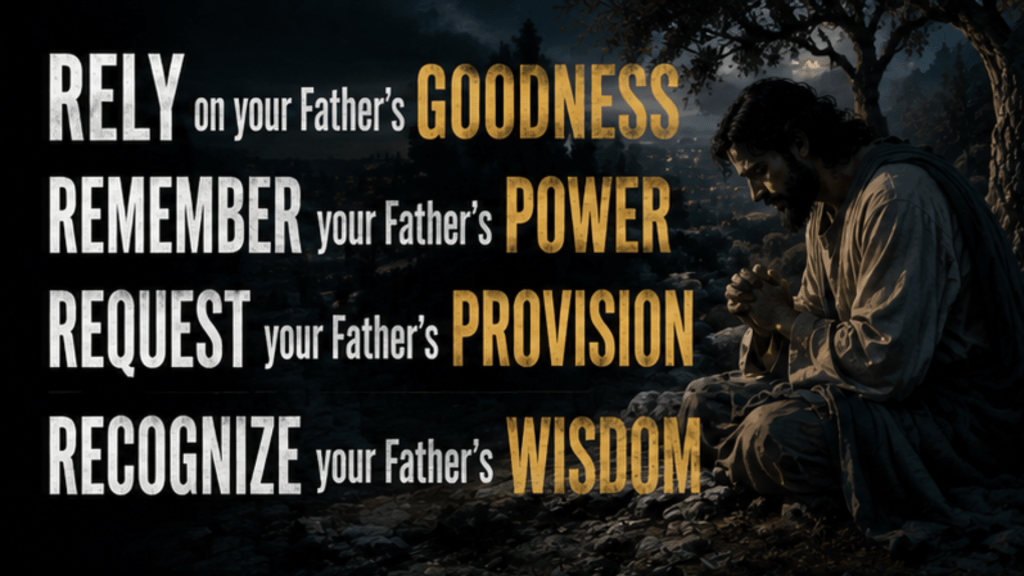
On the night Jesus had every reason to be overwhelmed by anxiety, He prayed.
Prayer is the alternative to anxiety.
Philippians 4:6-7 says:
“Do not be anxious about anything, but in everything by prayer and supplication with thanksgiving let your requests be made known to God. And the peace of God, which surpasses all understanding, will guard your hearts and your minds in Christ Jesus.”
When we turn our burdens over to God, we can rest in His peace instead of rolling around in our panic.
In the previous verses, Paul encourages believers to rejoice always. The absence of rejoicing creates a void that anxiety loves to fill. That’s why Paul continues by reminding us that thanksgiving should accompany every prayer.
Thanksgiving is the antidote to anxiety.
When my heart is full of gratitude for God’s goodness, faithfulness, and provision, there is less room for anxiety to take root.
This passage is ultimately about the power of prayer, not the size of our problems. We bring our needs to God because we are confident in His character and provision. That confidence grows through a lifestyle of thanksgiving.
Notice that Paul does not promise we’ll receive everything we ask for. He does promise peace. Peace comes when we release our requests into God’s hands and trust Him with the outcome.
Trust is the antidote to anxiety.
In the Garden of Gethsemane, Jesus asked His Father if there was another way. There wasn’t. Yet even though His request was not granted, He was so filled with peace that He endured His trial with faith, courage, patience, and even forgiveness. He trusted His Father to do what was right.
Don’t stay stuck on Anxiety Island.
Fill your life with gratitude for what God has done, what He is doing, and what He will do. Find reasons to rejoice in every circumstance. Present your requests to your Father—and leave them there.
Be confident that He will meet your needs, work all things together for your good, and always do what is right.
Click on the image to download the DiscipleQuest PDF
The DiscipleQuest PDF includes 7 days of verse study prompts. You can use these seven studies to dig deeper into what the Bible teaches about being at peace:
Matthew 6:25-34
1 Peter 5:7
Isaiah 26:3
Psalm 46:1-3
Isaiah 43:1-2
John 14:27
Psalm 55:12
Use these questions as journal prompts or as conversation starters with a group of friends or a Bible study group:
Describe the most comfortable place in your house?
Talk about a time in your life when you have felt a “deep” peace.
How do you think comfort and peace are related?
What are the situations in life that steal people’s peace?
Read Psalm 23.
Have a few people talk about their experiences walking (or watching someone walk) through the “valley of the shadow of death.”
Verse four refers to fearing evil. What evil things do people often fear?
How do death, evil, and fear steal our peace?
What other life experiences make us uncomfortable? How does being uncomfortable often steal our peace?
What phrases in Psalm 23 are comforting phrases?
The last phrase of the Psalm is “I shall dwell in the house of the LORD forever.”
How should knowledge of future comfort help us deal with the current discomforts of life?
Verse one of the psalm says, “The LORD is my shepherd, I shall not want.” How does contentment bring peace?
What aspects of your life are currently stealing your peace? How would the good shepherd tell you to deal with these?
PHILIPPIANS: Line by Line
Philippians 4:4-7: Rejoice in Everything
4a. Rejoice in the Lord always.
Paul writes these words from prison. He is not speaking theoretically. He is proving that joy is possible even when life is difficult. The secret is not changing our circumstances. The secret is fixing our attention on Jesus.
4B. Again, I will say, rejoice.
This is the theme of the entire letter. Paul repeats it so his friends won’t forget. Joy is not found in circumstances, comfort, success, or approval. Those things come and go, but joy is found in the Lord. If our joy depends on circumstances, it will disappear whenever life becomes difficult. If our joy depends on Jesus, it will always be available.
5a. Let your reasonableness be known to everyone.
Christians should be the most observably reasonable people around. Some people can always find a reason to be unhappy. Some people can always find a reason to be happy. Christians should always be the latter. If you are in Christ, and you’re not becoming a more joyful person, it’s either because you’re quenching the Spirit or because you aren’t really in Christ.
5b. The Lord is at hand.
(i) The Lord is at hand because He is present with us. He has not abandoned us. He knows everything that is happening, and He is in control of everything that is happening.
(ii) The Lord is at hand because He is returning soon. History is moving toward a conclusion. Every injustice will be addressed. Every wrong will be made right.
Because Jesus is near (remember Psalm 23), we do not need to panic. Because Jesus is coming, we do not need to worry.
6a. Do not be anxious about anything,
Anxiety is a burden God never intended us to bear. Nothing in life is a good reason to be anxious, but because we sometimes lose sight of God, anxiety can often creep in. This is not a suggestion that bad things and hard things don’t happen, but rather it is Paul’s core belief that bad things and hard things will not cause us anxiety if we deal with them the right way.
6b. But in everything…
“Everything” is a different way to say “anything.” This teaching from Paul is all-inclusive; there are no exceptions.
6c. by prayer and supplication with thanksgiving, let your requests be made known to God.
Prayer is an antidote to anxiety. When we pray with thanksgiving, we leverage what God has always done to embolden us in our belief that He will do it again. He wants us to ask Him for whatever we want, and He wants us to do so with a heart that recognizes and embraces His ability to provide whatever we need.
7a. And the peace of God, which surpasses all understanding,
Anxiety grows when we focus on what we don’t know. We worry about what might happen, what people might do, what others might think, etc. Peace happens when we focus on what God knows (even if we don’t know it). Our confidence in His control allows us to live with peace, no matter what is happening.
7b. will guard your hearts and minds in Christ Jesus.
When we let our emotions run wild, we become anxious. When we let our minds run wild, we become anxious. When we let Jesus run our minds and emotions, we find peace.
12 Not that I have already obtained this or am already perfect, but I press on to make it my own, because Christ Jesus has made me his own. 13 Brothers, I do not consider that I have made it my own. But one thing I do: forgetting what lies behind and straining forward to what lies ahead, 14 I press on toward the goal for the prize of the upward call of God in Christ Jesus. 15 Let those of us who are mature think this way, and if in anything you think otherwise, God will reveal that also to you. 16 Only let us hold true to what we have attained. 17 Brothers, join in imitating me, and keep your eyes on those who walk according to the example you have in us. 18 For many, of whom I have often told you and now tell you even with tears, walk as enemies of the cross of Christ. 19 Their end is destruction, their god is their belly, and they glory in their shame, with minds set on earthly things. 20 But our citizenship is in heaven, and from it we await a Savior, the Lord Jesus Christ, 21 who will transform our lowly body to be like his glorious body, by the power that enables him even to subject all things to himself. 1 Therefore, my brothers, whom I love and long for, my joy and crown, stand firm thus in the Lord, my beloved.
TEN POINTS TO PONDER
Pay attention to the strength of the action words/phrases in these verses: “press on”, “straining forward”, “hold true”, “stand firm”.
The previous verses make it clear that nothing we do can earn salvation. These verses make it clear that if we do nothing, we will not experience the abundant life made possible by salvation.
The Christian life is progressive. Day by day and step by step, we grow to be more like Christ. None of us has obtained it, and none of us is perfect, but we all keep pressing on.
The ultimate goal is to be found in Christ on the day we are called up to be with God.
In verse 15, Paul mentions that maturity is reflected in and developed by how we think. If we want to be spiritually mature, we must pay attention to our thought life and our mindset.
Christian maturity happens when we surround ourselves with mature believers and when we watch and imitate mature believers. You will become like the people with whom you spend the most amount of time.
The pattern of the world is to live by passions, live with urgency, and live for acceptance. The pattern of the kingdom is to live by God’s power, live with patience, and live for the glory of God. (v.19-21)
You are the only person who can decide whether to live as a citizen of this world or as a citizen of the next world. How you invest your time, talents, and treasures is the greatest indicator of how you’ve made that choice.
Because we know that one day Jesus will transform us and glorify our bodies, we should live today to glorify Him.
To “stand firm” in the Lord means to have your feet firmly planted in the person of Jesus. If you never think of Him, never commune with Him, never speak to Him, and never listen to Him… your feet are not planted in Him!
5 DAILY ACTIVITIES TO FIRMLY PLANT YOURSELF IN CHRIST
In the parable of the sower, Jesus taught that some people fail in their faith because they lack spiritual depth. When the trials of the world hit (and they always do), these people wither and die. Standing firm requires us to put down deep spiritual roots. Below are three Bible passages that talk about putting down spiritual roots and five principles I’ve drawn from these passages (you’ll notice how they each tie back to Philippians 3):
Passage 1: Psalm 1:1-3
Psalm 1:1-3 Blessed is the one who does not walk in step with the wicked or stand in the way that sinners take or sit in the company of mockers, but whose delight is in the law of the Lord, and who meditates on his law day and night. That person is like a tree planted by streams of water, which yields its fruit in season and whose leaf does not wither— whatever they do prospers.
Limit your time with people whose influence is spiritually shallow (Psalm 1)
The people with whom you spend time will influence you to become like them. To be sure, you can influence them as well, but if you are not intentional about the nature of your relationship, you will become like them more quickly than they become like you.
I often think of a ladder when I read this passage. Imagine two people on the same ladder, one desires to pull the other up, and the other is working to pull their partner down. Gravity sides with the low man on the ladder. He will have a much easier time pulling the other down. Our natural tendency toward sin and selfishness causes us to get pulled down much more quickly than we pull others up.
Psalm 1 warns against spending too much time with those who live in opposition to God. They influence you toward spiritual shallowness. Implied in this Psalm is the need to surround yourself with those who will produce spiritual depth in your life. Allow yourself to be influenced by those who will ask tough questions, hold you accountable, and encourage you toward faithfulness.
Immerse yourself in God’s Word (Psalm 1)
Psalm 1 also declares that the person who delights and meditates in God’s Word will be blessed. The Bible is God’s revelation of Himself to us. Everything we need to know about Him and everything we need to know about living a righteous life is included in its pages. Spiritual depth is the result of time spent with God’s Word.
Meditating on God’s Word indicates more than simply reading a passage, setting it down, and getting on with your day. Meditating means you take God’s truth with you throughout the day. You may not be able to memorize an entire chapter and recite it to yourself all day long, but you can identify a principle and repeatedly come back to it during the day. Perhaps you can write it down or email it to yourself. Maybe you can set an alarm on your phone reminding you to take a couple of minutes to review what you discovered. Most importantly, seek opportunities to apply God’s Word to your daily situations. As you do this, you’ll discover a new depth to your spiritual life.
Passage 2: Colossians 2:6-7
Colossians 2:6-7 — So then, just as you received Christ Jesus as Lord, continue to live your lives in him, rooted and built up in him, strengthened in the faith as you were taught, and overflowing with thankfulness.
Continually demonstrate gratitude to God (Col 2:7)
In Colossians 2, Paul is encouraging a group of Christians to live consistently with their roots in Jesus’ example and teaching. This is accomplished, according to Paul, by “overflowing with thankfulness.” Saying, “thank you” every so often is nice, but a quick prayer of thanksgiving once a day is hardly “overflowing.”
Causing anything to overflow requires filling it with more than it can handle. If you want to overflow with thanksgiving, you must FILL your life with more gratitude than you can handle. That means being thankful even when you don’t feel like it.
Begin your day by giving thanks (you can start by thanking God that He woke you up). At various points throughout the day (meals), give thanks. At the conclusion of your day, give thanks. When things go well, give thanks. When others treat you with kindness, give thanks. When things go poorly, give thanks that they aren’t worse. When others treat you with malice, give thanks that you are being treated like Jesus was. You can always find something for which to be grateful. The more you thank God, the more you’ll be rooted in His Son.
Fill your mind with Biblical teaching (Col 2:7)
This may seem similar to an earlier idea, but an important distinction should be noticed. Psalm 1 focused on what you do on your own. Do you long to study God’s Word? Do you carry it with you? Colossians 2 is focused on what you do with others. The keyword in this phrase is “taught”. You should regularly place yourself in relationships with those who can teach you God’s Word.
You can learn from pastors, small group leaders, authors, podcasts, YouTube, blogs, friends, family members, and even your children. The key is getting into places where you will hear the truth, submitting yourself to listen to the truth, and opening yourself to be changed by the truth. It’s no secret that God’s plan for us includes relationships with others. He created us to be shaped by our relationships. Allow yourself to be impacted by those around you so that you can develop a new level of spiritual depth.
Passage 3: Ephesians 3:16-18
Ephesians 3:16-18 — I pray that out of his glorious riches he may strengthen you with power through his Spirit in your inner being, so that Christ may dwell in your hearts through faith. And I pray that you, being rooted and established in love, may have power, together with all the Lord’s holy people, to grasp how wide and long and high and deep is the love of Christ,
Choose love (Eph 3:17)
Concentrate on how much Jesus loves you. Paul wrote in Ephesians that God’s love is wide, long, high, and deep. In other words, it’s way bigger than you can imagine. Think about that. The God of the universe loves you more intensely than you could ever love yourself. How do you want to respond to that love?
These verses say that we are rooted and established in love because we have Christ dwelling in our hearts. The more time you spend contemplating Christ’s love for you, the more that love will spill out of you and into the lives of all those around you. More importantly, the more you think about Jesus’ love for you, the more you will discover your love for Him.
At the end of the day, you cannot stand firm if your life is not rooted in Christ. The deeper your roots go, the more you will love and be loved by your Creator, Savior, Redeemer, and Lord.
Click on the image to download the DiscipleQuest PDF
The DiscipleQuest PDF includes 7 days of verse study prompts. You can use these seven studies to dig deeper into what the Bible teaches about being rooted:
Colossians 2:6-7
Psalm 1:2-3
Ephesians 3:17
Psalm 92:12-14
1 Corinthians 15:58
John 15:4-7
Matthew 7:24-25
Use these questions as journal prompts or as conversation starters with a group of friends or a Bible study group:
Read Philippians 4:1. What do you think it means to “stand firm” in the Lord?
Two obstacles exist for anyone who attempts to “stand firm”. The first is the ground on which they plant their feet, and the second is the forces that seek to dislodge them.
What are three steps a person can take to build their life on a foundation that allows them to stand for Jesus?
Make a list of five challenges people face that might dislodge them or cause them to stumble in their faith. What is the greatest challenge you face?
Read Matthew 7:24-27 and 1 Corinthians 3:11-13. What do these verses teach about the foundation of our life?
If Jesus is the foundation of your life, how should that impact what you think? How should it impact what you say? How should it impact the way you treat and talk about others?
Healthy trees can withstand a storm because they have put down strong roots. The Bible uses this as a picture describing how we can stand firm in the storms of life.
Read Psalm 1:1-3, John 15:5, and Galatians 5:22-23. What do these verses teach about roots, branches, and fruit?
What do you think it means to be “rooted in Him”?
If you allow Jesus to be the primary source of authority in your life, what kind of fruit should your life be bearing?
What do you think it means to be “built up in Him”?
Which of these areas is most challenging for you?
Walking Jesus’ path?
Being rooted in Jesus?
Allowing Jesus to be your foundation?
What is your next step?
How can this group pray for you?
PHILIPPIANS: Line by Line
3:12-4:1 Stand Firm
12a. Not that I have already obtained this or am already perfect,
Paul had not yet arrived at the end where he would receive his final reward, and his life was not yet free from sin. His statement here is a helpful reminder for every Christian. We will never fully arrive until we step from this life into the next life. Until then, perfection can be the pursuit, but it will never be gained. Therefore, we must give grace to ourselves, and we must give grace to others.
12b. But I press on to make it my own,
Rather than being discouraged by his shortcomings, Paul kept his focus on the prize. The evil one loves to throw obstacles in our way, and he loves to distract us. We defeat him by pressing on.
12c. Because Christ Jesus has made me his own.
Jesus has already done the work. He’s won the war. He’s secured the victory. We only need to stay faithful to the end. Once you belong to Jesus, He will never let you go.
13a. Brothers, I do not consider that I have made it my own.
Again, Paul makes it clear that he doesn’t think that he has arrived. It’s as if he’s saying, “All this stuff I’m teaching you is also stuff I’m working on.”
13b. But one thing I do: forgetting what lies behind and straining forward to what lies ahead,
Paul is responding to two truths. First, he has not arrived. Second, Jesus has done for him what he could not do for himself. Therefore, he is going to take action. The proper response to Jesus’ work is never passivity. His response entails two steps. First, he lets go of the past (his past failures, sins, mistakes, hurts, etc.). Second, he pushes forward. The hope of eternal life and the promise of abundant life drive Paul to move forward rather than live in the past.
14. I press on toward the goal for the prize of the upward call of God in Christ Jesus.
Paul’s focus is narrow and precise. All that matters is moving forward toward the ultimate goal. Because eternal life is the ultimate prize (the upward call), everything in Paul’s life is evaluated based on its eternal value. If it doesn’t carry an eternal benefit, it’s not part of the goal; it’s not part of the prize.
15a. Let those of us who are mature think this way,
This is another place in his letter where Paul circles back to our thinking process. Here, he points out that maturity is impacted and revealed by how we think. The mature person thinks more about eternity (the future) than they do about the past. We can reasonably infer from this statement that Paul considers our thought process and mindset to be critically important in our development as Christians.
15b. And if you think otherwise, God will reveal that also to you.
Paul encourages those who are not yet spiritually mature that God is still working on them (as he promised in chapter 1). As God completes His work in their life, their thinking will change. As they submit themselves to Him, He will make it easier for them to have an eternity-focused mindset.
16. Only let us hold true to what we have attained.
Don’t go backward! If you came to Christ because eternity mattered to you, don’t go back to thinking like the world.
17. Brothers, join in imitating me, and keep your eyes on those who walk according to the example you have in us.
In this new paragraph, Paul is teaching the Philippians how to maintain a mature mindset. Critically, they must surround themselves with and submit themselves to people who are further along in the journey. He wants them to find people who have a more mature mindset and then imitate them. It has been said that we all become like the people with whom we spend the most time. If you are constantly around people who have an eternity-first mindset, you’ll find that mindset growing in you as well.
18. For many of whom I have often told you and now tell you, even with tears, walk as enemies of the cross of Christ.
Paul had people in his life who weren’t following Jesus. Some of them were people who never had, and some were people who once had and now had strayed. The Philippians knew this was true and had even seen it in their own church and relationships. This still happens 2000 years later. We should not be surprised; Jesus told us this would happen (in the parable of the sower). Our response should not be despair, but rather prayer. And we should beware lest we walk the same path.
19a. Their end is destruction,
One of two endings awaits everyone. We will either face destruction or life. Those who choose to walk apart from Christ will spend eternity separate from Him, experiencing eternal destruction.
19b. Their god is their belly,
The way of the world is to satisfy every craving as quickly and as often as possible. Nothing matters beyond the present moment. No thought is given to consequences or outcomes. Everything is urgent.
19c. They glory in their shame, with minds set on earthly things.
Words, attitudes, and actions that should bring shame are actually celebrated. Paul described this phenomenon in Romans 1:32 – “Though they know God’s righteous decree that those who practice such things deserve to die, they not only do them but give approval to those who practice them.”
20a. But our citizenship is in heaven,
We all must choose which kingdom we serve, either the kingdom of this world or the kingdom of heaven. Those who are citizens of heaven do not worry about nor seek to accumulate the treasures and approval of the world.
20b. And from it we await a Savior, the Lord Jesus Christ,
Our King is Jesus. We are waiting for Him to come from Heaven to complete our salvation. Today, everyone who has accepted Christ’s death and resurrection as their own has received salvation from the penalty of sin (death). Because they’ve been given the Holy Spirit, they are gradually discovering salvation from the power of sin. Paul described this in verses 12-13. One day, we will all be saved from the presence of sin. At that time, we will completely obtain the resurrection, and we will be made perfect (complete).
21a. Who will transform our lowly body to be like his glorious body,
Our ultimate salvation is comprehensive. Our current bodies, wrecked by sin’s consequences and impact, will be replaced with resurrection bodies, untouchable by sin and evil.
21b. By the power that enables him even to subject all things to himself.
We can have complete confidence that Jesus will accomplish all of this because He has power over everything. The one who conquered death can conquer and control anything.
4:1a. Therefore, my brothers, whom I love and long for, my joy and crown,
The Philippians were special to Paul. They were an exemplary church. Yet, like Paul, they were not perfect, and they were not complete. They needed encouragement to continue pressing forward.
4:1b. Stand firm thus in the Lord, my beloved.
To stand firm is to plant your feet and not be moved. Do not be moved by the world’s standards (vs. 19). Do not be moved by an obsession with the past (vs. 13). Do not be moved by your own shortcomings and failures (vs. 12). Plant your feet on the finished work of Jesus and do not move or compromise until He returns.