Tag: faith

  • Too Good For Jesus? (1.11.26)

    Mark 2:13-17

    He went out again beside the sea, and all the crowd was coming to him, and he was teaching them. 14 And as he passed by, he saw Levi the son of Alphaeus sitting at the tax booth, and he said to him, “Follow me.” And he rose and followed him.
    15 And as he reclined at table in his house, many tax collectors and sinners were reclining with Jesus and his disciples, for there were many who followed him. 16 And the scribes of the Pharisees, when they saw that he was eating with sinners and tax collectors, said to his disciples, “Why does he eat with tax collectors and sinners?” 17 And when Jesus heard it, he said to them, “Those who are well have no need of a physician, but those who are sick. I came not to call the righteous, but sinners.”

    10 POINTS TO PONDER

    Spiritual health is not measured by behavior alone, but by our awareness of need.

    Self-righteousness is often the refusal to let Jesus diagnose our true condition.

    Comparing yourself to others will either lead to depression (because you think you don’t measure up) or delusion (because you think they don’t measure up).

    Following rules and “doing good” cannot save us. The law reveals our need for salvation. Only Jesus can save us.

    Sin is a condition before it is an action—an inward disorder that manifests outwardly. Jesus positions Himself not as a moral consultant or ethical reformer, but as a physician who comes to heal what is fundamentally broken in humanity.

    The church was never intended to be a country club; it is supposed to be a trauma center (there are no “members” in a trauma center, only those needing healing and those aiding in the healing). Which are you?

    Nobody is perfect. Anyone who thinks churches are full of “good” people has misunderstood the Gospel. We hope that churches are filled with people who are changing because of what Jesus is doing in their lives.

    God loves everyone. He loved us while we were still lost in our sins. And He loves those who are still lost in their sins.

    but God shows his love for us in that while we were still sinners, Christ died for us. (Romans 5:8)

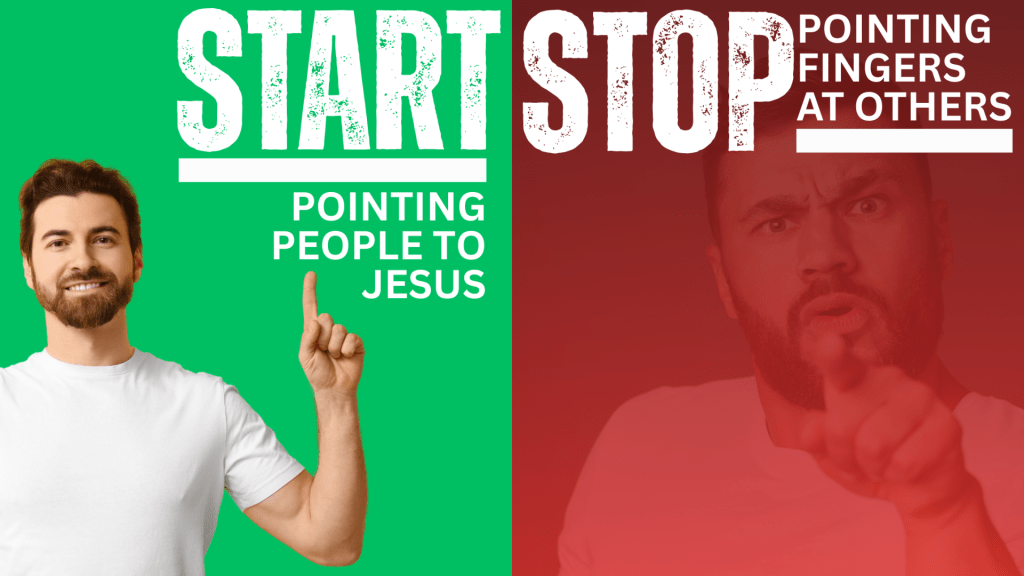
    Our job is to point people to Jesus. Our job is never to point our fingers at others in judgment.

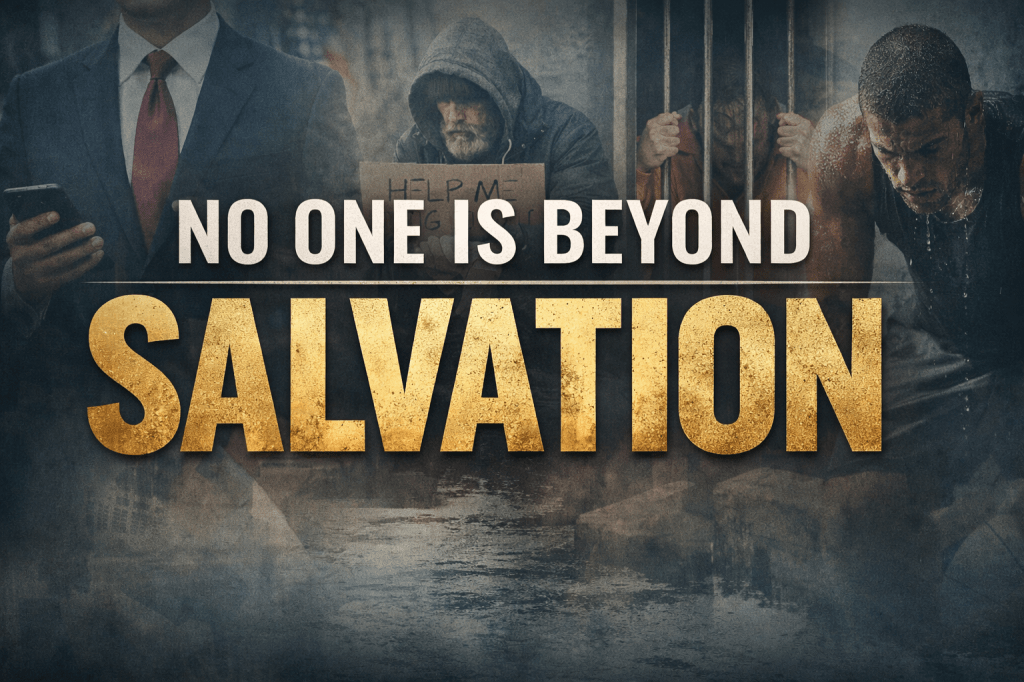
    No one is so good that they don’t need Jesus to save them, and no one is so bad that Jesus cannot save them. We all need Jesus.


    WHY DO WE POINT FINGERS AT OTHER PEOPLE?

    When you were a kid, did anyone ever tell you, “Whenever you point one finger at someone else, there are four pointing back at you”? Never mind that the math doesn’t quite work—especially when you factor in the thumb—it always sounded wise in the moment. And it stuck, because there’s something universally true behind it: no one likes being blamed.

    We don’t like being blamed for things we didn’t do. And if we’re honest, we don’t like being blamed for things we did do either. Most of us have at least a little experience trying to deflect responsibility, soften the facts, or redirect attention when we know we’re at fault. Blame is uncomfortable because it exposes us.

    What makes the gospel so striking is that Jesus was willing not only to be accused, but to accept conviction and punishment for something He did not do. More than that, He accepted judgment for everything we did do. Scripture says He “became sin” for us. He carried blame He didn’t deserve so we could receive grace we didn’t earn. That’s worth remembering the next time you’re falsely accused—you’re in very good company.

    So here’s the real question: If we dislike having fingers pointed at us so much, why are we so quick to point them at others? There are many reasons, but a few show up again and again.

    Sometimes we point fingers because we feel badly about ourselves. When guilt or shame is heavy, it’s tempting to spread it around. Misery loves company, and so does unaddressed guilt. Pointing at others can feel like relief, even though it never actually heals anything.

    Other times, we point fingers because we don’t feel like we measure up. Comparison has a way of magnifying our shortcomings. And when we’re focused on how we fall short, we start looking for someone else to stand below us. Finding fault in others becomes a way to feel taller, if only for a moment.

    We also point fingers when we feel threatened. We want to protect what we believe we’ve earned—our reputation, our position, our sense of worth. When someone seems like a threat, highlighting their flaws can feel like a way to secure our own standing.

    And at the deepest level, we point fingers when we don’t fully trust God. Blame is often an attempt at control. But the truth is, we can’t control people or circumstances. We can only control our own actions and responses. Trusting God means doing what is right and responsible within our control, and then releasing what isn’t to Him.

    Recently, I came across a simple but helpful principle: you are responsible for what is under your control. Pointing fingers is often a subtle way of giving that responsibility away. It shifts the focus outward instead of inward. It keeps us from asking the harder, more helpful questions about our own hearts, choices, and trust in God.

    A better path requires humility. It means checking our ego, admitting when we’re wrong, taking ownership where it belongs, and choosing a better response moving forward. That kind of posture doesn’t weaken us—it frees us. It keeps situations and people we can’t control from controlling us.

    Instead of pointing fingers, Jesus invites us to come to Him—honest, humble, and open to His healing. And that’s where real change begins.

    DiscipleQuest

    Click on the image to download the DiscipleQuest PDF

    The DiscipleQuest PDF includes 7 days of verse study prompts. You can use these seven studies to dig deeper into the following verses about God’s grace:

    • Romans 5:8
    • Ephesians 2:8,9
    • Hebrews 4:16
    • Psalm 103:8
    • Titus 2:11
    • 2 Corinthians 12:9
    • Romans 3:23-24

    Use these questions as journal prompts or as conversation starters with a group of friends or a Bible study group:

    1. Think about a time when you were convinced you were “fine,” only to later realize something deeper was wrong. How does that experience shape the way you hear Jesus’ words here?
    2. When you imagine Jesus describing Himself as a physician, what emotions does that stir in you—comfort, resistance, relief, or discomfort? Why?
    3. According to Jesus’ metaphor, what is the difference between those who are “well” and those who are “sick”?
    4. Who is Jesus responding to in this verse, and what prompted His statement?
    5. What does the word “call” imply about Jesus’ authority and initiative in this passage?
    6. Jesus suggests that the real issue is not sickness, but awareness of sickness. Why is self-perception so central to receiving grace?
    7. How does this verse challenge the idea that moral behavior automatically equals spiritual health?
    8. In what ways can comparison with others distort our understanding of our own need for Christ?
    9. What might it look like, practically, to come to Jesus as a patient rather than a performer?
    10. How could embracing Jesus as your Great Physician reshape the way you view church, community, and spiritual growth?
  • Jesus Is King! (1.04.26)

    MARK 1:14-15

    Now after John was arrested, Jesus came into Galilee, proclaiming the gospel of God, and saying, “The time is fulfilled, and the kingdom of God is at hand; repent and believe in the gospel.”

    10 POINTS TO PONDER

    “The time is fulfilled” means God is never early or late—He is always right on time. You can trust His timing, even when it doesn’t match your own.

    From Genesis to David to the prophets, God has been telling one story. Jesus wasn’t an unexpected surprise —He brought God’s plan to completion.

    I will put enmity between you and the woman,
    and between your offspring and her offspring;
    he shall bruise your head,
    and you shall bruise his heel.”
    (Genesis 3:15)

    The kingdom of God is not a place you go someday—it is a rule you respond to today. Who is functionally ruling your life right now?

    “At hand” means near, present, and unavoidable. The wait is over. The journey has begun.

    Repentance begins by acknowledging the truth about yourself: “I’m not the king.” 

    Real repentance always leads somewhere—it demands change and humility, not just regret or guilt.

    Belief is recognizing the truth about Jesus: “He is the King.” If that’s true, what area of your life still resists His authority?

    If Jesus is truly King, obedience isn’t a burden—it’s a response of trust.

    Serving and partnering with the King means representing Him in everyday life—how you live, love, speak, and decide. Jesus’ kingship touches everything: fun, family, finances, friendships, future, and focus.

    The gospel always leads to a question, not a conclusion: What will you do with Jesus? Will you receive Him, repent to Him, or return to Him?

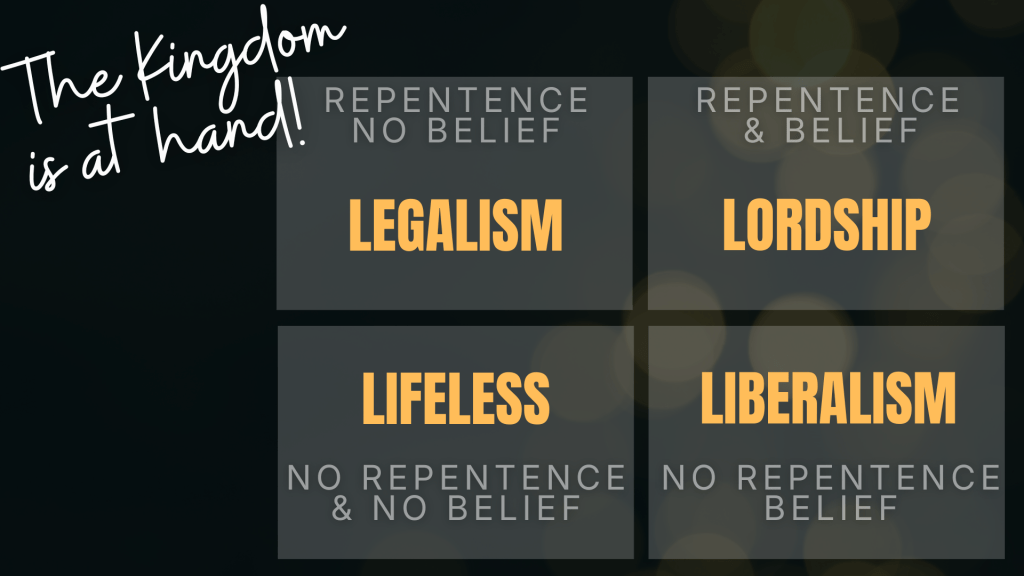
    REPENT AND BELIEVE

    No repentance + No belief = LIFELESS
    This is spiritual unresponsiveness—no turning and no trusting. Paul describes it as being “dead in sin,” alive physically but disconnected spiritually. A biblical picture is the rich young ruler who walked away unchanged when confronted by Jesus; he neither turned nor trusted (Mark 10). Action step: Ask God for honesty. Pray one simple prayer: “Help me see the truth about myself.” Life begins when honesty does.

    No repentance + Belief = LIBERALISM
    Here, belief exists, but surrender does not. Jesus is admired, discussed, even affirmed—but not obeyed. James said that even the demons believe in God, but their belief doesn’t lead to repentence (James 2). Action step: Identify one area where you believe Jesus is right but still insist on staying in control—and intentionally release it.

    Repentance + No belief = LEGALISM
    This posture recognizes personal failure but refuses to trust Christ’s sufficiency. It leads to guilt-driven striving and spiritual exhaustion. The elder brother in the parable of the prodigal son obeyed outwardly but never trusted the father’s heart (Luke 15). Action step: Stop trying to earn what can only be received. Say, “Jesus, I trust You with what I can’t fix.”

    Repentance + Belief = LORDSHIP
    This is the response Jesus calls for in Mark 1:15—turning from self-rule and trusting Christ’s rule. The tax collector who cried out for mercy went home justified because he told the truth about himself and trusted the grace of God (Luke 18). Action step: Name Jesus as King today—in prayer, in obedience, and in one concrete decision that aligns your life with His authority.

    DiscipleQuest

    Click on the image to download the DiscipleQuest PDF

    The DiscipleQuest PDF includes 7 days of verse study prompts. You can use these seven studies to dig deeper into the following verses about obeying Jesus:

    • John 14:15
    • Psalm 119:9
    • Romans 12:1
    • James 1:22
    • Joshua 1:7-8
    • 1 John 2:3-4
    • Acts 5:29
    1. When you hear Jesus say, “The time is fulfilled,” what emotions or questions surface for you—comfort, urgency, resistance, confusion? Why do you think that is?
    2. Which is harder for you right now: trusting God’s timing or responding to God’s authority? What’s happening in your life that makes that true?
    3. According to Mark 1:14–15, what does Jesus claim has already happened, and what does He say must now happen in response?
    4. How does Jesus’ announcement show that the kingdom is something present and active, not merely future or symbolic?
    5. Why is it significant that Jesus doesn’t describe the kingdom first—but instead calls people to repent and believe?
    6. What does the long storyline of Scripture (from God’s promises to their fulfillment in Jesus) teach you about God’s faithfulness to finish what He starts?
    7. What are the natural responses one might have to the truth that Jesus is king? How does this truth practically impact the way I live?
    8. Why do repentance and belief naturally belong together if Jesus truly is King? What happens when one is present without the other?
    9. If repentance means recognizing the truth about yourself, what specific area of your life is currently resisting that honesty?
    10. 10. If belief means recognizing the truth about Jesus, what would quick, real repentance look like this week if you truly trust His kingship?
  • New Wine (12.28.25)

    Matthew 9:14-17

    Then the disciples of John came to him, saying, “Why do we and the Pharisees fast, but your disciples do not fast?” And Jesus said to them, “Can the wedding guests mourn as long as the bridegroom is with them? The days will come when the bridegroom is taken away from them, and then they will fast. No one puts a piece of unshrunk cloth on an old garment, for the patch tears away from the garment, and a worse tear is made. Neither is new wine put into old wineskins. If it is, the skins burst and the wine is spilled and the skins are destroyed. But new wine is put into fresh wineskins, and so both are preserved.”

    John 15:5

    I am the vine; you are the branches. Whoever abides in me and I in him, he it is that bears much fruit, for apart from me you can do nothing.

    TEN TAKE-HOME THOUGHTS

    • A good spiritual practice can become a bad spiritual distraction if it replaces dependence on Jesus.
    • A tight grip on yesterday—whether wins or wounds—can keep you from what God wants to do today.
    • Jesus didn’t come to be added to your life; He came to transform it by His presence.
    • It’s about the wine, not the wineskin—about Christ, not the method that once led you to Him.
    • Life is best lived in the present, with an eye on the future, having learned from the past.
    • Righteousness is never found in habits, rules, or standards we create—it is found only in Christ.
    • Anything that distracts you from abiding in Jesus, no matter how good it once was, must be surrendered.
    • Begin and end every day with gratitude.
    • Learn from and let go of the past so that you can grow in the future.
    • Eliminate everything in your life that distracts you from abiding in Christ.

    DiscipleQuest

    Click on the image to download the DiscipleQuest PDF

    The DiscipleQuest PDF includes 7 days of verse study prompts. You can use these seven studies to dig deeper into the following verses about the new life:

    • 2 Corinthians 5:17
    • Colossians 3:9-10
    • Galatians 2:20
    • John 15:5
    • Romans 6:4
    • Philippians 4:13
    • 1 Peter 2:1-3

    Use these questions as journal prompts or as conversation starters with a group of friends or a Bible study group:

    1. When you think about your spiritual life right now, where do you sense a tension between what has always worked and what God may be inviting you into now?
    2. Is there a habit, practice, mindset, or season from your past that you find yourself clinging to—even if it may no longer be helping you grow closer to Jesus?
    3. In Matthew 9:14–15, why does Jesus compare His presence to a wedding celebration rather than a time of fasting or mourning?
    4. What point is Jesus making with the images of unshrunk cloth and new wine in old wineskins in verses 16–17?
    5. How do these illustrations help explain why the disciples of John and the Pharisees struggled to understand what Jesus was doing?
    6. Why do you think it can be difficult for people to recognize when something that was once good has become a distraction?
    7. What does this passage reveal about how much Jesus values His presence over religious routines or spiritual performance?
    8. How does this teaching challenge the idea that spiritual growth is mainly about adding more discipline rather than receiving new life from Christ?
    9. What is one “old wineskin” in your life—something familiar, comfortable, or controlling—that God may be asking you to loosen your grip on?
    10. What would it look like this week to prioritize abiding in Jesus rather than relying on methods, habits, or standards that once pointed you to Him?