MARK 1:14-15
Now after John was arrested, Jesus came into Galilee, proclaiming the gospel of God, and saying, “The time is fulfilled, and the kingdom of God is at hand; repent and believe in the gospel.”
10 POINTS TO PONDER
“The time is fulfilled” means God is never early or late—He is always right on time. You can trust His timing, even when it doesn’t match your own.
From Genesis to David to the prophets, God has been telling one story. Jesus wasn’t an unexpected surprise —He brought God’s plan to completion.
I will put enmity between you and the woman,
and between your offspring and her offspring;
he shall bruise your head,
and you shall bruise his heel.” (Genesis 3:15)
The kingdom of God is not a place you go someday—it is a rule you respond to today. Who is functionally ruling your life right now?
“At hand” means near, present, and unavoidable. The wait is over. The journey has begun.
Repentance begins by acknowledging the truth about yourself: “I’m not the king.”
Real repentance always leads somewhere—it demands change and humility, not just regret or guilt.
Belief is recognizing the truth about Jesus: “He is the King.” If that’s true, what area of your life still resists His authority?
If Jesus is truly King, obedience isn’t a burden—it’s a response of trust.
Serving and partnering with the King means representing Him in everyday life—how you live, love, speak, and decide. Jesus’ kingship touches everything: fun, family, finances, friendships, future, and focus.
The gospel always leads to a question, not a conclusion: What will you do with Jesus? Will you receive Him, repent to Him, or return to Him?
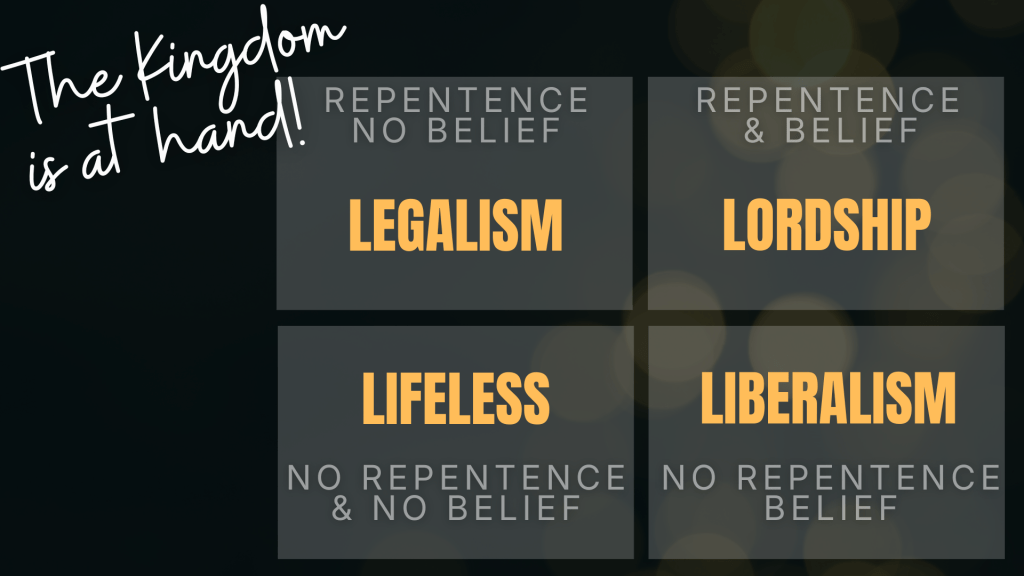
REPENT AND BELIEVE
No repentance + No belief = LIFELESS
This is spiritual unresponsiveness—no turning and no trusting. Paul describes it as being “dead in sin,” alive physically but disconnected spiritually. A biblical picture is the rich young ruler who walked away unchanged when confronted by Jesus; he neither turned nor trusted (Mark 10). Action step: Ask God for honesty. Pray one simple prayer: “Help me see the truth about myself.” Life begins when honesty does.
No repentance + Belief = LIBERALISM
Here, belief exists, but surrender does not. Jesus is admired, discussed, even affirmed—but not obeyed. James said that even the demons believe in God, but their belief doesn’t lead to repentence (James 2). Action step: Identify one area where you believe Jesus is right but still insist on staying in control—and intentionally release it.
Repentance + No belief = LEGALISM
This posture recognizes personal failure but refuses to trust Christ’s sufficiency. It leads to guilt-driven striving and spiritual exhaustion. The elder brother in the parable of the prodigal son obeyed outwardly but never trusted the father’s heart (Luke 15). Action step: Stop trying to earn what can only be received. Say, “Jesus, I trust You with what I can’t fix.”
Repentance + Belief = LORDSHIP
This is the response Jesus calls for in Mark 1:15—turning from self-rule and trusting Christ’s rule. The tax collector who cried out for mercy went home justified because he told the truth about himself and trusted the grace of God (Luke 18). Action step: Name Jesus as King today—in prayer, in obedience, and in one concrete decision that aligns your life with His authority.

Click on the image to download the DiscipleQuest PDF
The DiscipleQuest PDF includes 7 days of verse study prompts. You can use these seven studies to dig deeper into the following verses about obeying Jesus:
- John 14:15
- Psalm 119:9
- Romans 12:1
- James 1:22
- Joshua 1:7-8
- 1 John 2:3-4
- Acts 5:29

- When you hear Jesus say, “The time is fulfilled,” what emotions or questions surface for you—comfort, urgency, resistance, confusion? Why do you think that is?
- Which is harder for you right now: trusting God’s timing or responding to God’s authority? What’s happening in your life that makes that true?
- According to Mark 1:14–15, what does Jesus claim has already happened, and what does He say must now happen in response?
- How does Jesus’ announcement show that the kingdom is something present and active, not merely future or symbolic?
- Why is it significant that Jesus doesn’t describe the kingdom first—but instead calls people to repent and believe?
- What does the long storyline of Scripture (from God’s promises to their fulfillment in Jesus) teach you about God’s faithfulness to finish what He starts?
- What are the natural responses one might have to the truth that Jesus is king? How does this truth practically impact the way I live?
- Why do repentance and belief naturally belong together if Jesus truly is King? What happens when one is present without the other?
- If repentance means recognizing the truth about yourself, what specific area of your life is currently resisting that honesty?
- 10. If belief means recognizing the truth about Jesus, what would quick, real repentance look like this week if you truly trust His kingship?

 Lake Bible Notes
Leave a comment