MARK 5:21-43
And when Jesus had crossed again in the boat to the other side, a great crowd gathered about him, and he was beside the sea. 22 Then came one of the rulers of the synagogue, Jairus by name, and seeing him, he fell at his feet 23 and implored him earnestly, saying, “My little daughter is at the point of death. Come and lay your hands on her, so that she may be made well and live.” 24 And he went with him.
And a great crowd followed him and thronged about him. 25 And there was a woman who had had a discharge of blood for twelve years, 26 and who had suffered much under many physicians, and had spent all that she had, and was no better but rather grew worse. 27 She had heard the reports about Jesus and came up behind him in the crowd and touched his garment. 28 For she said, “If I touch even his garments, I will be made well.” 29 And immediately the flow of blood dried up, and she felt in her body that she was healed of her disease. 30 And Jesus, perceiving in himself that power had gone out from him, immediately turned about in the crowd and said, “Who touched my garments?” 31 And his disciples said to him, “You see the crowd pressing around you, and yet you say, ‘Who touched me?’” 32 And he looked around to see who had done it. 33 But the woman, knowing what had happened to her, came in fear and trembling and fell down before him and told him the whole truth. 34 And he said to her, “Daughter, your faith has made you well; go in peace, and be healed of your disease.”
35 While he was still speaking, there came from the ruler’s house some who said, “Your daughter is dead. Why trouble the Teacher any further?” 36 But overhearing what they said, Jesus said to the ruler of the synagogue, “Do not fear, only believe.” 37 And he allowed no one to follow him except Peter and James and John the brother of James. 38 They came to the house of the ruler of the synagogue, and Jesus saw a commotion, people weeping and wailing loudly. 39 And when he had entered, he said to them, “Why are you making a commotion and weeping? The child is not dead but sleeping.” 40 And they laughed at him. But he put them all outside and took the child’s father and mother and those who were with him and went in where the child was. 41 Taking her by the hand he said to her, “Talitha cumi,” which means, “Little girl, I say to you, arise.” 42 And immediately the girl got up and began walking (for she was twelve years of age), and they were immediately overcome with amazement. 43 And he strictly charged them that no one should know this, and told them to give her something to eat. Mark 5:21-43
10 Points to Ponder
Fear loses its controlling power when faith is placed in someone truly reliable. “Don’t fear. Only believe” is not optimism—it’s a call to trust Jesus’ character.
Jesus’ command to believe is rooted in who He is, not in how the situation appears. Faith rests on character, not circumstances.
Jesus’ love is not passive sentiment; it is active movement toward people in need. He didn’t stay behind—He went with Jairus.
Jesus’ complete knowledge means nothing in your life is random, overlooked, or misunderstood. The God who numbers hairs and sees sparrows also sees every detail of your fear.
Look at the birds of the air: they neither sow nor reap nor gather into barns, and yet your heavenly Father feeds them. Are you not of more value than they? (Matthew 6:26)
Because Jesus is all-powerful, even death is not a final obstacle—only a temporary one. The One who holds the keys of death is never intimidated by it.
Because Jesus holds all things together, uncertainty never equals instability. What feels shaky to us is still secure in Him.
Jesus is all-loving. Therefore, he wants what is best for us.
Jesus is all-knowing. Therefore, He knows what is best for us.
Jesus is all-powerful. Therefore, He can do what is best for us.
Every fearful response we choose is an attempt to regain control apart from trust. Anger, anxiety, blame, and control are substitutes for faith.
Fear distracts us by causing us to focus on what might not even be real. Faith keeps us focused by keeping our eyes on what is eternally real.
Faith becomes visible when we choose patience, responsibility, and goodness in ordinary moments. Trust in Jesus is most evident in how we live today.
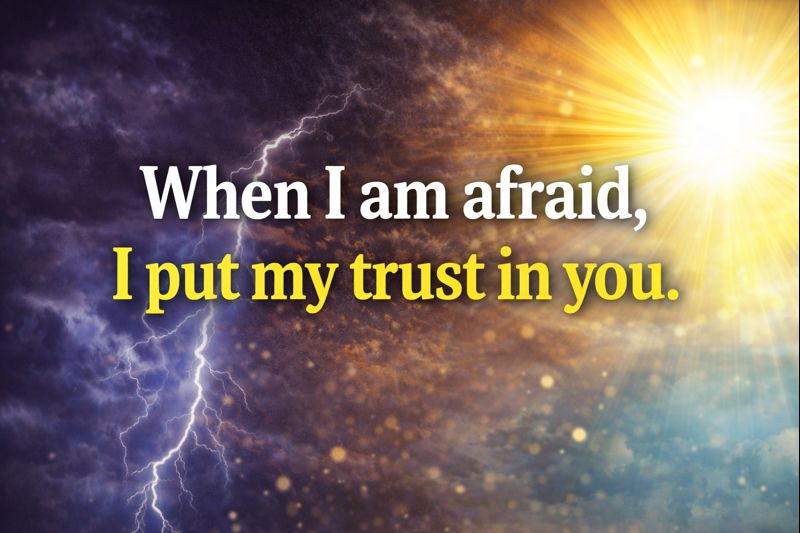
Psalm 56:3 is the ultimate WHEN/THEN verse.
Fear shows up in all kinds of ways, and usually at the most inconvenient times. It tends to arrive when life feels uncertain, when outcomes are unclear, or when we’re reminded how little control we actually have. The problem isn’t that fear shows up—it’s what we do next. Most of us have some default reactions. We get angry and want to walk away. We get anxious and pull back. We try to grab control, assign blame, or make excuses. Those responses feel natural, but they rarely lead us anywhere good.
That’s why the when/then principle is so helpful. When fear shows up, then I don’t have to react—I can choose. Fear doesn’t get to dictate my behavior unless I let it. Scripture doesn’t pretend fear isn’t real; it simply redirects it. “When I am afraid, I put my trust in you.” That’s not denial, and it’s not pretending everything is fine. It’s a conscious decision to shift my focus from what I can’t control to the One who can. Fear becomes the signal, not the driver.
Living this out means building better reflexes. When life feels uncertain, then I focus on today instead of spiraling into tomorrow. When anxiety rises, then I slow down and choose patience. When fear tempts me to protect myself, then I look for good, take responsibility, and try to act more like Jesus. Over time, those small choices reshape how we respond. Fear may still knock, but trust doesn’t have to leave the room.

Click on the image to download the DiscipleQuest PDF
The DiscipleQuest PDF includes 7 days of verse study prompts. You can use these seven studies to dig deeper into the following verses about faith in the face of fear:
- Joshua 1:9
- Isaiah 41:10
- John 14:26
- Romans 8:38-39
- Hebrews 13:6
- 2 Timothy 1:7
- Matthew 6:31-33

- When fear shows up in your life, what is usually your default response—anger, anxiety, control, withdrawal, or something else?
- Can you recall a recent moment when fear influenced a decision you made? What did it cost you—or protect you from?
- What does Jesus’ command, “Do not fear, only believe,” reveal about the relationship between fear and faith?
- What stands out to you about Jesus calling the woman “daughter,” and why might that moment matter as much as the healing itself?
- Why do you think Jesus removed the crowd but invited the parents to stay, and what does that teach us about His love and wisdom?
- How does seeing Jesus as all-loving, all-knowing, and all-powerful change the way you interpret fearful situations?
- Which aspect of Jesus’ character—His love, His knowledge, or His power—do you find hardest to trust when fear is high? Why?
- What does this passage suggest about the difference between reacting to fear and responding in faith?
- Using the WHEN/THEN framework, how would you finish this sentence:
When I am afraid, then I will… ? - What is one specific, practical way you could choose trust over fear this week—in your relationships, decisions, or mindset?

 Lake Bible Notes
Leave a comment