
GENESIS 5
1This is the book of the generations of Adam. In the day that God created man, He made him in His own likeness. 2Male and female He created them, and He blessed them. And in the day they were created, He called them “man.”
3When Adam was 130 years old, he had a son in his own likeness, after his own image; and he named him Seth. 4And after he had become the father of Seth, Adam lived 800 years and had other sons and daughters. 5So Adam lived a total of 930 years, and then he died.
6When Seth was 105 years old, he became the father of Enosh. 7And after he had become the father of Enosh, Seth lived 807 years and had other sons and daughters. 8So Seth lived a total of 912 years, and then he died.
9When Enosh was 90 years old, he became the father of Kenan. 10And after he had become the father of Kenan, Enosh lived 815 years and had other sons and daughters. 11So Enosh lived a total of 905 years, and then he died.
12When Kenan was 70 years old, he became the father of Mahalalel. 13And after he had become the father of Mahalalel, Kenan lived 840 years and had other sons and daughters. 14So Kenan lived a total of 910 years, and then he died.
15When Mahalalel was 65 years old, he became the father of Jared. 16And after he had become the father of Jared, Mahalalel lived 830 years and had other sons and daughters. 17So Mahalalel lived a total of 895 years, and then he died.
18When Jared was 162 years old, he became the father of Enoch. 19And after he had become the father of Enoch, Jared lived 800 years and had other sons and daughters. 20So Jared lived a total of 962 years, and then he died.
21When Enoch was 65 years old, he became the father of Methuselah. 22And after he had become the father of Methuselah, Enoch walked with God 300 years and had other sons and daughters. 23So Enoch lived a total of 365 years.
24Enoch walked with God, and then he was no more, because God had taken him away.
25When Methuselah was 187 years old, he became the father of Lamech. 26And after he had become the father of Lamech, Methuselah lived 782 years and had other sons and daughters. 27So Methuselah lived a total of 969 years, and then he died.
28When Lamech was 182 years old, he had a son. 29And he named him Noah, saying, “May this one comfort us in the labor and toil of our hands caused by the ground that the LORD has cursed.” 30And after he had become the father of Noah, Lamech lived 595 years and had other sons and daughters. 31So Lamech lived a total of 777 years, and then he died.
32After Noah was 500 years old, he became the father of Shem, Ham, and Japheth.
TEN POINTS TO PONDER
A list of names becomes much more interesting when you realize those names belong to real people who lived real lives and made real decisions that impacted future generations. Genesis 5 is a reminder that ordinary lives matter in God’s bigger story.
The Bible isn’t just part of our church’s name. It needs to shape how we think and how we live. Even the chapters we are tempted to skip can teach us something we need to know.
Everybody lives and everybody dies. Genesis 5 repeats “and he died” until we can’t ignore it. Even 900 years wasn’t forever. The most important question isn’t “How long will I live?” but “Am I ready for what comes after?”
We cannot talk our way out of our sin, but Jesus has already paid for it. Our confidence about eternity comes from belonging to Him, not from having a sufficiently impressive list of accomplishments.
God’s plan is never derailed. Adam and Eve sinned. Cain killed Abel. Violence spread. But God was still moving His story toward the Savior He had promised. What feels out of control to us is never beyond His ability to redeem.
We can be faithful with the things God has put in our hands and trust Him with the things He has kept in His. Trusting God doesn’t mean doing nothing. It means doing what He asks without insisting that we control the outcome.
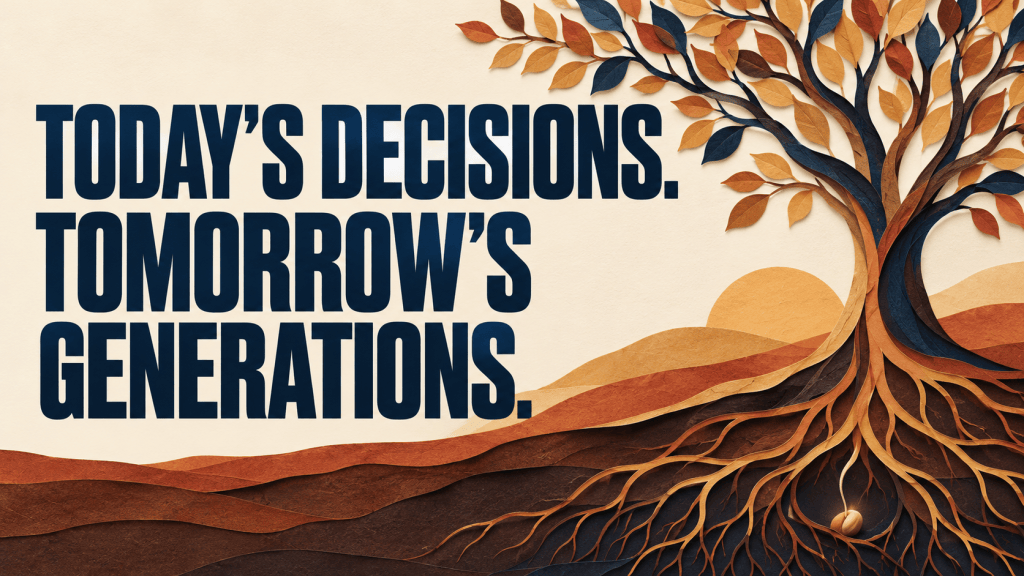
Today’s decisions impact tomorrow’s generations. Before you make a decision, ask what it might change in five minutes, five days, five years, and fifty years. Some decisions will still be producing results long after you are gone.
At Lake, we are enjoying the fruit of decisions made by people who came before us. Now we are making decisions for people who haven’t arrived yet. Investing in a child, welcoming a family, or helping someone follow Jesus can shape a future we may never see.
The best path through life is to walk with God. Walking together requires DIRECTION and PROXIMITY. We need to go where He is leading and stay close enough to listen. Claiming to follow God while consistently heading the other way won’t get us where He wants us to go.
Your influence is not limited to your children, and your usefulness does not end when you retire. Someone can learn to follow Jesus by watching you. Who are you helping walk with God, and what are you passing on?

WALK WITH GOD. HELP SOMEONE ELSE DO THE SAME.
Enoch’s life is described with four simple words: “Enoch walked with God.”
Genesis doesn’t give us his résumé, his accomplishments, or his favorite hobbies. It tells us about his relationship with God. Apparently, that was the most important thing to know about him.
What would someone need to know about you?
We spend a lot of time thinking about where life is taking us. We plan careers, manage money, raise families, and prepare for retirement. Those things matter. But wherever we are going, the best way to get there is to walk with God.
Walking with God requires DIRECTION.
If God is going one way and you are going another, you aren’t walking together. Sometimes our next step is simply to stop arguing with what He has already told us. Is there something you know He wants you to do that you keep putting off?
Walking with God also requires PROXIMITY.
You can be headed in the same direction as someone and still be a mile away. Staying close to God means making room to listen to His Word, talk with Him, and respond to what He says. Begin and end your day remembering who He is, what He has done, what He expects, and what He has promised.
And remember: someone else is watching how you walk. The faith you practice today may become part of the faith they practice tomorrow.
Today: Take five minutes to ask God where you need to change direction or draw closer. Choose one specific step of obedience. Then consider one person you can encourage to walk with Him this week.

Click on the image to download the DiscipleQuest PDF
Use these seven passages for this week’s daily verse studies. They will help you dig deeper into walking with God, trusting His purposes, and passing faith to the next generation:
- Hebrews 9:27–28
- Romans 8:1–4
- Proverbs 3:5–6
- Psalm 78:4–7
- 2 Timothy 2:1–2
- Hebrews 11:5–6
- Micah 6:8

Use these questions as journal prompts or as conversation starters with a group of friends or a Bible study group:
What is an interesting story about someone in your family who lived before you? How did that person’s decisions affect your life?
If you could ask one of your ancestors a question, who would you choose, and what would you ask?
Read Genesis 5. What patterns do you notice? What words or phrases repeat? Where does the pattern change?
Why do you think God included this list of names in the Bible? What might we miss if we skipped it?
The phrase “and he died” appears repeatedly. How should the reality that our lives will end affect the way we live now? Read Hebrews 9:27–28. What hope does Jesus give us?
Read Genesis 3:15 and Luke 3:23–38. Notice how the names in Genesis 5 fit into the larger story leading to Jesus. How does this help us see God’s faithfulness when the story around us seems to be falling apart?
When have you faced a situation you couldn’t control? What did it look like—or what would it have looked like—to be faithful with your responsibilities while trusting God with the outcome?
Think of a decision you are facing. What might it change in five minutes, five days, five years, and fifty years? Does looking further ahead change the way you think about it?
Who has helped you learn to follow Jesus? What did you learn from their example that you might not have learned from their words alone?
What decisions can we make at Lake today that could benefit people who haven’t arrived yet? How can you personally help pass faith to the next generation, whether or not you have children?
Read Genesis 5:21–24 and Hebrews 11:5–6. What do these passages tell us about Enoch? What do you think it means to walk with God in ordinary, everyday life?
Walking with God requires direction and proximity. Which is the greater challenge for you right now: going where He leads or staying close enough to listen? Why?
What habits help you remember who God is, what He has done, what He expects, and what He has promised? What tends to crowd those habits out?
Which of the four life lessons most directly challenges you this week? What is one specific step you can take, and who could you encourage or invite to take that step with you?
How can the group pray for you and help you?


Leave a Reply