Tag: philippians

  • USEFUL TO GOD (5.24.2026)

    PHILIPPIANS 2:19-30

    19I hope in the Lord Jesus to send Timothy to you soon, so that I too may be cheered by news of you. 20For I have no one like him, who will be genuinely concerned for your welfare. 21For they all seek their own interests, not those of Jesus Christ. 22But you know Timothy’sd proven worth, how as a sone with a father he has served with me in the gospel. 23I hope therefore to send him just as soon as I see how it will go with me, 24and I trust in the Lord that shortly I myself will come also.

    25I have thought it necessary to send to you Epaphroditus my brother and fellow worker and fellow soldier, and your messenger and minister to my need, 26for he has been longing for you all and has been distressed because you heard that he was ill. 27Indeed he was ill, near to death. But God had mercy on him, and not only on him but on me also, lest I should have sorrow upon sorrow. 28I am the more eager to send him, therefore, that you may rejoice at seeing him again, and that I may be less anxious. 29So receive him in the Lord with all joy, and honor such men, 30for he nearly diedf for the work of Christ, risking his life to complete what was lacking in your service to me.


    TEN POINTS TO PONDER

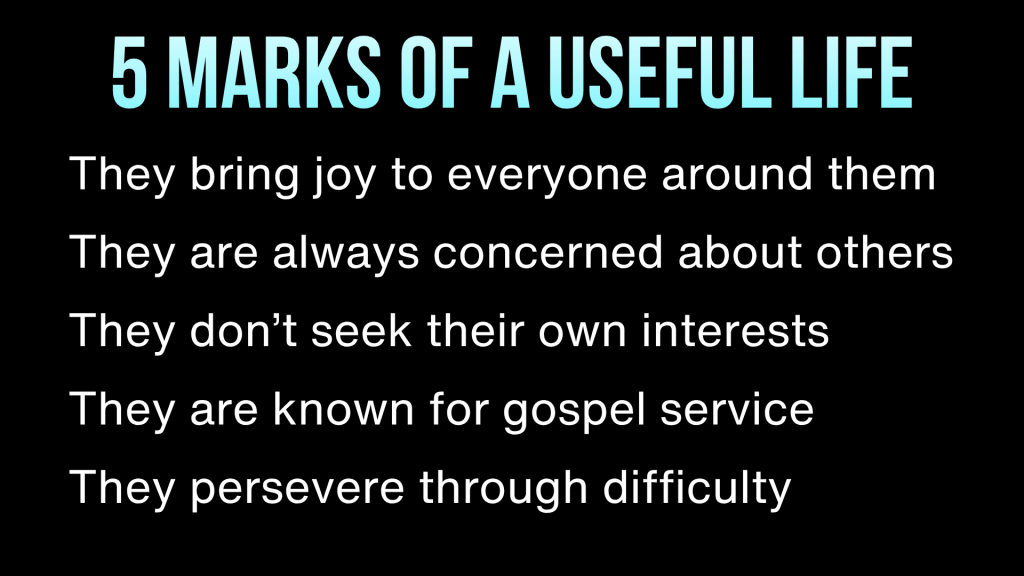
    Timothy was a companion of Paul. Epaphroditus was a resident of Philippi. They were from two different countries, with vastly different life experiences. Yet they were united in their desire to serve God. Gospel service is a powerful unifier.

    Epaphroditus was likely named after the Greek god Aphrodite. This indicates that he grew up in a home that didn’t know God or believe in Jesus. God saves people and uses people, no matter what their past looks like.

    Paul wanted to hear news of the Philippians’ growth because he found great joy when others experienced good. The more we focus on others and the less we focus on ourselves, the easier it will be to live joyfully.

    Even though Paul was the “leader of the band”, he spent a great deal of time speaking positively about and building up Timothy and Epaphroditus. No one ever regrets time spent building into the lives of others.

    It is impossible to be Christ-centered and self-centered at the same time.

    Epaphroditus not only brought the Philippians’ support gift to Paul, he also stayed to physically care for Paul in prison. He placed his own life on pause in order to further the Gospel by caring for Paul.

    Even though Epaphroditus was a great blessing to Paul, Paul was eager to send him back to Philippi because Paul wanted the Philippians to be blessed by Paul.

    Look at Philippians 4:3. It is possible that the greatest service Paul wanted Epaphroditus to render was to play the lead role in reconciling Euodia and Syntyche.

    In God’s church, those who serve are worthy of the highest honor. Those who self-promote, demand respect, and pursue their own agenda are not to be honored.

    The biggest impact makers in the Kingdom of God are those who are others-focused.

    1-2-3 TO BE MORE USEFUL

    The following 1-2-3 model can really be used to apply any biblical truth to your life. Today, we’re focused on how to be more useful to God.

    1. IDENTIFY ONE AREA OF YOUR LIFE THAT NEEDS WORK

    As you think through the different spheres of your life, you can probably identify “growth areas” in all of them. Just pick one. That way, you can be laser-focused without distraction. Possible areas of life include:

    • Family
    • Work
    • School
    • Neighborhood
    • Hobby Groups (sports, clubs, etc.)
    • Friends
    • Church

    2. CHOOSE TWO USEFUL ACTIONS

    When you think about actions that are useful, remember that useful people are joy-forward and others-focused. A good way to identify specific actions is to think of the word ACT.

    • ACTION – Is it something I can actually DO? Don’t just think about it, do it!
    • COMPLETABLE – How will I know when I’ve done it or finished it? Don’t be vague.
    • TIME-ORIENTED – Is it reasonable to accomplish in a reasonable amount of time?
    • SAMPLES:
      • I will text one friend an encouraging note every day before 10am tomorrow.
      • I will make a list of 10 things for which I’m grateful before bed every night.
      • I will post a helpful Bible verse on social media every day during my lunch break.

    3. COMPLETE THE ACTIONS THREE TIMES THIS WEEK

    Even if your goal is to do something every day, you will probably forget or get distracted every so often. Many people quit because they don’t think they can be perfect. DON’T LET PERFECT BE THE ENEMY OF DONE!

    This week, shoot for three times. And when you accomplish it, celebrate and reward yourself!

    Click on the image to download the DiscipleQuest PDF

    The DiscipleQuest PDF includes 7 days of verse study prompts. You can use these seven studies to dig deeper into what the Bible teaches about focusing on others:

    • Romans 12:10
    • Mark 10:43-45
    • Micah 6:8
    • Galatians 6:2
    • 1 Corinthians 10:24
    • John 13:14-15
    • Proverbs 11:25

    Use these questions as journal prompts or as conversation starters with a group of friends or a Bible study group:

    Who do you know that has earned the title, “servant”? Describe how they serve the people in their lives.

    Read Philippians 2:19-30. The three main characters are Paul, Timothy, and Epaphroditus. How do you see each of them demonstrating a servant’s heart?

    Based on what you read here, what is one word you would use to describe Timothy? What is one word you would use to describe Epaphroditus?

    Verses 19,28,& 29 all describe joy. What is bringing joy to people in these verses? What does this tell you about how you can experience more joy?

    Look at the three words Paul uses to describe Epaphroditus in verse 25. What might Epaphroditus have done to earn those titles? Who do you know that fits those descriptions?

    Why is it so hard to focus on other people? Why is it so easy to focus on ourselves?

    Make a list of ten ways Jesus focused on other people.

    Make a list of five things people can do to focus on other people.

    Who is one person you want to serve this week, and what is one action you will take to do so?

    PHILIPPIANS: Line by Line

    2:19-30: Finding joy by serving others

    19. I hope in the Lord Jesus to send Timothy to you soon, so that I too may be cheered by news of you.

    Timothy was Paul’s right-hand man. He did for Paul what Paul couldn’t do for himself, and since Paul couldn’t leave Rome (prison), he was going to send Timothy to help build up the Philippians. Nothing made Paul happier than hearing that his spiritual children were growing in their faith.

    20. For I have no one like him, who will be genuinely concerned for your welfare.

    Most people will express or demonstrate a little concern for others, but it is not a deep, genuine concern. Timothy was unique because he always put others ahead of himself. He was passionately concerned to see as many people grow in their faith as possible.

    21. For they all seek their own interests, not those of Jesus Christ.

    Most people put their own desires and needs ahead of everyone else. Interestingly here, Paul seems to indicate that the interests of Jesus intersect with the interests of others. When I am others-focused, I will have the same life focus as Jesus. As long as I am focused on myself, I will not see the world the way Jesus does.

    22a. But you know Timothy’s proven worth…

    Timothy had already demonstrated his hear and his abilities. His value was well-known throughout the early church communities. There is no better reputation to have than as a servant.

    22b. …how as a son with a father he has served with me in the gospel.

    Paul had poured his life into Timothy, and now Timothy was beginning to look more and more like Paul. It’s as though Paul’s spiritual DNA has been passed along to Timothy and now the young man shares the older man’s passion to see the gospel spread to every nation.

    23. I hope therefore to send him just as soon as I see how it will go with me,

    Paul was waiting for a verdict in his trial. He didn’t know if he would be executed or freed. It is likely that Timothy wouldn’t leave his side until this matter was settled, but Paul assured the Philippians that he would be sending the young man as soon as possible.

    24. And I trust in the Lord that shortly I myself will come also.

    Here, Paul hints that he hopes and believes that he will be set free. As he said in 1:22, if he is given more time, he is fully dedicated to serving more and ministering more. Therefore, if he is released, his plan is to travel to Philippi so that he can encourage and build up the Christians there.

    25a. I have thought it necessary to send to you Epaphroditus…

    Paul “hoped” to send Timothy, but he found it “necessary” to send Epaphroditus. Even though Epaphroditus was a great help and comfort to Paul, the apostle’s desire was to have Epaphroditus serve the church in Philippi. Their growth was more important than his comfort.

    It appears that Epaphroditus is named after the Greek goddess Aphrodite. This leads us to believe that he was saved out of a family that passionately served the false gods of their day. He is a living picture of the mercy and grace of God that often pulls us out of our sin and situation so He can save us to a much higher purpose.

    25b. …my brother and fellow worker and fellow soldier…

    Paul describes the closeness of his relationship with Epaphroditus (brother). He elevates Epaphroditus by naming him as a “fellow worker” when he could have easily described him as an assistant, a helper, or a student. He also hints at Epaphroditus’ tenacity and spirit by naming him as a fellow soldier. The gospel work was difficult, dangerous, and sometimes painful. Epaphroditus never shied away from any of it.

    25c. …and your messenger and minister to my need…

    Epaphroditus was probably from Philippi and had been sent by the church to deliver a message to Paul as well as to bring gifts and financial support to him. Additionally, Epaphroditus stayed on after delivering the gifts so that he could provide physical care and comfort to Paul while he was in prison.

    26. For he has been longing for you all and has been distressed because you heard that he was ill.

    Epaphroditus was not upset or anxious because of his own illness, but he was distressed because the Philippians were distressed. This is the true heart of a servant. He didn’t want his friends to be concerned or upset, even if they were doing so for him. He wanted to do whatever he could to bring peace and joy to the people in his life.

    27a. Indeed he was ill, near to death.

    We are not sure if Epaphroditus became ill while delivering the message to Paul (it may have been a difficult trip), or if he became ill while helping to care for Paul. Whichever it was, he continued on with his service until his illness became life-threatening. He placed the lives of everyone else above his own.

    27b. But God had mercy on him…

    Anytime our life is extended (in sickness or in health), it is because of God’s mercy and grace. We deserve nothing from Him, but He generously gives us life in His creation. The healing He provided to Epaphroditus was an obvious act of mercy, and it should cause us to consider how God has also been merciful to us. The mercy of God should always drive us to gratitude.

    27c. …and not only on him but on me also, lest I should have sorrow upon sorrow.

    Paul was already in prison and in danger of losing his life. Had Epaphroditus died, it would have been one more difficulty piled on top. He was grateful that God spared him from that sorrow.

    28a. I am the more eager to send him, therefore…

    Epaphroditus was a picture of grace and mercy to Paul. His service and delivery of a gift was a sign of God’s (and the Philippians’) grace to him. His healing was a sign of God’s mercy. Now, even though he had done so much, Paul wanted to send him away. He wanted the Philippians to also experience the grace and mercy of God through the work and leadership of Epaphroditus.

    28b. …that you may rejoice at seeing him again, and that I may be less anxious.

    Epaphroditus’ return to Philippi meant more stability for the church there. It meant they would have one of their leaders back. It meant they would have more opportunities to grow spiritually because of his ministry. For all of these reasons, it would mean joy for the Philippians, and it would mean joy for Paul. Paul was anxious for them to grow, and Epaphroditus’ return would facilitate that growth.

    29. So receive him in the Lord with all joy, and honor such men…

    Paul expected the Philippians to give Epaphroditus a warm welcome, and he expected the church to take good care of Epaphroditus and Timothy (upon his arrival).

    30a. …for he nearly died for the work of Christ…

    The illness Epaphroditus suffered was because he was faithful to his calling. Had he bailed from his job, he likely would not have become ill and he certainly would not have continued to worsen. The decision to follow Jesus requires us to be willing to give our lives. If we love our own life more than we love Him, we may not actually be ready to follow Him.

    30b. …risking his life to complete what was lacking in your service to me.

    The Philippians sent a wonderful gift to Paul (4:18). But what they couldn’t give him was their physical presence. Epaphroditus provided that.

  • When the Going Gets Tough… Rejoice! (4.26.26)

    PHILIPPIANS 1:12-26

    12 I want you to know, brothers, that what has happened to me has really served to advance the gospel, 13 so that it has become known throughout the whole imperial guard and to all the rest that my imprisonment is for Christ. 14 And most of the brothers, having become confident in the Lord by my imprisonment, are much more bold to speak the word without fear.
    15 Some indeed preach Christ from envy and rivalry, but others from good will. 16 The latter do it out of love, knowing that I am put here for the defense of the gospel. 17 The former proclaim Christ out of selfish ambition, not sincerely but thinking to afflict me in my imprisonment. 18 What then? Only that in every way, whether in pretense or in truth, Christ is proclaimed, and in that I rejoice.

    Yes, and I will rejoice, 19 for I know that through your prayers and the help of the Spirit of Jesus Christ this will turn out for my deliverance, 20 as it is my eager expectation and hope that I will not be at all ashamed, but that with full courage now as always Christ will be honored in my body, whether by life or by death. 21 For to me to live is Christ, and to die is gain. 22 If I am to live in the flesh, that means fruitful labor for me. Yet which I shall choose I cannot tell. 23 I am hard pressed between the two. My desire is to depart and be with Christ, for that is far better. 24 But to remain in the flesh is more necessary on your account. 25 Convinced of this, I know that I will remain and continue with you all, for your progress and joy in the faith, 26 so that in me you may have ample cause to glory in Christ Jesus, because of my coming to you again.


    10 POINTS TO PONDER

    Paul’s solution to his problems is relevant to us because Paul faced many of the same problems that we face.

    Paul faced situational problems (life circumstances that were not what he desired), he faced relational problems (people were slandering him and gossiping about him publicly), and he faced emotional problems (he was discouraged and disappointed).

    Jesus faced all of the same kinds of problems as Paul. He was arrested, falsely tried, and convicted. He was betrayed by one of his best friends. In the garden, he was under such emotional pressure that He was sweating drops of blood.

    Even though Philippians 1:12-26 is a description of Paul’s problems, he still mentions joy three separate times. When you talk about your problems, does it cause you joy or does it cause you anger and discouragement?

    Paul’s solution to his problems was not to make them go away (he couldn’t control that), but to choose to view them through a different lens. In every situation, He looked for Gospel-opportunities.

    Paul didn’t ignore his troubles or pretend they didn’t exist. He acknowledged them and wrote about them. But he didn’t focus on them. He didn’t replay them in his mind. He didn’t allow them to control him.

    Instead of bars and chains, Paul saw a captive audience. Instead of slander and gossip, Paul saw people hearing about Jesus. Instead of no light at the end of the tunnel, Paul saw an endless opportunity to spread the light of Christ.

    Paul didn’t fear death, and so he was able to live fully.

    “To live is Christ” means that every day I am sustained by Christ for the glory of Christ. When I live fully for him, every problem becomes a potential opportunity to talk about Jesus.

    When we can’t find joy in the midst of trouble, it is often because we are not actually or fully living for Christ. We have been distracted, and we have unintentionally made our lives all about comfort, convenience, wealth, accomplishment, advancement, popularity, or anything else.


    OH, THE JOY…

    Oh, the joys of those who do not

    follow the advice of the wicked,

    or stand around with sinners,

    or join in with mockers. (Psalm 1:1 NLT)

    Other translations begin this verse with “Blessed is the man…” I like the phrasing of the NLT, “Oh, the joys…” This is a good reminder that the blessed life is a life of joy. Blessings do not necessarily come in the shape of material or financial gain. Blessings are not always related to our circumstances. Blessings do not have to be us receiving something really wanted. However, a blessed life is always a life full of joy.

    THE TRUEST JOY IS NOT THE RESULT OF HUMAN RELATIONSHIPS

    Interestingly, in Psalm 1, the author first points to what does NOT bring the joy-filled life (He will use verse 2 to explain the source of the blessed life). Here is the conclusion. Joy is not found in the coalitions you create for your own benefit. I know it may not exactly say this, but let me suggest that it is exactly what it means. Consider this:

    • Since the Garden of Eden, self-exaltation has been at the root of all evil.
    • The wicked, the sinners, and the mockers are all people who can be characterized first as those who are selfish.
    • These are people who create relationships for their own gain. Those who enter relationships with these people do so for their own gain, even if that “gain” is simply feeling more popular or better about oneself.
    • Relationships that center around my own desires and advancement will never bring me joy.

    I’ve seen it in marriages, in business partnerships, and even in churches; devastation is often the result when relationships are leveraged for personal gain. The relationships you have will never completely fulfill you… ESPECIALLY, if they are relationships formed with the wicked, the sinners, and the mockers… aka the self-absorbed.

    But…

    If you want to know the true secret of joy, check out Psalm 1:2!

    Click on the image to download the DiscipleQuest PDF

    The DiscipleQuest PDF includes 7 days of verse study prompts. You can use these seven studies to dig deeper into what the Bible teaches about joy in the midst of suffering:

    • Romans 5:3-4
    • Isaiah 61:3
    • 1 Peter 1:6-7
    • 2 Corinthians 4:16-17
    • Psalm 30:5
    • John 16:20-22
    • 1 Thessalonians 5:16

    Use these questions as journal prompts or as conversation starters with a group of friends or a Bible study group:

    What was the greatest day of your life? What made it so great?

    What was the most difficult day of your life? How did you get through it?

    When you think of heaven, to what do you most look forward? What questions do you have about heaven?

    Read Philippians 1:21-23. What do you like about these verses? What raises questions?

    What kind of things would have driven Paul to be having these kind of thoughts? (read 2 Corinthians 6:3-10)

    Have you ever experienced the kind of feelings Paul writes about in these verses? How did you deal with them?

    When you think about being in the presence of the Lord, are you excited or terrified? Why?

    Read Philippians 1:24-26. Why did Paul decide it was better to remain present on the earth?

    Life is not really worth living if you are only living it for yourself!

    How has someone impacted your life because they were focused on your benefit instead of their own?

    What are some simple ways you can be more others focused in your life?

    How can this group be more others focused? What are some things we can do to bring benefit to our church, our community, or our workplaces?

    How will we pray for one another this week?

    PHILIPPIANS: Line by Line

    12-26: The Purpose Behind Paul’s Troubles 

    12a. I want you to know, brothers, that what has happened to me… What had happened to Paul was that he had been imprisoned in Rome. He was possibly going to stand trial for his life. This was at the end of long captivity in Palestine, multiple trials and false accusations, and finally transport by sea that ended in a shipwreck. All of this matters because it sets the stage for what Paul is about to say. Everyone who reads this can identify with Paul because they’ve had bad things happen, but very few people can say they’ve had more bad things happen than Paul.

    12b. …has really served to advance the gospel,

    For Paul, every situation in life was an opportunity to advance the gospel. No matter what he faced, he immediately began thinking about how he could use this situation to tell someone about Jesus. This mindset left him no room for complaining or quitting. Even the toughest circumstances still afforded him an opportunity to fulfill his life’s purpose.

    13. so that it has become known throughout the whole imperial guard and to all the rest that my imprisonment is for Christ.

    Paul was likely guarded (and possibly chained to) the imperial guard in Rome. They were a captive audience. So he used that opportunity to tell them about Christ. It’s worth noting, that Paul’s positive attitude in suffering likely empowered his message to everyone with whom he spoke. His words had more meaning because his life matched them.

    14a. And most of the brothers, having become more confident in the Lord by my imprisonment…

    Their confidence didn’t grow in themselves or in Paul. Because they saw Paul’s relationship with Christ, their confidence grew in Christ. You never know who might be watching you, but if they are, will your life cause them to draw closer to God?

    14b. are much more bold to speak the word without fear.

    When one person is bold enough to do the right things, often others will follow. Some people just need to know that they are not the only one. Your choice to be courageous might inspire someone else to do even more than you can!

    15. Some indeed preach Christ from envy and rivalry, but others from good will.

    Paul’s experience was no different than ours. He had people in his life that were rivals. Somehow they were capitalizing on Paul’s misfortune to grow their own influence and following.

    16. The latter do it out of love, knowing that I am put here for the defense of the gospel.

    Paul is likely saying that he was “put here” in prison because of His gospel work. Those who understood this truth were continuing to build on the work Paul had started. They were building up the believers in Rome, Philippi, and around the world.

    17a. The former proclaim Christ out of selfish ambition,

    There have always been and there will always be people who seek to use religion (including Christianity) to enrich themselves, empower themselves, and control others.

    17b. not sincerely but thinking to afflict me in my imprisonment.

    These self-promoting teachers were likely slandering Paul, pointing to his “criminal” status as evidence that he could not be trusted. Because Paul had built so many churches and had built up so many Christians, they were trying to capitalize on the wide reach he had.

    18. What then? Only that in every way, whether in pretense or in truth, Christ is proclaimed, and in that I rejoice.

    In verse 12, Paul said that everything in his life served to advance the gospel, and that continues to be his mindset. Even if he was slandered, falsely accused, and lied about; he rejoiced as long as it meant more people were hearing about Jesus. Paul’s joy was not grounded in what happened to him or in what others did, it was rooted in Christ and the proclamation of the gospel (this will be a recurring theme in Philippians).

    18-19. Yes, and I will rejoice, for I know that through your prayers and the help of the Spirit of Jesus Christ this will turn out for my deliverance,

    Paul knew that his deliverance would come, he just didn’t know how. He might be delivered from prison and granted his freedom, or he might be delivered from life and granted his eternal reward. This is a powerful reminder that God always delivers and always heals His children. But sometimes deliverance means He brings us to Himself.

    20. as it is my eager expectation and hope that I will not be at all ashamed, but that with full courage now as always Christ will be honored in my body, whether by life or death.

    When Paul talks about be ashamed, he is pointing to his reunion with Christ in glory. He hopes that he will not have to say “I should have done more” or “I could have done more.” The secret, in Paul’s mind, to living a life he can be proud of is to honor Christ in everything he does (“Iin my body” could also read “with my body”. It is an action oriented phrase.), even if he dies doing it.

    21. For to me to live is Christ, and to die is gain.

    Once internalized and acted upon, this formula is life-changing. Those who have been faithful in life will discover that death is a doorway to something even better. If I live for Christ, death is gain. But, the reverse is also true. Death is loss for those who do not live for Christ.

    22a. If I am to live in the flesh, that means fruitful labor for me. 

    Because Paul viewed every circumstance as an opportunity to share the gospel, he realized that the longer he lived (even if it was difficult), the opportunits he would have to bear Christ-honoring fruit.

    22b-23. Yet which I shall choose I cannot tell. I am hard pressed between the two. My desire is to depart and be with Christ, for that is far better.

    Paul is not revealing suicidal intent here. He is, however, giving us a window into the difficulty of his life. He was tired, discouraged, and likely in pain. He knew that heaven would be far better. Here, he is expressing that he is ready to die and he is even eager to die if that is what God has for him. While Christians should never pursue death, they should also never fear it. No matter how good our life may be, once we have finished our assignment for God, the next life will be better.

    24. But to remain in the flesh is more necessary on your account.

    God has us on this earth for the good of others. The longer Paul remained alive the more good he could do for others. More people would hear the gospel. More people would be encouraged by his example. More people would grow in their faith. Consider your own life and what you are producing. If more people were impacted by how you live, would it push them closer to or pull them further from God?

    25. Convinced of this, I will remain and continue with you all, for your progress and joy in the faith, 

    Paul didn’t view his ongoing life as an opportunity to pursue his own dreams or build his own empire. He viewed his life as a catalyst for the growth of others. Imagine how your daily life would change if you regularly asked yourself, “How will this decision or action enhance the faith of the people around me?”

    26. so that in me you may have ample cause to glory in Christ Jesus, because of my coming to you again.

    Paul hoped that his freedom gained would lead to a reunion with the Philippians and an opportunity to build their faith in person. He hoped that every connection people had with him caused them to give glory to Jesus.

  • Encouraged and Motivated by Prayer (4.19.26)

    PHILIPPIANS 1:3-11

    3I thank my God in all my remembrance of you, 4always in every prayer of mine for you all making my prayer with joy, 5because of your partnership in the gospel from the first day until now. 6And I am sure of this, that he who began a good work in you will bring it to completion at the day of Jesus Christ. 7It is right for me to feel this way about you all, because I hold you in my heart, for you are all partakers with me of grace, both in my imprisonment and in the defense and confirmation of the gospel. 8For God is my witness, how I yearn for you all with the affection of Christ Jesus. 9And it is my prayer that your love may abound more and more, with knowledge and all discernment, 10so that you may approve what is excellent, and so be pure and blameless for the day of Christ, 11filled with the fruit of righteousness that comes through Jesus Christ, to the glory and praise of God.

    10 THEOLOGICAL TRUTHS FROM PAUL’S PRAYER

    Our relationship with God is responsive in nature. He moves, and we respond. For this reason, gratitude is a powerful tool to deepen our connection to God.

    In every circumstance, we can pray with joy because we know that the God to whom we are praying is in control and will do what is best.

    All who have put their faith in Christ are partners together for the Gospel. This should change the way we think about other Christians and other churches. We are not competitors, we are partners.

    God finishes everything He starts. If your life doesn’t feel finished, God isn’t done.

    Even in prison, Paul believed that he was a recipient of God’s grace. Oftentimes, God’s grace is extended even more when we are in times of trouble.

    Paul yearned for fellowship with the Philippians. When we are unified in Christ with other believers, we will develop a depth of fellowship that cannot be replicated by anything the world offers.

    Love is not blind. Love is more than a feeling. True love is built on knowledge and discernment. It is a product of the mind as much as the heart. True love seeks to analyze and recognize what is MOST valuable. True love leads to purity and blamelessness.

    Verses six and ten both mention the day of Christ, which refers to the end of all things. At that time, God will complete His work in us, and we will be completely pure and blameless. Until then, He is working on us to make us more pure and more blameless in what we love and how we live.

    Our lives should produce the fruit of righteousness that can only come through Jesus Christ. Therefore, anything that does not come from Him is not good for us, and anything that makes us more like Him is good for us.

    All good things bring glory to God. Anything that does not bring glory to God should not be on our todo list.


    GRATEFUL PEOPLE HAVE SELECTIVE MEMORIES

    PHILIPPIANS 1:3
    I thank my God in all my remembrance of you,

    Paul’s time in Philippi wasn’t exactly a vacation at the beach or a walk in the park. You can read all the details in Acts 16, but among other things, he had to deal with a heckler, he and his friends got beaten up, and he was even thrown in jail.

    Yet, in Philippians 1:3, Paul wrote that he was thankful every time he remembered the people who lived in Philippi. Was he thankful for all the bad times? (not that he shouldn’t be as God helps us grown in difficult circumstances) Actually, verses 4-5 clue us in as to why he was grateful.

    PHILIPPIANS 1:4-5
    always in every prayer of mine for you all making my prayer with joy, because of your partnership in the gospel from the first day until now.

    Paul was grateful for the good times. He had warm memories of partnering with the Philippians to see the Gospel spread throughout their time. He was thankful for the support they had given as He proclaimed the truth.

    GRATEFUL PEOPLE HAVE SELECTIVE MEMORIES.

    You can choose which memories you dwell on. Only you can decide which story from the past you will play on repeat in your mind. If you choose to focus on the worst of times and the worst of people, you’ll be depressed, bitter, and tough to live with.

    If you choose to focus on the blessings and the blessed people, you’ll be grateful, hopeful, and a joy to be around.

    What will you put on your memory playlist today?

    Click on the image to download the DiscipleQuest PDF

    The DiscipleQuest PDF includes 7 days of verse study prompts. You can use these seven studies to dig deeper into what the Bible teaches about loving what God loves:

    • Amos 5:15
    • Romans 12:9
    • 1 John 5:1
    • John 14:15
    • Psalm 119:97
    • 1 John 4:19-21
    • Hebrews 1:9

    Use these questions as journal prompts or as conversation starters with a group of friends or a Bible study group:

    Paul starts many of his letters with prayers for the believers. Since we’ve already looked at his prayer for the Philippians, we’ll compare that prayer to a similar prayer in Colossians. As you work through this study, keep Paul’s prayer in Philippians 1 in the back of your mind.

    When you pray for someone else, what kinds of things do you pray for? How do you decide for whom you are going to pray?

    Read Paul’s prayer for the Colossians in Colossians 1:9-14.

    Which part of this prayer do you most appreciate?

    Which part of this prayer raises questions in your mind? (give the group a chance to discuss these questions)

    Are any parts of this prayer convicting for you? Why?

    Paul says he has not stopped praying for the people in Colosse. What do you think he means by that?

    How would your relationship with someone change if you prayed for them every day?

    For what kinds of people should you be praying every day?

    Here are some of the things Paul prayed for the Colossians:

    • increased knowledge of God’s will
    • spiritual wisdom and understanding
    • a life that honors and pleases God
    • the fruit of good works
    • a growing knowledge of God
    • strength, endurance, and patience
    • joy

    Which of these prayer items do you most need?

    Take a minute as a group and have everyone pray silently for each other and the needs they’ve expressed.

    For whom will you commit to pray every day this week? What will be your prayer for them?

    PHILIPPIANS: Line By Line

    1:3-11: Paul’s Prayer for the Philippians

    3. I give thanks to my God for every remembrance of you.

    Some people spark memories that make us grateful, and some spark memories that make us sad, angry, hurt, and other negative emotions. Paul’s words here are a reminder first that we are to pray for our enemies (Jesus said so). Secondly, his words are a challenge to us to strive to be the kind of people who spark gratitude in the memories of others. How we live and treat others impacts whether they remember us with gratitude or another lesser emotion.

    4. Always praying with joy for all of you in my every prayer.

    Every time Paul mentions joy in this book, we do well to remind ourselves that he was in prison and still had reason for joy. One of those reasons is that he continued (always) to pray. In any circumstance, the more we unite ourselves to God in prayer, the more our relationship with Him and in Him will supersede our situation, and the joy will flow. 

    5. Because of your partnership in the gospel from the first day until now.

    Paul’s joy was the result of partnership and the result of the gospel. Partnering is fun, and we can partner with others in many pursuits, but not every pursuit will bring joy. My partnerships may bring wealth, power, position, influence, popularity, and more. However, all those things will go away. When we partner with people in the gospel, the benefits are eternal. Partnering in the Gospel isn’t easy, and it might be frightening, but where two or three are gathered in His name (that’s partnering), He is there in the midst. He will never leave or forsake!

    6. I am sure of this, that he who started a good work in you will carry it on until the day of Christ Jesus.

    If your life doesn’t feel finished, that’s because God isn’t done with you. His work in you will take a lifetime, but as He shapes you, you will become a masterpiece (Ephesians 2:10). Paul’s confidence doesn’t rise from his own teaching or leadership. His confidence doesn’t rise from the Philippians’ ability or resources. His confidence is fully and only rooted in God’s faithfulness. Because God is faithful, Paul is confident that the good work will be completed in all of God’s children. As an aside, it’s good to remember that only God can determine when and how that work is done! We might think we know better, but He’ll do it His way, and it will be done right.

    7a. Indeed, it is right for me to think this way about all of you, because I have you in my heart, and you are all partners with me…

    Here again, Paul uses the word “partners,” which is a reminder that we are called to live and work in community with one another. When we think of our relationships with other Christians, if the word “partner” doesn’t spring to mind, we might need to think about doing something differently.

    7b. …you are partners with me in grace, both for my imprisonment…

    Previously, Paul said the Philippians partnered in the gospel (what Jesus did for them), and now he says they are partners in grace (what God gave them because of Jesus’ work). Amazingly, Paul connects God’s grace to his imprisonment. He is reminding the Philippians that no matter how bad they might think something is, it could always be worse. It’s better to be imprisoned in this life than to be separated from God for eternity. But for God’s grace, we would all be separated from Him!

    7c …and in the defense and confirmation of the gospel

    Their partnership now extends to how they respond to Jesus’ work and God’s gift. Defending the gospel together is their words as they tell people the good news and argue on behalf of Jesus. Confirming the gospel together is their actions as they demonstrate a changed life because of Jesus. Both defending and confirming the gospel will ultimately lead to more people receiving the gospel.

    8. For God is my witness, how deeply I miss all of you with the affection of Christ Jesus.

    There can be no doubt about how Paul felt about the Philippians. Later in the letter, he is going to offer them some challenges, but he wants to make sure they know his motives are pure and for their good. It is interesting to think about “missing someone” with the affection of Christ Jesus. Another way to say this is to say that Paul longs to be with them, in the same way that Jesus longs to be with us. How comforting it is to know that Jesus is more eager to be with us in eternity than we are to be with Him!

    9. And I pray this: that you love will keep on growing in knowledge and every kind of discernment.

    Paul wants the Philippians to be discerning in what they love. It is easy to be distracted by all the world offers, and to fall in love with the desires of the flesh, the desires of the eyes, and the pride of life; but the more we know Jesus, the more we can discern how to love as He does.

    10a. So that you may approve the things that are superior… 

    When we see the words “so that,” we know that we are probably about to read an outcome of some sort. Paul’s desired outcome for the Philippians is first that they choose what is best. Not every choice we make in life is best for us, but there are some things that are “superior”. The more we grow in love and knowledge of Christ, the more superior our choices will be.

    10b. …and may be pure and blameless in the day of Christ,

    The day of Christ culminates in His return. Paul’s desire is that the Philippians continuously grow and mature until they meet Jesus. The measuring stick of that growth is purity and blamelessness. Both words represent victory over sin. Here is where we remember that we are not alone in this struggle. As we saw in verse 6, God is working with us and in us to bring our purity and blamelessness to completion. Our job is allow His work, to avoid fighting Him, quenching the Spirit, or seizing control ourselves.

    11. Filled with the righteousness that comes through Jesus Christ to the glory and praise of God.

    When we gain victory over sin, God gets the credit. Of course, it’s Jesus who did the work to make all of this possible. So when we grow in the love and knowledge of Jesus, His work cleanses us, and God is glorified!