
PHILIPPIANS 2:19-30
19I hope in the Lord Jesus to send Timothy to you soon, so that I too may be cheered by news of you. 20For I have no one like him, who will be genuinely concerned for your welfare. 21For they all seek their own interests, not those of Jesus Christ. 22But you know Timothy’sd proven worth, how as a sone with a father he has served with me in the gospel. 23I hope therefore to send him just as soon as I see how it will go with me, 24and I trust in the Lord that shortly I myself will come also.
25I have thought it necessary to send to you Epaphroditus my brother and fellow worker and fellow soldier, and your messenger and minister to my need, 26for he has been longing for you all and has been distressed because you heard that he was ill. 27Indeed he was ill, near to death. But God had mercy on him, and not only on him but on me also, lest I should have sorrow upon sorrow. 28I am the more eager to send him, therefore, that you may rejoice at seeing him again, and that I may be less anxious. 29So receive him in the Lord with all joy, and honor such men, 30for he nearly diedf for the work of Christ, risking his life to complete what was lacking in your service to me.
TEN POINTS TO PONDER
Timothy was a companion of Paul. Epaphroditus was a resident of Philippi. They were from two different countries, with vastly different life experiences. Yet they were united in their desire to serve God. Gospel service is a powerful unifier.
Epaphroditus was likely named after the Greek god Aphrodite. This indicates that he grew up in a home that didn’t know God or believe in Jesus. God saves people and uses people, no matter what their past looks like.
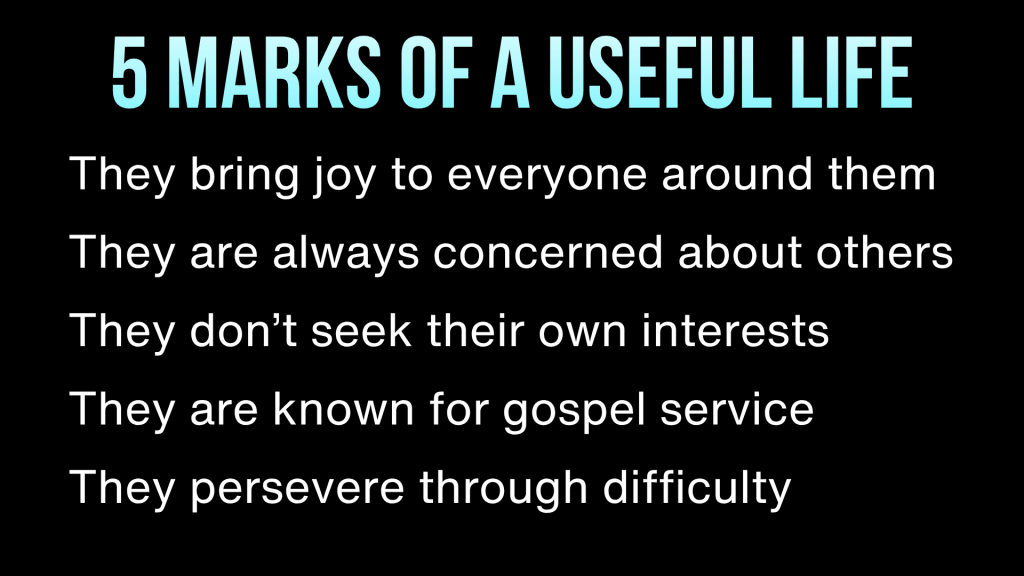
Paul wanted to hear news of the Philippians’ growth because he found great joy when others experienced good. The more we focus on others and the less we focus on ourselves, the easier it will be to live joyfully.
Even though Paul was the “leader of the band”, he spent a great deal of time speaking positively about and building up Timothy and Epaphroditus. No one ever regrets time spent building into the lives of others.
It is impossible to be Christ-centered and self-centered at the same time.
Epaphroditus not only brought the Philippians’ support gift to Paul, he also stayed to physically care for Paul in prison. He placed his own life on pause in order to further the Gospel by caring for Paul.
Even though Epaphroditus was a great blessing to Paul, Paul was eager to send him back to Philippi because Paul wanted the Philippians to be blessed by Paul.
Look at Philippians 4:3. It is possible that the greatest service Paul wanted Epaphroditus to render was to play the lead role in reconciling Euodia and Syntyche.
In God’s church, those who serve are worthy of the highest honor. Those who self-promote, demand respect, and pursue their own agenda are not to be honored.
The biggest impact makers in the Kingdom of God are those who are others-focused.

1-2-3 TO BE MORE USEFUL
The following 1-2-3 model can really be used to apply any biblical truth to your life. Today, we’re focused on how to be more useful to God.
1. IDENTIFY ONE AREA OF YOUR LIFE THAT NEEDS WORK
As you think through the different spheres of your life, you can probably identify “growth areas” in all of them. Just pick one. That way, you can be laser-focused without distraction. Possible areas of life include:
- Family
- Work
- School
- Neighborhood
- Hobby Groups (sports, clubs, etc.)
- Friends
- Church
2. CHOOSE TWO USEFUL ACTIONS
When you think about actions that are useful, remember that useful people are joy-forward and others-focused. A good way to identify specific actions is to think of the word ACT.
- ACTION – Is it something I can actually DO? Don’t just think about it, do it!
- COMPLETABLE – How will I know when I’ve done it or finished it? Don’t be vague.
- TIME-ORIENTED – Is it reasonable to accomplish in a reasonable amount of time?
- SAMPLES:
- I will text one friend an encouraging note every day before 10am tomorrow.
- I will make a list of 10 things for which I’m grateful before bed every night.
- I will post a helpful Bible verse on social media every day during my lunch break.
3. COMPLETE THE ACTIONS THREE TIMES THIS WEEK
Even if your goal is to do something every day, you will probably forget or get distracted every so often. Many people quit because they don’t think they can be perfect. DON’T LET PERFECT BE THE ENEMY OF DONE!
This week, shoot for three times. And when you accomplish it, celebrate and reward yourself!

Click on the image to download the DiscipleQuest PDF
The DiscipleQuest PDF includes 7 days of verse study prompts. You can use these seven studies to dig deeper into what the Bible teaches about focusing on others:
- Romans 12:10
- Mark 10:43-45
- Micah 6:8
- Galatians 6:2
- 1 Corinthians 10:24
- John 13:14-15
- Proverbs 11:25

Use these questions as journal prompts or as conversation starters with a group of friends or a Bible study group:
Who do you know that has earned the title, “servant”? Describe how they serve the people in their lives.
Read Philippians 2:19-30. The three main characters are Paul, Timothy, and Epaphroditus. How do you see each of them demonstrating a servant’s heart?
Based on what you read here, what is one word you would use to describe Timothy? What is one word you would use to describe Epaphroditus?
Verses 19,28,& 29 all describe joy. What is bringing joy to people in these verses? What does this tell you about how you can experience more joy?
Look at the three words Paul uses to describe Epaphroditus in verse 25. What might Epaphroditus have done to earn those titles? Who do you know that fits those descriptions?
Why is it so hard to focus on other people? Why is it so easy to focus on ourselves?
Make a list of ten ways Jesus focused on other people.
Make a list of five things people can do to focus on other people.
Who is one person you want to serve this week, and what is one action you will take to do so?
PHILIPPIANS: Line by Line
2:19-30: Finding joy by serving others
19. I hope in the Lord Jesus to send Timothy to you soon, so that I too may be cheered by news of you.
Timothy was Paul’s right-hand man. He did for Paul what Paul couldn’t do for himself, and since Paul couldn’t leave Rome (prison), he was going to send Timothy to help build up the Philippians. Nothing made Paul happier than hearing that his spiritual children were growing in their faith.
20. For I have no one like him, who will be genuinely concerned for your welfare.
Most people will express or demonstrate a little concern for others, but it is not a deep, genuine concern. Timothy was unique because he always put others ahead of himself. He was passionately concerned to see as many people grow in their faith as possible.
21. For they all seek their own interests, not those of Jesus Christ.
Most people put their own desires and needs ahead of everyone else. Interestingly here, Paul seems to indicate that the interests of Jesus intersect with the interests of others. When I am others-focused, I will have the same life focus as Jesus. As long as I am focused on myself, I will not see the world the way Jesus does.
22a. But you know Timothy’s proven worth…
Timothy had already demonstrated his hear and his abilities. His value was well-known throughout the early church communities. There is no better reputation to have than as a servant.
22b. …how as a son with a father he has served with me in the gospel.
Paul had poured his life into Timothy, and now Timothy was beginning to look more and more like Paul. It’s as though Paul’s spiritual DNA has been passed along to Timothy and now the young man shares the older man’s passion to see the gospel spread to every nation.
23. I hope therefore to send him just as soon as I see how it will go with me,
Paul was waiting for a verdict in his trial. He didn’t know if he would be executed or freed. It is likely that Timothy wouldn’t leave his side until this matter was settled, but Paul assured the Philippians that he would be sending the young man as soon as possible.
24. And I trust in the Lord that shortly I myself will come also.
Here, Paul hints that he hopes and believes that he will be set free. As he said in 1:22, if he is given more time, he is fully dedicated to serving more and ministering more. Therefore, if he is released, his plan is to travel to Philippi so that he can encourage and build up the Christians there.
25a. I have thought it necessary to send to you Epaphroditus…
Paul “hoped” to send Timothy, but he found it “necessary” to send Epaphroditus. Even though Epaphroditus was a great help and comfort to Paul, the apostle’s desire was to have Epaphroditus serve the church in Philippi. Their growth was more important than his comfort.
It appears that Epaphroditus is named after the Greek goddess Aphrodite. This leads us to believe that he was saved out of a family that passionately served the false gods of their day. He is a living picture of the mercy and grace of God that often pulls us out of our sin and situation so He can save us to a much higher purpose.
25b. …my brother and fellow worker and fellow soldier…
Paul describes the closeness of his relationship with Epaphroditus (brother). He elevates Epaphroditus by naming him as a “fellow worker” when he could have easily described him as an assistant, a helper, or a student. He also hints at Epaphroditus’ tenacity and spirit by naming him as a fellow soldier. The gospel work was difficult, dangerous, and sometimes painful. Epaphroditus never shied away from any of it.
25c. …and your messenger and minister to my need…
Epaphroditus was probably from Philippi and had been sent by the church to deliver a message to Paul as well as to bring gifts and financial support to him. Additionally, Epaphroditus stayed on after delivering the gifts so that he could provide physical care and comfort to Paul while he was in prison.
26. For he has been longing for you all and has been distressed because you heard that he was ill.
Epaphroditus was not upset or anxious because of his own illness, but he was distressed because the Philippians were distressed. This is the true heart of a servant. He didn’t want his friends to be concerned or upset, even if they were doing so for him. He wanted to do whatever he could to bring peace and joy to the people in his life.
27a. Indeed he was ill, near to death.
We are not sure if Epaphroditus became ill while delivering the message to Paul (it may have been a difficult trip), or if he became ill while helping to care for Paul. Whichever it was, he continued on with his service until his illness became life-threatening. He placed the lives of everyone else above his own.
27b. But God had mercy on him…
Anytime our life is extended (in sickness or in health), it is because of God’s mercy and grace. We deserve nothing from Him, but He generously gives us life in His creation. The healing He provided to Epaphroditus was an obvious act of mercy, and it should cause us to consider how God has also been merciful to us. The mercy of God should always drive us to gratitude.
27c. …and not only on him but on me also, lest I should have sorrow upon sorrow.
Paul was already in prison and in danger of losing his life. Had Epaphroditus died, it would have been one more difficulty piled on top. He was grateful that God spared him from that sorrow.
28a. I am the more eager to send him, therefore…
Epaphroditus was a picture of grace and mercy to Paul. His service and delivery of a gift was a sign of God’s (and the Philippians’) grace to him. His healing was a sign of God’s mercy. Now, even though he had done so much, Paul wanted to send him away. He wanted the Philippians to also experience the grace and mercy of God through the work and leadership of Epaphroditus.
28b. …that you may rejoice at seeing him again, and that I may be less anxious.
Epaphroditus’ return to Philippi meant more stability for the church there. It meant they would have one of their leaders back. It meant they would have more opportunities to grow spiritually because of his ministry. For all of these reasons, it would mean joy for the Philippians, and it would mean joy for Paul. Paul was anxious for them to grow, and Epaphroditus’ return would facilitate that growth.
29. So receive him in the Lord with all joy, and honor such men…
Paul expected the Philippians to give Epaphroditus a warm welcome, and he expected the church to take good care of Epaphroditus and Timothy (upon his arrival).
30a. …for he nearly died for the work of Christ…
The illness Epaphroditus suffered was because he was faithful to his calling. Had he bailed from his job, he likely would not have become ill and he certainly would not have continued to worsen. The decision to follow Jesus requires us to be willing to give our lives. If we love our own life more than we love Him, we may not actually be ready to follow Him.
30b. …risking his life to complete what was lacking in your service to me.
The Philippians sent a wonderful gift to Paul (4:18). But what they couldn’t give him was their physical presence. Epaphroditus provided that.


Leave a Reply