GENESIS 1:1-5
1 In the beginning, God created the heavens and the earth. 2 The earth was without form and void, and darkness was over the face of the deep. And the Spirit of God was hovering over the face of the waters.
3 And God said, “Let there be light,” and there was light. 4 And God saw that the light was good. And God separated the light from the darkness. 5 God called the light Day, and the darkness he called Night. And there was evening and there was morning, the first day.
TEN POINTS TO PONDER
The question of “beginnings” is not a science or history question because it was not observed and cannot be replicated. It is, then, a logical question.
Our goal when thinking about origins should be to discover the most reasonable explanation for the existence of everything. Is it more likely that this all came from something else or from nothing?
It is possible for someone to love Jesus and still disagree with you about the manner or timeline in which God created the world. Do not call unclean what God has made clean.
In Mark 10:6, Jesus quoted Genesis 1. In doing so, He revealed His belief that Genesis 1 is authoritative. If Jesus believed Genesis 1 was a true record of creation, we should believe the same.
Some Christians struggle with the idea of creation because they find it hard to believe, but if God raised Jesus from the dead, it’s no big deal for Him to have created the world in 6 days.
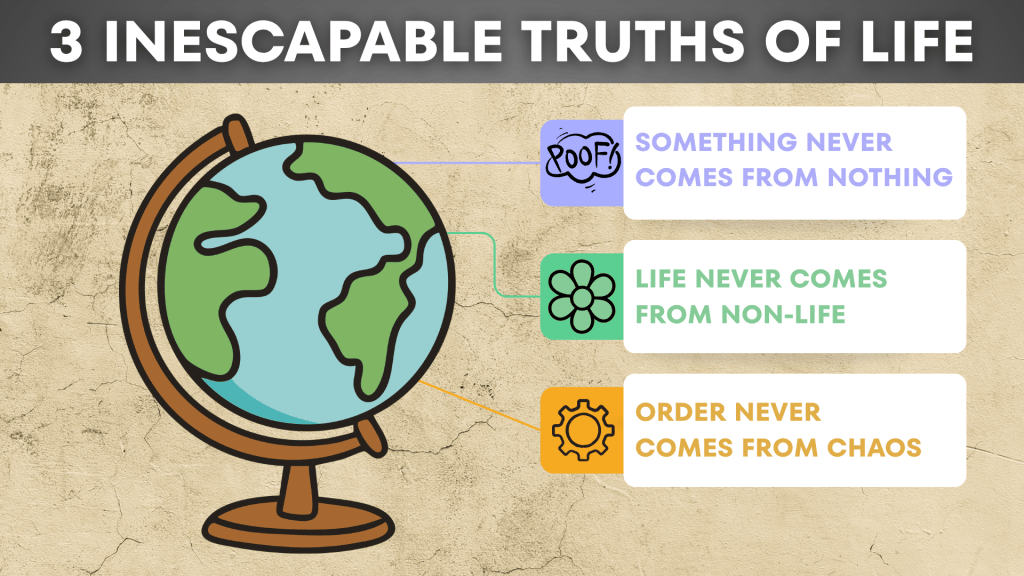
Three impossible beliefs that every naturalist must rely on:
- Something came from nothing.
- Life came from non-life
- Order came from chaos
Just as God brought order from chaos in creation, He loves to bring order from chaos in our lives (if we’ll let Him).
Because the universe is created, we are responsible and accountable to the Creator. He knows best how life is to be lived, and we ought to pay attention.
Because we were purposefully created, we should live with purpose. God’s purposes for our lives will always be best.
Your value does not come from what you have or what you have accomplished or what people think of you. You are valuable because you have been created in the image of God!
Nothing Comes From Nothing
One of the most important questions any person can ask is deceptively simple: How did all of this begin? Genesis opens with a bold declaration—“In the beginning, God created…”—and that single sentence confronts every worldview with a choice. Either there is Something More behind the universe, or there is Nothing Else. Naturalism insists that matter and energy simply exist, without cause or intention. But that explanation collapses under its own weight. Something never comes from nothing. Life never comes from non‑life. Order never emerges from chaos. These are not theological statements; they are logical ones.
When we acknowledge that the universe requires a first cause, we begin to see the fingerprints of intention everywhere. The fine‑tuning of our world, the precision of rotation, the delicate balance of oxygen, the staggering complexity of the human body—none of these sit comfortably under the banner of “it just happened.” The first cause must be eternal, intelligent, and intentional. And Scripture names that cause: Yahweh, the God who speaks light into existence and breathes life into dust. The resurrection of Jesus becomes the ultimate validation that the God who begins creation is also the God who renews it.
Why does this matter? Because if there is Something More, then we are not accidents. We are creations. And created things have purpose. In a world where so many feel aimless and adrift, the doctrine of creation anchors us in meaning. You are here because God wanted you here. You are valuable because He says you are valuable. And that truth reshapes not only how we see the world—but how we live within it.

Click on the image to download the DiscipleQuest PDF
The DiscipleQuest PDF includes 7 days of verse study prompts. You can use these seven studies to dig deeper into what the Bible teaches about creation:
- Exodus 20:11
- John 1:3
- Nehemiah 9:6
- Romans 1:20
- Psalm 19:1
- Colossians 1:16
- Isaiah 45:12

Use these questions as journal prompts or as conversation starters with a group of friends or a Bible study group:
OPTION ONE: Creation, the Creator, and Culture
This study is based on Romans 1:18-25. It is important to understand and move toward the understanding that God is the Creator and is not to be confused with the creation in any way! This is a foundational thought for all Biblical understanding.
FOUR THOUGHTS ABOUT “CREATION”:
- It was made by God
- It points to God
- It is a resource, not a source
- It is incapable of receiving worship or service
20 Questions
- Are men really ungodly and righteous? Why or why not?
- By whose standards are these judgments made?
- What makes someone ungodly or unrighteous?
- What truths about God do people suppress? Why?
- What are the attributes of God that are clear to everyone?
- How can creation point us to God?
- Does it matter that God is immortal?
- If God is the creator, what –if any– is our responsibility to him?
- Why wouldn’t someone want to believe that God is the creator?
- What do you think it means to “worship the creature”? Do people worship the creature today?
- How does suppressing God’s truth make it easier for people to claim “wisdom”?
- Do people prefer “black and white” wisdom or “gray”? Why? Does God see in black and white?
- Why does God consider man’s wisdom to be “futile thinking”? Can you think of an example of this?
- In what way are men’s hearts darkened and foolish? Does this apply to everyone? Why or why not?
- How are people “without excuse”? For what? To whom?
- Why is God wrathful?
- Who is in danger of facing God’s wrath?
- How is God’s wrath evident today?
- How will it be evident in the future?
- What is the solution to God’s wrath?
OPTION TWO: Meeting God in Creation
- Read Genesis 1:1-5. Which word in these verses is the most important? Why?
- Do you find it difficult or easy to hold faith and science together? What experiences have shaped that tension?
- What do the words “without form and void” suggest about the condition of creation in Genesis 1:2?
- How does the movement from darkness and disorder toward light and order reveal God’s character?
- Does it matter whether or not God created the world? Does it matter whether or not He did it in six days? Why?
- Why can conversations about creation become divisive, even among Christians who agree on the gospel?
- Which questions about creation do you consider essential to the Christian faith, and which allow room for gracious disagreement?
- What difference does it make that humans are created in the image of God? How does it change the way you think about yourself? How should it change the way you think about others?
- How would your priorities change if you consistently remembered that you are accountable to the One who made you?
- What is one concrete step you can take this week to live as someone who was created on purpose, for a purpose?
 Lake Bible Notes
Leave a comment