
• Something More or Nothing Else? (9.06.2026)

    GENESIS 1:1-5

    1 In the beginning, God created the heavens and the earth. 2 The earth was without form and void, and darkness was over the face of the deep. And the Spirit of God was hovering over the face of the waters.
    3 And God said, “Let there be light,” and there was light. 4 And God saw that the light was good. And God separated the light from the darkness. 5 God called the light Day, and the darkness he called Night. And there was evening and there was morning, the first day.

    TEN POINTS TO PONDER

    The question of “beginnings” is not a science or history question because it was not observed and cannot be replicated. It is, then, a logical question.

    Our goal when thinking about origins should be to discover the most reasonable explanation for the existence of everything. Is it more likely that this all came from something else or from nothing?

    It is possible for someone to love Jesus and still disagree with you about the manner or timeline in which God created the world. Do not call unclean what God has made clean.

    In Mark 10:6, Jesus quoted Genesis 1. In doing so, He revealed His belief that Genesis 1 is authoritative. If Jesus believed Genesis 1 was a true record of creation, we should believe the same.

    Some Christians struggle with the idea of creation because they find it hard to believe, but if God raised Jesus from the dead, it’s no big deal for Him to have created the world in 6 days.

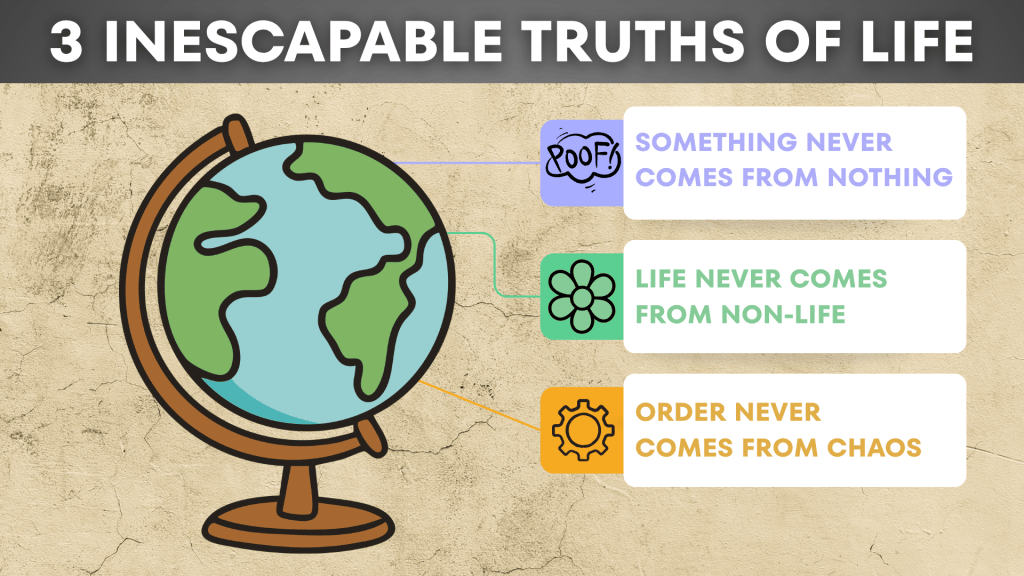
    Three impossible beliefs that every naturalist must rely on:

    • Something came from nothing.
    • Life came from non-life
    • Order came from chaos

    Just as God brought order from chaos in creation, He loves to bring order from chaos in our lives (if we’ll let Him).

    Because the universe is created, we are responsible and accountable to the Creator. He knows best how life is to be lived, and we ought to pay attention.

    Because we were purposefully created, we should live with purpose. God’s purposes for our lives will always be best.

    Your value does not come from what you have or what you have accomplished or what people think of you. You are valuable because you have been created in the image of God!

    Nothing Comes From Nothing

    One of the most important questions any person can ask is deceptively simple: How did all of this begin? Genesis opens with a bold declaration—“In the beginning, God created…”—and that single sentence confronts every worldview with a choice. Either there is Something More behind the universe, or there is Nothing Else. Naturalism insists that matter and energy simply exist, without cause or intention. But that explanation collapses under its own weight. Something never comes from nothing. Life never comes from non‑life. Order never emerges from chaos. These are not theological statements; they are logical ones.

    When we acknowledge that the universe requires a first cause, we begin to see the fingerprints of intention everywhere. The fine‑tuning of our world, the precision of rotation, the delicate balance of oxygen, the staggering complexity of the human body—none of these sit comfortably under the banner of “it just happened.” The first cause must be eternal, intelligent, and intentional. And Scripture names that cause: Yahweh, the God who speaks light into existence and breathes life into dust. The resurrection of Jesus becomes the ultimate validation that the God who begins creation is also the God who renews it.

    Why does this matter? Because if there is Something More, then we are not accidents. We are creations. And created things have purpose. In a world where so many feel aimless and adrift, the doctrine of creation anchors us in meaning. You are here because God wanted you here. You are valuable because He says you are valuable. And that truth reshapes not only how we see the world—but how we live within it.

    Click on the image to download the DiscipleQuest PDF

    The DiscipleQuest PDF includes 7 days of verse study prompts. You can use these seven studies to dig deeper into what the Bible teaches about creation:

    • Exodus 20:11
    • John 1:3
    • Nehemiah 9:6
    • Romans 1:20
    • Psalm 19:1
    • Colossians 1:16
    • Isaiah 45:12

    Use these questions as journal prompts or as conversation starters with a group of friends or a Bible study group:

    OPTION ONE: Creation, the Creator, and Culture

    This study is based on Romans 1:18-25.  It is important to understand and move toward the understanding that God is the Creator and is not to be confused with the creation in any way! This is a foundational thought for all Biblical understanding.

    FOUR THOUGHTS ABOUT “CREATION”:

    1. It was made by God
    2. It points to God
    3. It is a resource, not a source
    4. It is incapable of receiving worship or service

    20 Questions

    • Are men really ungodly and righteous? Why or why not?
    • By whose standards are these judgments made?
    • What makes someone ungodly or unrighteous?
    • What truths about God do people suppress? Why?
    • What are the attributes of God that are clear to everyone?
    • How can creation point us to God?
    • Does it matter that God is immortal?
    • If God is the creator, what –if any– is our responsibility to him?
    • Why wouldn’t someone want to believe that God is the creator?
    • What do you think it means to “worship the creature”? Do people worship the creature today?
    • How does suppressing God’s truth make it easier for people to claim “wisdom”?
    • Do people prefer “black and white” wisdom or “gray”? Why? Does God see in black and white?
    • Why does God consider man’s wisdom to be “futile thinking”? Can you think of an example of this?
    • In what way are men’s hearts darkened and foolish? Does this apply to everyone? Why or why not?
    • How are people “without excuse”? For what? To whom?
    • Why is God wrathful?
    • Who is in danger of facing God’s wrath?
    • How is God’s wrath evident today?
    • How will it be evident in the future?
    • What is the solution to God’s wrath?

    OPTION TWO: Meeting God in Creation

    • Read Genesis 1:1-5. Which word in these verses is the most important? Why?
    • Do you find it difficult or easy to hold faith and science together? What experiences have shaped that tension?
    • What do the words “without form and void” suggest about the condition of creation in Genesis 1:2?
    • How does the movement from darkness and disorder toward light and order reveal God’s character?
    • Does it matter whether or not God created the world? Does it matter whether or not He did it in six days? Why?
    • Why can conversations about creation become divisive, even among Christians who agree on the gospel?
    • Which questions about creation do you consider essential to the Christian faith, and which allow room for gracious disagreement?
    • What difference does it make that humans are created in the image of God? How does it change the way you think about yourself? How should it change the way you think about others?
    • How would your priorities change if you consistently remembered that you are accountable to the One who made you?
    • What is one concrete step you can take this week to live as someone who was created on purpose, for a purpose?
  • Everything I Need (8.30.2026)

    PHILIPPIANS 4:14-23

    14Yet it was kind of you to share my trouble. 15And you Philippians yourselves know that in the beginning of the gospel, when I left Macedonia, no church entered into partnership with me in giving and receiving, except you only. 16Even in Thessalonica you sent me help for my needs once and again. 17Not that I seek the gift, but I seek the fruit that increases to your credit. 18I have received full payment, and more. I am well supplied, having received from Epaphroditus the gifts you sent, a fragrant offering, a sacrifice acceptable and pleasing to God. 19And my God will supply every need of yours according to his riches in glory in Christ Jesus. 20To our God and Father be glory forever and ever. Amen.

    21Greet every saint in Christ Jesus. The brothers who are with me greet you. 22All the saints greet you, especially those of Caesar’s household.

    23The grace of the Lord Jesus Christ be with your spirit.

    LUKE 12:13-21

    13Someone in the crowd said to him, “Teacher, tell my brother to divide the inheritance with me.” 14But he said to him, “Man, who made me a judge or arbitrator over you?” 15And he said to them, “Take care, and be on your guard against all covetousness, for one’s life does not consist in the abundance of his possessions.” 16And he told them a parable, saying, “The land of a rich man produced plentifully, 17and he thought to himself, ‘What shall I do, for I have nowhere to store my crops?’ 18And he said, ‘I will do this: I will tear down my barns and build larger ones, and there I will store all my grain and my goods. 19And I will say to my soul, “Soul, you have ample goods laid up for many years; relax, eat, drink, be merry.”’ 20But God said to him, ‘Fool! This night your soul is required of you, and the things you have prepared, whose will they be?’ 21So is the one who lays up treasure for himself and is not rich toward God.”

    TEN POINTS TO PONDER

    Just 10 verses earlier, Paul was confronting the church and challenging them to stop feuding. Now he is commending them for their kindness. This is how grace works. He began the book by talking about it, and now he’s ending the book by demonstrating it.

    These verses are about generosity, both the Philippians generosity to Paul and God’s generosity to Paul. When God has been generous to us, we should be generous to others.

    Paul was grateful for everything the Philippians had done for him because he realized that they had been a conduit for God’s glorious provision.

    When we are generous to other people, not only are we partnering with them, but we are partnering with what God is doing in their life.

    Generosity helps us release our grip on what we hold most tightly. And when we loosen our grip on those things, those things loosen their grip on us.

    When I think about what I most need, or truly need, it’s helpful to think about the future. How important will this “thing” be in 5 months or 5 years? Will it even last that long?

    If one of your problems is that you have so much stuff you don’t know what to do with it all, then you probably don’t really need a whole lot more!

    Most of what I think I need, I actually just want. The one thing I truly need is eternal life. If I don’t have that, nothing else matters.

    God’s riches are vast. He owns everything that exists. But all of that pales in comparison to His riches in Christ. And those riches are extended to us!

    In verse 21, as in most of his letters, Paul makes it clear that he never does ministry alone. He relies on the people around him as much as he relies on the churches that support him. None of us are in this alone. If we aren’t relying on others, we’re missing out on the abundant life.

    16 REASONS TO BE GRATEFUL TO GOD

    Give thanks because of who God is:

    1. Creator — even in its broken state, creation still trumpets the goodness of God.
    2. Sustainer — if He ever removed His hands, all would fall apart.
    3. Provider — He provides all our needs (not necessarily our wants)
    4. Healer — every earthly healing is a small taste of the eternal healing that waits for us all
    5. Savior — history is full of stories recounting God’s saving action on behalf of His people
    6. Redeemer — He spared no expense to buy us back from our rebellion

    Give thanks because of what God has done:

    1. He chose Abraham — from Abraham he launched a new nation and inaugurated a redemptive plan
    2. He rescued His people — by humbling the world’s superpower, God displayed His power
    3. He delivered a remnant — in the midst of judgment and destruction, God saved a few to carry on His plan
    4. He sent His Son — Jesus came to do for us what we could never do for ourselves
    5. He sent His Spirit — a comforter, a guide, a counselor, a convictor, He is with us forever
    6. He launched His church — a global community, united by love for Christ and the experience of salvation

    Give thanks because of what God has promised:

    1. An inheritance — reserved for us by God. We have hope that this life is NOT all there is
    2. Complete salvation — in the future we will experience salvation from the power & presence of sin
    3. Eternal life — death is not the end. On the other side of the grave is a brilliant, exhilarating & perfect life
    4. All things new — no more sorrow or pain or death. Eden Restored!

    Click on the image to download the DiscipleQuest PDF

    The DiscipleQuest PDF includes 7 days of verse study prompts. You can use these seven studies to dig deeper into what the Bible teaches about God’s provision (remember to check out surrounding verses if you need more context):

    • Genesis 22:13-14
    • Psalm 23:1
    • Ephesians 1:3
    • Psalm 37:25
    • John 6:35
    • Matthew 7:9-11
    • Romans 8:31-32

    Use these questions as journal prompts or as conversation starters with a group of friends or a Bible study group:

    Do you generally think you have too much or too little? Why?

    Read Luke 12:13-21. Have a few people try to summarize this parable with just one word.

    Jesus used a question from the crowd to launch this parable, but He made it clear that it was a bad question. What was wrong with the question (or the attitude behind the question) in verses 13-15?

    In verses 15, Jesus warned against all kinds of greed or covetousness. What are some different ways that greed can creep into our mind?

    Notice how often the rich man used words like, “I”, “me” or “my”. What does that tell you about him?

    If the rich man had been focused on gratitude, how might he have expressed gratitude to God in this story?

    From the outside looking in, most people would have thought the rich man was highly successful. Why is it so easy for us to develop the wrong mindset about success in life?

    The rich man’s life was full of safety, security, comfort, and convenience. How can these four things distract us from our relationship with God? How are you tempted to place too high a value on these things?

    If you could give one piece of advice to the rich man, what would it be?

    How does the story of the rich man challenge you? What is something you need to change in the way you think or the way you act? How will you take a step in this direction this week?

    PHILIPPIANS: Line by line

    Philippians 4:14-23: All your needs

    14. Yet it was kind of you to share my trouble.

    Even though much in his life was not going well, Paul never stopped being others-focused. He expressed gratitude and encourages the Philippians. Even though they were far away, they hadn’t left him alone, and he appreciated their concern and their provision.

    15. And you Philippians yourselves know that in the beginning of the gospel, when I left Macedonia, no church entered into partnership with me in giving and receiving, except you only.

    Paul’s special relationship with the church dated back to the beginning of their time together. During his early missionary journeys, they were one of the only churches who supported him. He uses the word partnership to make sure they understand that all of his Gospel work is only possibly because of their support. Because they shared in the work, they also get to share in the credit. Those who were saved through Paul’s ministry were saved in part because of the Philippians generosity.

    16. Even in Thessalonica you sent me help for my needs once and again.

    When Paul left Philippi, after starting the church there, he went to Thessalonica. It was right around the corner. And that quickly, the church in Philippi began supporting his work. They didn’t wait, they didn’t need to “grow more mature” or become more stable financially. They immediately started sacrificing so that they could contribute to the Kingdom mission.

    17. Not that I seek the gift, but I seek the fruit that increases to your credit.

    Paul is essentially saying, “I don’t want something FROM you. I want something FOR you.” The gifts he received were useful for him, but even more so the gifts were good for the Philippians. By sacrificing and being generous, Paul knew they would grow to be more Christlike and that their trust in God’s provision would be strengthened.

    18a. I have received full payment, and more. I am well supplied, having received from Epaphroditus the gifts you sent,

    Paul is assuring them that Epaphroditus was a trustworthy messenger and that he had indeed delivered everything they had sent. Even more importantly, it was plenty. Paul had everything he needed and more, thanks to them.

    18b.a fragrant offering, a sacrifice acceptable and pleasing to God.

    This verse sounds like Romans 12:1. Our lives should be offered as sacrifice that is pleasing to God. When we make personal sacrifices so that we can be generous to others, God is pleased.

    19a. And my God

    Paul’s dependance on God is the result of his relationship with God. To him, God is not an impersonal force or an unknowable deity. God is Paul’s God, they have a relationship. He is intimately acquainted with God’s presence.

    19b. will supply every need of yours

    It’s easy to get this verse wrong. The promise is not that all of our desires will be supplied, but that all of our needs will be supplied. We should never be surprised, confused, or disappointed that God hasn’t given us what we want. He never promised He would. And if He doesn’t give us something, it’s because He knows we don’t need it and He knows it wouldn’t be best for us.

    19c.according to his riches in glory in Christ Jesus.

    The manner of provision helps us understand the nature of the needs. That Jesus is the provision means that the need is sin. Only Jesus can provide salvation and forgiveness, and there is nothing we need more than that. If were given everything we ever wanted in life, but didn’t receive Jesus, it would all mean nothing at the end. If we receive nothing in life, but have Jesus at the end, it will mean everything.

    20. To our God and Father be glory forever and ever. Amen.

    When we understand that God has already met our most important (and only) need through Christ, we are left with nothing to do but to worship and glorify Him.

    21-22. Greet every saint in Christ Jesus. The brothers who are with me greet you. All the saints greet you, especially those of Caesar’s household.

    Everything was relational to Paul. He wanted the church in Philippians to know that they were not alone. He wanted to remind them that they were working together with people they didn’t know and who they would likely never meet. The kingdom of God is much larger than any one person or any one Church.

    23. The grace of the Lord Jesus Christ be with your spirit.

    Paul ends where he began. With the grace of God. We are at peace with God because He extended grace to us in the life, death, and resurrection of Jesus. In the same way, we can be at peace with others if we are willing to extend grace to them. Where peace is lacking, grace is likely missing. Where grace is not given, peace will not grow. If you want to live at peace, be a person who extends grace.

  • The Secret of Contentment (8.23.2026)

    Philippians 4:10-13

    10I rejoiced in the Lord greatly that now at length you have revived your concern for me. You were indeed concerned for me, but you had no opportunity. 11Not that I am speaking of being in need, for I have learned in whatever situation I am to be content. 12I know how to be brought low, and I know how to abound. In any and every circumstance, I have learned the secret of facing plenty and hunger, abundance and need. 13I can do all things through him who strengthens me.

    Matthew 6:25-33

    “Therefore I tell you, do not be anxious about your life, what you will eat or what you will drink, nor about your body, what you will put on. Is not life more than food, and the body more than clothing? 26Look at the birds of the air: they neither sow nor reap nor gather into barns, and yet your heavenly Father feeds them. Are you not of more value than they? 27And which of you by being anxious can add a single hour to his span of life?g 28And why are you anxious about clothing? Consider the lilies of the field, how they grow: they neither toil nor spin, 29yet I tell you, even Solomon in all his glory was not arrayed like one of these. 30But if God so clothes the grass of the field, which today is alive and tomorrow is thrown into the oven, will he not much more clothe you, O you of little faith? 31Therefore do not be anxious, saying, ‘What shall we eat?’ or ‘What shall we drink?’ or ‘What shall we wear?’ 32For the Gentiles seek after all these things, and your heavenly Father knows that you need them all. 33But seek first the kingdom of God and his righteousness, and all these things will be added to you.

    TEN POINTS TO PONDER

    If Paul had to learn contentment, I should not be surprised when it doesn’t come naturally to me. Conversion makes me new immediately; learning to live like the new person Christ has made me takes time.

    I can be content even when I don’t get what I want. Paul didn’t learn to change his circumstances, he learned to be content in every circumstance.

    We don’t only struggle with contentment when we are in need. Paul said he had to learn to be content even when he had an abundance. Sometimes, the more we have the more we want.

    Philippians 4:13 is not a promise that we will always succeed or always get what we want. It is a promise that no matter what we get, we will get through.

    Sometimes God takes me through a tough situation and sometimes God takes me out of a tough situation (sometimes He takes His children home!).

    The Bible never teaches that we won’t sometimes find ourselves in need. It always teaches that our needs will be met.

    Worry is the killer of contentment. It is rooted in what might happen whereas contentment is rooted in what has happened. Worry feeds on fear, contentment grows from trust.

    Contentment is choosing to focus on what God has already done and has already given rather than looking at what I don’t have and what hasn’t happened.

    It’s hard to be content when my expectations run ahead of God’s promises.

    It’s okay to pray, “God change this.” It’s even better to pray, “God change me through this.”

    Contentment from the Commandments

    Contentment and gratitude go hand in hand. The more I practice gratitude, the more I’ll experience contentment. Consider how the 10 commandments can help you express more gratitude.

    Gratitude is a powerful tool for fighting anxiety, fear, and selfishness. It also promotes contentment, generosity, peace, and trust. I am always looking for new methods to develop more gratitude in my life. Here is an idea I have to use the 10 commandments as a jumping-off point for gratitude. Consider praying through these commands and using each one to express thanksgiving to God.

    1. Have no other gods before Me.

    Thank you for being all-powerful, all-present, always in control, and still caring about me.

    2. Make no false idols.

    Thank you for being everything I need so that I never need to look elsewhere for provision.

    3. Do not take the name of the LORD in vain.

    Thank you for the privilege of calling on your name through prayer. Thank you for hearing my prayers.

    4. Remember the Sabbath.

    Thank you for all of creation and for building healthy rhythms into creation as an example for how to live my life.

    5. Honor your father and mother.

    Thank you for my family and for the people in my life who are like family to me.

    6. You shall not kill.

    Thank you for life and all you do to sustain me.
    7. You shall not commit adultery.

    Thank you for relationships and for love and for the gift of marriage. Thank you for your faithfulness to me.

    8. You shall not steal.

    Thank you for entrusting me with so many gifts. Thank you for giving me far more than I ever needed.

    9. You shall not bear false witness against your neighbor.

    Thank you for truth. Thank you that Jesus is the truth and the life. Thank you for you Word which is truth for life.

    10. You shall not covet.

    Thank you for providing all my needs. Thank you for your promise to always give me everything I need.

    Click on the image to download the DiscipleQuest PDF

    The DiscipleQuest PDF includes 7 days of verse study prompts. You can use these seven studies to dig deeper into what the Bible teaches about contentment:

    • 1 Timothy 6:6-8
    • Hebrews 13:5-6
    • Proverbs 15:16
    • Matthew 6:31-33
    • Psalm 23:1
    • 2 Corinthians 12:9-10
    • Proverbs 30:8-9

    Use these questions as journal prompts or as conversation starters with a group of friends or a Bible study group:

    Read Philippians 4:10-13. Have a few people summarize the passage in one sentence.

    Discuss what the 4-5 most important words are in this passage.

    Paul says he had “learned” to be content. What does that word tell us about contentment? Why might contentment need to be learned rather than simply chosen?

    Compare Philippians 4:11–13 with Matthew 6:25–33. What similarities do you see between Paul’s contentment and Jesus’ teaching about worry?

    Jesus says, “Your heavenly Father knows that you need them all.” How does knowing that God knows our needs help us understand Paul’s contentment?

    Why do you think comparison is such a powerful enemy of contentment? Where are we most tempted to compare ourselves with others?

    How do our expectations contribute to discontentment? What’s the difference between something God has promised us and something we simply expected him to give us?

    Paul learned contentment through experience. What difficult circumstance has God used in your past to teach you something about his faithfulness?

    Finish this sentence: “I would be more content if only __________.” What does your answer reveal about where you’re looking for satisfaction?

    What is one specific practice you could begin this week that would help you learn contentment rather than simply wishing you were more content?

    PHILIPPIANS: Line by line

    Philippians 4:10-13: The Secret of contentment

    10. I rejoiced in the Lord greatly that now at length you have revived your concern for me. You were indeed concerned for me, but you had no opportunity. 

    Paul and the Philippians had a long-standing relationship in which the Philippian Church had supported him in his ministry. Due to circumstances, they had been unable to send support to him for a period of time, but now, their most recent gift was delivered to Paul by Epaphroditus. Paul expressed to them how grateful he was. And then used their gift as an opportunity to remind them of the importance of contentment.

    11a. Not that I am speaking of being in need,

    The Philippians gift was generous and needed, but Paul also knew that if it hadn’t arrived, God would have provided another way. Even though he had needs, Paul never considered himself “in need”, because he knew God would provide.

    11b. for I have learned…

    Contentment didn’t come naturally for Paul. He had to learn it. It doesn’t come naturally to any of us. If we are not intentional about developing contentment, we will not be content.

    11c. in whatever situation I am to be content.

    The nature of contentment is that it is not dependent on circumstances. Contentment flows from something greater than our current situation. Therefore, true contentment can exist anywhere at any time.

    12. I know how to be brought low, and I know how to abound. In any and every circumstance, I have learned the secret of facing plenty and hunger, abundance and need.

    Paul was content whether things were good or bad, whether he had everything he wanted or nothing he desired. He had experienced all of life and had learned that nothing in life can bring contentment. Something beyond what life offers is needed.

    13a. I can do all things

    This is not a promise that we can have success or victory in every situation and it is not a promise that we can attain or achieve everything we hope for. All things is a reference to verse 12, the highs and lows of life and the much and the little of life.

    13b. through him who strengthens me.

    God’s strength is the secret of contentment. Because He can do anything, and because He’ll always do what is best for me, I can be content no matter what I have and no matter what is happening. In every situation of life, I know that I’ll get through because God is with me.

  • Think On These Things (8.16.2026)

    PHILIPPIANS 4:8-9

    8Finally, brothers, whatever is true, whatever is honorable, whatever is just, whatever is pure, whatever is lovely, whatever is commendable, if there is any excellence, if there is anything worthy of praise, think about these things. 9What you have learnede and received and heard and seen in me—practice these things, and the God of peace will be with you.

    TEN POINTS TO PONDER

    • Scientists estimate that we think at least 60,000 thoughts every day. We cannot CONTROL everything that finds it way into our mind, but we must DECIDE what we will do with them.
    • 2 Corinthians 10:5 instructs us to “take every thought captive”. This is possible, but it requires intentionality and preparation.
    • Four verses earlier, Paul taught to rejoice in everything and be anxious about nothing. This requires a mindset shift. It requires me to think intentionally instead of instinctively when bad stuff comes my way.
    • The only way to think intentionally in difficult moments is to prepare your mind in the routine moments.
    • In every moment, I can choose to look for and think about the things that are true, honorable, just, pure, lovely, commendable, excellent, and praiseworthy.
    • The wrong things to think about are speculative, demeaning, one-sided, immoral, ugly, secretive, half-hearted, and divisive.
    • Jesus is the embodiment of all of these virtues. If I want to fill my mind with them, I should fill my mind with Him.
    • The cross is the opposite of all these virtues. The cross doesn’t teach us to ignore what is wrong. It teaches us that what is wrong never gets the final say.
    • Paul wasn’t just theorizing here. He had lived this truth and had experienced the blessing of this mindset. Through all of his struggles and tribulations, he learned that he could do all things through Christ and by taking the mind of Christ.
    • In verse 9, Paul describes God as the “God of peace.” Because God is peace, the closer we draw to Him, the more we will experience true peace.

    GOOD INGREDIENTS = AMAZING OUTCOMES

    Marianne bakes amazing chocolate chip cookies. She has the whole process down to a science. A while back, we needed to make a batch of cookies and she didn’t have time, so she asked me to make them. She gave me her recipe and left me on my own.

    They turned out ok. Not great. Edible.

    She understands better than I do the perfect ratios in the ingredients. She has a deeper and more accurate experience with the recipe because she has made the cookies so many more times than I do.

    Simply put, the better you understand and utilize the ingredients, the better your final product will be.

    Do you understand the proper ingredients to bake a spiritually healthy life? Paul gave us a recipe in Philippians 4:8.

    Finally, brothers, whatever is true, whatever is honorable, whatever is just, whatever is pure, whatever is lovely, whatever is commendable, if there is any excellence, if there is anything worthy of praise, think about these things.

    This verse follows Paul’s instructions to not be anxious or fearful about anything. His main point is that we need to fill our minds with God’s ingredients instead of the world’s ingredients.

    Take a moment and think about how you fill your mind.

    • What radio shows or podcasts do you listen to?
    • What do you watch on TV or Netflix?
    • Which movies do you go to?
    • What thoughts fill your imagination?
    • What music is on your playlist?
    • With whom do you have the longest conversations?
    • Whose advice do you most often follow?
    • Which books shape your decisions?
    • What events do you replay in your mind?
    • What conversations do you dwell on?

    Now apply Philippians 4:8 to all these inputs. The ingredients with which you fill your mind will determine whether or not you honor God with your life.

    Before you go to bed tonight, take a moment and evaluate how well you filled your mind during the day. Then take a couple minutes and refill yourself with the truth of God (read your Bible, meditate on a verse you know, give thanks for His presence, provision, promises, and power).

    Every morning, plan intentionally to fill your mind with ingredients that lead to hope, peace, joy, righteousness, faith, and love.

    Bake a life that pleasing to God!

    Click on the image to download the DiscipleQuest PDF

    The DiscipleQuest PDF includes 7 days of verse study prompts. You can use these seven studies to dig deeper into what the Bible teaches about thinking (you’ve probably seen some of these before, but it’s worth taking a fresh look!):

    • Proverbs 14:15
    • Romans 12:2
    • 2 Corinthians 10:5
    • Psalm 119:5
    • Romans 8:5-6
    • Philippians 2:5
    • Proverbs 4:23

    Use these questions as journal prompts or as conversation starters with a group of friends or a Bible study group:

    Read Philippians 4:8-9. What are the 3 most meaningful words in these verses for you? Why?

    At the end of verse 8, Paul says, “think on these things”. What is the difference between noticing something and thinking deeply about it? Why does this matter?

    Philippians 2:5 also talks about our mindset. How does that teaching fit together with Philippians 4:8?

    In verse 9, Paul says to “practice these things”. What is the connection between how we think and what we do?

    Walk through the eight virtues of Philippians 4:8 (true, honorable, just, pure, lovely, commendable, excellent, praiseworthy). Which is the easiest one for you to apply? Which is most difficult? Why?

    How does the world promote a completely opposite way of thinking than what is described in this verse? Give some specificis.

    Talk about Jesus is reflected or described in each of the eight virtues of Philippians 4:8.

    Which is easier? Thinking ABOUT Jesus all the time or thinking LIKE Jesus all the time? Why?

    2 Corinthians 10:5 says to take everything thought captive. One is one recurring thought you struggle with that needs to be taken captive? How can you apply the list in Philippians 4:8 to this thought pattern?

    What is one simply action you can take every day to intentionally prepare yourself to “think on these things”?

    PHILIPPIANS: Line by line

    Philippians 4:8-9: Think on these things

    8a. Finally

    Paul begins with the word “finally” which is an indication that what he’s about to say is directly tied to everything he has said in the letter already. He’s repeatedly called the Philippians attention to the importance of their mindset, and now he is going to give some very practical advice to help them change and control their mindset.

    We can also understand “finally” to be a reference to what he has just said in chapter 4. He may be suggesting that a mind focused on these eight virtues is the remedy for conflict, for discouragement, and for anxiety.

    8b. brothers, whatever is true, whatever is honorable, whatever is just, whatever is pure, whatever is lovely, whatever is commendable, if there is any excellence, if there is anything worthy of praise…

    This list is more than just good things to think about. This is a list that can guide our response when struggles and difficulties come our way, and this list is a description of Jesus. Everything on this list can be applied to Him.

    Practically, this list can help us be intentional in the manner we prepare our mind. This list can remind us what to look for and think about in the dark days. This list can empower us to rejoice in everything and to be anxious for nothing. Also, this list can enable us to assume the mind of Christ.

    Many great definitions of these virtues have been written. My contribution below is a series of questions we can ask to identify whether or not our thinking filter is aligned with Paul’s list:

    • True – Am I thinking about this accurately? Or am I choosing to focus on something that might not even be true? 
    • Honorable – is this elevating or degrading the conversation? 
    • Just – Am I seeing this from all perspectives? Not just the comfortable way or convenient way? 
    • Pure – Do I want my pastor or my grandparents to know I’m thinking about this? 
    • Lovely – Is this worth pausing and looking at? Does it fill me with gratitude and awe? 
    • Commendable – I don’t need to criticize. How can I complement? 
    • [special note] We could look at the last two on this list as a summary of the first six. Paul says “if there is anything…” which may be a clue that the first six are excellent and praiseworthy.
    • Excellent – Does this reflect the character of God? Does it encourage me to do my work hard and do my best?
    • Praiseworthy – Does this highlight God’s goodness in my life? Would I be excited to share this openly? Does it point worship to Jesus?

    8c. think about these things.

    Some things you notice, some things you study, and some things you replay in your mind. The kind of thinking Paul describes here is the third. It is something we are to do and keep doing. Our mindset should be prepared by setting aside time to think on these things, and it should be defined by choosing to intentionally think about these rather than instinctively thinking like the world.

    9a. What you have learned and received and heard and seen in me

    Paul’s life was an example of this kind of thinking. When Paul was in Philippi at the beginning of this church, he was falsely accused, beaten and imprisoned. His response was to sing hymns and pray. Even though he was writing this letter from prison, he reminded the Philippians that he was grateful that God used his imprisonment for good. In his letter, he mentioned people who were mistreating him, but expressed gratitude that God was using it for good. Paul was himself a brilliant example of thinking on these things even when life was difficult.

    9b. practice these things

    In verse 8, Paul says “think on these things”. Here he says “practice these things”. This is a reminder that following Christ is not just a mental or academic exercise, it is a lived experience. Secondly, this is a reminder that our actions are always driven by our thoughts. Whatever we fill our minds with will eventually work its way out in our actions. Therefore, if you want your life to look like Jesus’, then your thoughts must look like Jesus’.

    9c. and the God of peace will be with you

    In verse seven, Paul mentions the peace of God. Here he changes to the God of peace. He is drawing our attention to the presence of God. This is not an outcome of our right thinking, it is motivation to think right. He is reminding us that God is present with us all the time. His peace is accessible to us all the time. The only reason we don’t experience the peace of God is because we are not relying on the God of peace. When we change our mindset, we open ourselves to what the God of peace is offering.

  • Can’t We All Just Get Along? (8.09.2026)

    PSALM 133

    1Behold, how good and pleasant it is
    when brothers dwell in unity!a
    2It is like the precious oil on the head,
    running down on the beard,
    on the beard of Aaron,
    running down on the collar of his robes!
    3It is like the dew of Hermon,
    which falls on the mountains of Zion!
    For there the Lord has commanded the blessing,
    life forevermore.

    PSALM 134

    1Come, bless the Lord, all you servants of the Lord,
    who stand by night in the house of the Lord!
    2Lift up your hands to the holy place
    and bless the Lord!

    3May the Lord bless you from Zion,
    he who made heaven and earth!

    TEN POINTS TO PONDER

    • God is unity defined. As the three in one, He is three persons who are perfectly united while also being distinct from one another.
    • Unity is not uniformity. God does not want us all to be exactly the same, think exactly the same, or act exactly the same. He made us all different. He wants us to embrace our uniqueness while also choosing oneness. Unity is togetherness, not sameness.
    • Unity makes everything better: family, marriage, work, sports, neighborhoods, schools, friend groups, and even church!
    • The night before He died, Jesus’ singular prayer for His followers (and for us) was that we would all be unified. He wanted our unity to match the unity of the Trinity (distinct but one).
    • When the early church was most unified, they saw the most people coming to faith in Christ. As the church grew and division slowly spread, the massive numbers of salvations began to decline.
    • Unity is not something we can manufacture. It is a gift and provision from God. Before we can be united to each other, we must be united with God.
    • Unity flows from God to us. The more united we each are with God, the more united we all will be with one another.
    • When I am focused on all that God has done for me, I will be less concerned with what others have done to me or haven’t done for me.
    • When I am focused on the grace and mercy God has given to me, it is easier for me to give grace and mercy to others.
    • The more we put ourselves in places to experience the goodness of God while alongside others, the easier it will be to be unified with others.

    YOU’LL NEVER WALK ALONE

    One of the greatest blessings we have been given is a group of people with whom to walk through life. Jesus gave us the church so we would never have to walk alone. Sometimes in our pursuit of a “personal” relationship with God, we forge that He has called us to be part of a community. That calling must be a priority for us. Check out these 13 reasons why Christians can never walk alone!

    1. When we were saved, we were baptized into a body (1 Cor.12)

    2. Christ’s final command was to “love one another”. (John 13)

    3. Christ’s one prayer for the church was “unity” (John 17)

    4. Man was created in the image of God. Unity with diversity. (Gen 1-2)

    5. It is not good for man to be alone. (Gen. 2)

    6. The mission of the church cannot be accomplished if we do not love one another (John 13,17)

    7. The message the apostles taught new believers from the beginning was to “love one another” (1 John 3)

    8. A mature church is a unified church. (Eph. 4)

    9. Our “spiritual worship” is necessarily tied to our love for each other. (Rom. 12)

    10. Jesus’ example was to sacrifice solitude in favor of service. (Luke 9)

    11. We are called to think more highly of others than ourselves. (Philp. 2)

    12. Jesus expected us to seek first THE kingdom, not our kingdom. (Matt. 6)

    13. Righteousness requires justice and mercy to our fellow man. (Amos)

    Click on the image to download the DiscipleQuest PDF

    The DiscipleQuest PDF includes 7 days of verse study prompts. You can use these seven studies to dig deeper into what the Bible teaches about unity:

    • 1 Corinthians 12:12
    • Ephesians 4:3
    • John 17:23
    • Colossians 3:14
    • 1 Corinthians 1:10
    • Jeremiah 32:38-39
    • Romans 15:5-6

    Use these questions as journal prompts or as conversation starters with a group of friends or a Bible study group:

    When you hear the word “unity,” what comes to mind? How is biblical unity different from simply agreeing about everything?

    David says unity is both “good” and “pleasant.” What is the difference between those two ideas? Why is it significant that unity is both?

    Psalm 133 talks about brothers “dwelling” together in unity. What is the difference between being around people and genuinely living in unity with them?

    What most commonly threatens unity among Christians—not theoretically, but in real relationships?

    David compares unity to the precious oil flowing from Aaron’s head, down his beard, and onto his robes. What does the repeated picture of something flowing downward suggest about where true unity originates?

    David’s second picture is dew coming from Hermon and falling on Zion. In what ways does healthy unity bring life, refreshment, or growth to a church, family, or group of friends?

    Psalm 133 celebrates togetherness without saying everyone must be identical. What differences can Christians have while still enjoying genuine unity? Where should we draw the line?

    The Psalm ends, “For there the LORD has commanded the blessing, life forevermore.” What is the relationship between God’s blessing and the unity of God’s people?

    Think about a relationship in which maintaining unity is difficult for you. What would you need to surrender, change, forgive, or stop trying to control in order to pursue unity?

    What is one concrete thing you could do this week to strengthen unity in your family, church, workplace, or another relationship?

  • Jesus > David (8.02.2026)

    PSALM 132

    1Remember, O Lord, in David’s favor,
    all the hardships he endured,
    2how he swore to the Lord
    and vowed to the Mighty One of Jacob,
    3“I will not enter my house
    or get into my bed,
    4I will not give sleep to my eyes
    or slumber to my eyelids,
    5until I find a place for the Lord,
    a dwelling place for the Mighty One of Jacob.”

    6Behold, we heard of it in Ephrathah;
    we found it in the fields of Jaar.
    7“Let us go to his dwelling place;
    let us worship at his footstool!”

    8Arise, O Lord, and go to your resting place,
    you and the ark of your might.
    9Let your priests be clothed with righteousness,
    and let your saints shout for joy.
    10For the sake of your servant David,
    do not turn away the face of your anointed one.

    11The Lord swore to David a sure oath
    from which he will not turn back:
    “One of the sons of your body
    I will set on your throne.
    12If your sons keep my covenant
    and my testimonies that I shall teach them,
    their sons also forever
    shall sit on your throne.”

    13For the Lord has chosen Zion;
    he has desired it for his dwelling place:
    14“This is my resting place forever;
    here I will dwell, for I have desired it.
    15I will abundantly bless her provisions;
    I will satisfy her poor with bread.
    16Her priests I will clothe with salvation,
    and her saints will shout for joy.
    17There I will make a horn to sprout for David;
    I have prepared a lamp for my anointed.
    18His enemies I will clothe with shame,
    but on him his crown will shine.”

    TEN POINTS TO PONDER

    • Whether you are intentional or not, you are making room for something in your life. Make sure you are making room for God.
    • David prioritized God’s presence even over shelter and sleep. How much are you willing to give up to experience the presence of God?
    • David wasn’t looking for a building as much as he was longing for God’s presence to occupy the center of Israel’s life.
    • The greatest gift God has ever given His people is His presence. Everything else is just the overflow.
    • The priests’ clothing and the people’s joy remind us that right worship requires both God’s righteousness and God’s grace.
    • The Jewish people knew the promises of God but they hadn’t fully experienced the promises of God. Even so, they worshipped in the waiting.
    • Even though the throne of David may appear to be empty, God still reigns over all, and we can still trust His control and submit to His commands.
    • God’s promises are always true and trustworthy even when we can’t see their fulfillment in front of us.
    • Jesus is the fulfillment of God’s promises. If we have Him, we have everything.
    • God didn’t choose Zion because of what it was. He chose it because of what He intended to make it.

    In Jeremiah 22, God removed the Davidic dynasty from the line of Jeconiah. Yet… Jeconiah is mentioned in Matthew’s genealogy of Jesus. How do we reconcile this?
    A few years ago, David preached on this issue. You can watch the sermon here: LINK TO SERMON.


    Where Do You Look for Help When It Seems God Isn’t Paying Attention?

    Psalm 121:4

    Behold, he who keeps Israel

    will neither slumber nor sleep

    If you’ve ever had a difficult day, or week, or month, or year; you know that it can be hard to find comfort in words like Psalm 121:1-2. These verses were made famous by the Von Trapp family, “I lift my eyes to the hills. From where does my help come? My help comes from the LORD, who made heaven and earth.”

    You might read those verses and say, “Great. But I don’t have any hills to look up to, and I don’t feel like anyone is coming to help.” We can’t all be Maria. We don’t all stumble into the perfect family and the perfect solution for our problems.

    So, what do you do? How do you find hope, when all you see in front of you is despair?

    Recently, when reading this Psalm, I stumbled out of verses 1 and 2, sidestepped verse 3 and then got tackled by verse 4.

    Indeed, He who watches over Israel will neither slumber nor sleep

    Look! Israel’s protector does not sleep or slumber!

    Behold, he that keepeth Israel shall neither slumber nor sleep.

    Get it?

    This was written thousands of years ago. It was written during a pretty good time in Israel’s history. They had warrior-kings who were expanding their kingdoms. They were united. They were free.

    Then stuff happened.

    A civil war divided the kingdom forever.
    Evil kings oppressed and enslaved the people.
    Conquering hoards from far away lands leveled cities and carried away captives
    The holy city and the temple were destroyed
    The Assyrians, the Babylonians, the Persians, the Greeks, the Ptolemies, the Syrians and the Romans ruled Israel. Each, more oppressive than the other.
    The Romans wiped the nation from the earth.
    For nearly 2000 years, Israel had no home.
    The Muslims and the Turks and the Crusaders plundered the land.
    The Holocaust.

    and still…  Israel survives.

    Over the course of time, many people groups have been wiped from the earth. No nation, no ethnic group, no people should ever survive what Israel has been through.

    But he who is watching over Israel never closes His eyes.

    God watches over His people. We may not always get the rescue we expect, when we expect it. We may not always receive the precise solution for which we pray. We may not even feel like looking to the hills for help…

    But God is watching. He does not sleep.

    He who watches over Israel, who has watched over Israel, is also watching you.


    Click on the image to download the DiscipleQuest PDF

    The DiscipleQuest PDF includes 7 days of verse study prompts. You can use these seven studies to dig deeper into what the Bible teaches about pursuing the presence of God:

    • Psalm 27:4
    • Exodus 33:14-15
    • Psalm 42:1-2
    • Jeremiah 29:13
    • James 4:8
    • Philippians 3:8
    • Psalm 84:10

    Use these questions as journal prompts or as conversation starters with a group of friends or a Bible study group:

    Read Psalm 132:1-10. Try to summarize these verses in one or two sentences.

    David refused to rest until he found a place for the ark (vv. 3–5). What does that reveal about what mattered most to him?

    If someone observed your schedule and priorities for a month, what would they conclude is most important to you?

    How does regularly spending time with God change the way we experience the rest of life?

    How can a church help one another keep God’s presence at the center rather than simply staying busy with church activities?

    Verses 8–10 focus on God’s presence. Verses 11–18 focus on God’s promises. Why do you think the psalm holds those two ideas together?

    Israel waited centuries for God’s promise to David to be fulfilled. Why is waiting often one of the hardest parts of following God?

    What helps you continue trusting God when you can’t yet see what He is doing?

    Psalm 132 reminds us that God always keeps His promises, even if not immediately. Which promise of God are you currently clinging to?

    Two verses in this Psalm talk about “shouting for joy”. Should Christians shout for joy today? Why or why not?

  • From Restless to Relaxed (7.26.2026)

    PSALM 131

    1 My heart is not proud, O LORD,

    my eyes are not haughty.

    I do not aspire to great things

    or matters too lofty for me.

    2Surely I have stilled and quieted my soul;

    like a weaned child with his mother,

    like a weaned child is my soul within me.

    3O Israel, put your hope in the LORD,

    both now and forevermore.


    10 POINTS TO PONDER

    Contentment begins when we recognize that God is very good and we are not God.

    “This Psalm is one of the shortest to read but one of the longest to learn.” (Charles Spurgeon)

    Many of our greatest worries live in places God never intended us to carry responsibility.

    Peace begins when we stop demanding answers and start trusting the One who has them.

    A calm and quiet soul doesn’t come naturally. We must cultivate it by intentionally and repeatedly responding to life’s challenges with patient trust in God.

    Pride asks, “How can I stay in control?” Hope asks, “How can I trust God more?”

    Three questions that keep us restless and without peace: Am I enough? What is happening? Why?

    Hope is forward-facing. It’s impossible to have overflowing hope if you’re living in the past.

    Contentment means I have no demands or expectations from God. I am simply content to be His.

    God’s provision is for today, tomorrow, and forever. This is more than I can hope for from anyone else, including myself.

    SOMETIMES YOU NEED TO SAY “NO”

    One of the fascinating connections between Psalm 131 and Jesus’ temptation in the wilderness is that both passages begin with three refusals.

    David says:

    “My heart is not lifted up.
    My eyes are not raised too high.
    I do not occupy myself with things too great and too marvelous for me.”

    Jesus says:

    No to turning stones into bread.
    No to throwing Himself from the temple.
    No to bowing before Satan for the kingdoms of the world.

    The circumstances couldn’t be more different, but the battle is the same.

    Satan has always tempted humanity with the same three lies.

    1. You can HAVE whatever you want.

    “Turn these stones into bread.”

    This is an appeal to our appetites.

    If you’re hungry, eat.
    If you crave it, satisfy it.
    If it feels good, it must be right.

    Our culture has elevated desire into a moral authority. We assume our strongest feelings deserve immediate fulfillment.

    David recognized the danger. “My heart is not lifted up.”

    A proud heart insists that its desires deserve to be met. A humble heart learns contentment.

    Jesus refused to satisfy a legitimate need in an illegitimate way because He knew that life is sustained by more than physical provision. Real satisfaction is found in God.


    2. You can DO whatever you want.

    “Throw yourself down.”

    This is an appeal to autonomy.

    Nobody should tell you what to do.
    Take the risk.
    Write your own rules.
    You’ll be fine.

    David’s second refusal sounds surprisingly similar:

    “My eyes are not raised too high.”

    The eyes are often the doorway to ambition. They constantly search for something bigger, higher, or more exciting than what God has presently given.

    Jesus refused to force God’s hand. He would not manipulate the Father into proving His faithfulness.

    Faith obeys.
    Pride tests.

    God’s commands aren’t restrictions designed to steal our joy; they’re guardrails designed to preserve it.


    3. You can BE whoever you want.

    “All these kingdoms I will give You…”

    This is an appeal to identity.

    Become someone important.
    Build your platform.
    Make people admire you.
    Be the center.

    David’s final refusal reaches even deeper:

    “I do not occupy myself with things too great and too marvelous for me.”

    He wasn’t saying there are things beyond his intelligence.

    He was saying there are responsibilities, ambitions, and outcomes that belong to God—not to him.

    Jesus understood the same truth.

    He had come to receive a kingdom, but not by bypassing the cross.

    His identity would be defined by His Father, not by Satan’s shortcuts.

    When we stop trying to become someone God never called us to be, we finally become content with the person He is shaping us into.


    The Same Battle

    Jesus resisted the temptation to satisfy Himself.

    David resisted the temptation to elevate himself.

    Both refused the illusion of control.

    Perhaps that’s why Psalm 131 ends with one of the Bible’s simplest invitations:

    “O Israel, hope in the LORD from this time forth and forevermore.”

    Restlessness grows when we believe Satan’s promises.

    Peace grows when we trust God’s.

    The more we meditate on God’s Word, the easier it becomes to recognize the lies that promise satisfaction but deliver only striving.

    God’s way has always been better.

    And the moment contentment replaces control, restlessness begins to give way to peace.

    Click on the image to download the DiscipleQuest PDF

    The DiscipleQuest PDF includes 7 days of verse study prompts. You can use these seven studies to dig deeper into what the Bible teaches about choosing contentment:

    • Philippians 4:11-13
    • Proverbs 30:7-9
    • Hebrews 13:5
    • Matthew 6:31-34
    • Proverbs 19:23
    • Ecclesiastes 5:10
    • Psalm 62:1-2

    Use these questions as journal prompts or as conversation starters with a group of friends or a Bible study group:

    Read Psalm 131. Which verse is your favorite? Why?

    If you had to summarize Psalm 131 in one sentence, what would you say is David’s main message?

    Psalm 131 begins with three “I do not…” statements. Why do you think David might have struggled with these things? Can you think of times in David’s life when this might have been more of a struggle?

    What do you think David means when he says, “I have calmed and quieted my soul”? How is that different from simply feeling calm?

    Paul said, “I have learned in whatever situation I am to be content” (Philippians 4:11). How does Paul’s testimony echo David’s experience?

    Would the people closest to you describe you as restful or restless? Why or why not?

    Which of David’s three struggles do you identify with most? [A proud heart, ambitious eyes, occupying yourself with things beyond your responsibility]

    Where are you currently trying to control something that God may be asking you to trust Him with instead?

    What is a practical habit that could help you “calm and quiet” your soul more consistently (prayer, Scripture, silence, Sabbath, journaling, walking, or something else)?

  • Life in the Depths (7.19.2026)

    PSALM 130

    1 Out of the depths I cry to you, O LORD!
    2 O Lord, hear my voice!
    Let your ears be attentive
    to the voice of my pleas for mercy!
    3 If you, O LORD, should mark iniquities,
    O Lord, who could stand?
    4 But with you there is forgiveness,
    that you may be feared.
    5 I wait for the LORD, my soul waits,
    and in his word I hope;
    6 my soul waits for the Lord
    more than watchmen for the morning,
    more than watchmen for the morning.
    7 O Israel, hope in the LORD!
    For with the LORD there is steadfast love,
    and with him is plentiful redemption.
    8 And he will redeem Israel
    from all his iniquities.


    10 POINTS TO PONDER

    Sometimes our difficulties are a result of our own poor choices, and sometimes they are outside of our control. Regardless of the source, we can always choose to respond by crying about them or by crying out for help with them.

    The hard times in life are not what define you. Your response to the hard times in life is what defines you.

    Complaining is like mold to the soul. The more you hold on to your gripes, the more infectious and widespread they become. Eventually, they take over and destroy your life.

    If you never pause and wait for God to work things out, you’ll never experience His deliverance. If you never experience His deliverance, your faith in Him will never grow. If your faith in Him never grows, you’ll have a hard time pausing and waiting for Him to work things out. You have to give up control at some point; it launches the cycle of trust, faith, and growth.

    “The depth is simply the height inverted, as sin is the index of moral grandeur. The cry is not only truly human, but divine as well. God is deeper than the deepest depth in man. He is holier than our deepest sin is deep. There is no depth so deep to us as when God reveals his holiness in dealing with our sin…. [And so] think more of the depth of God than the depth of your cry. The worst thing that can happen to a man is to have no God to cry to out of the depth.” (Eugene Peterson)

    To fear God is not to hide from God. Rather, it is to know Him, to love Him, to Revere Him, to worship Him, and to serve Him. However, until our sin is forgiven, we can only hide from Him.

    Every world religion seeks to assuage guilt and shame by working harder and doing more. If you don’t measure up, their rules simply teach you to work harder and do more. Yet, we know that this is an impossible exercise. We can never do enough or work hard enough to overcome the far-reaching harm of our sin. We need forgiveness, and we cannot earn or provide that for ourselves.

    God (in Christ) IS forgiveness. Just as Jesus is the personification of God’s love, He is also the personification of God’s forgiveness. He willingly bears the guilt-burden of our sin so that we can live freely, both now and eternally with Him.

    When I find myself in the depths of life, I can remind myself that God’s steadfast love means He is with me in the struggle. His plentiful redemption means that He has and is working on my behalf. His forgiveness means I can be confident of a future with Him.

    If my hope is in myself, I will be disappointed.
    If my hope is in my friends and family, I will be disappointed.
    If my hope is in politicians or government, I will be disappointed.
    If my hope is in role models or influencers, I will be disappointed.
    If my hope is in Jesus, I will be content.


    EVEN AT THIS LATE HOUR

    Joel, the prophet, called on the nation of Israel to repent.

    Chapter two of his writings paints a frightening picture of the impending doom his countrymen faced. He predicted the advance of a powerful attacking army such as had never been seen before. He described those days as dark, cloudy, and gloomy.

    But he also reminded Israel that their God was still able to save them.

    “Even at this late hour,” Joel said, “when things look so bad, our God can still save the day.”

    He reminded his friends that God is gracious, merciful, slow to anger, abounding in steadfast love, and One who relents from punishing.

    “Even though we don’t deserve it,” Joel preached, “God still may rescue us!”

    Joel called the nation to repent.

    A Call to Repentance

    Old people, young people—even babies—were to gather and cry out for salvation.

    This was not a time for celebration. Joel told bridegrooms and brides to leave their ceremony and join the congregation in a nationwide appeal to God.

    “Spare your people, O LORD. Do not let your reputation be mocked. Do not let people say, ‘Where is their God?’”

    A Prayer for Today

    The prayer Joel prescribed for Israel can also be prayed by you.

    You may not face an advancing horde of Assyrians, a plague of locusts, or a devastating famine. You may, however, find yourself in dark days, living under a cloud of gloom.

    Perhaps it is time for you to turn back to God, your Father, and allow Him to step in and save you.

    Use the prayer of Israel as a template for your own repentance.

    A Truly Repentant Prayer Is About God’s Glory

    • Recognize that your sin besmirches God’s reputation.
    • Look into your heart to discover genuine and authentic pain for the negative publicity you have brought to God’s name.
    • Recognize that your salvation enhances God’s reputation.
    • Let your repentance be a promissory note to repay God’s mercy and grace with your own public worship and witness.

    Joel’s appeal remains just as relevant today as it was when he first proclaimed it:

    “Rend your hearts and not your clothing. Return to the LORD, your God, for He is gracious and merciful, slow to anger, and abounding in steadfast love, and relents from punishing.” (Joel 2:13)

    Click on the image to download the DiscipleQuest PDF

    The DiscipleQuest PDF includes 7 days of verse study prompts. You can use these seven studies to dig deeper into what the Bible teaches about waiting with hope:

    • Lamentations 3:25-26
    • Isaiah 30:18
    • Romans 8:24-25
    • James 5:7-8
    • Galatians 6:9
    • Psalm 33:18-22
    • Titus 2:11-13

    Use these questions as journal prompts or as conversation starters with a group of friends or a Bible study group:

    Do you have any good “restoration stories”? (cars, houses, relationships, etc.)

    What types of emotions result when a broken relationship is restored? Why is it often so difficult to restore a broken relationship?

    What kinds of things (words, thoughts, actions, etc.) cause our relationship with God to be broken? How do we restore our relationship with God?

    Read Psalm 51:1-6. Which of these verses make the biggest impression on you? Why?

    What character traits does David use to describe God in these verses? How does David speak of himself in these verses? Do your feelings about yourself ever seem similar to David’s?

    Read Psalm 51:7-12. What does David want God to do for him?

    In verse 12, David talks about the “joy of salvation”. Have you ever experienced the joy of salvation? How would you describe it?

    Have you ever had a time when you felt that God “restored” your relationship with Him? How did you respond?

    Read Psalm 51:13-19. Verses 13-15 talk about how we respond after God forgives us. Do you think most Christians spend enough time telling others what God has done for them? Why or why not?

    When God forgives our sins, what should we tell others about that experience? In your own words, how would you describe God’s forgiveness?

    What is your one key take-home thought after reading this Psalm?

  • The #BlessedLife (7.05.2026)

    PSALM 128

    1 Blessed is everyone who fears the LORD,
    who walks in his ways!
    2 You shall eat the fruit of the labor of your hands;
    you shall be blessed, and it shall be well with you.
    3 Your wife will be like a fruitful vine
    within your house;
    your children will be like olive shoots
    around your table.
    4 Behold, thus shall the man be blessed
    who fears the LORD.
    5 The LORD bless you from Zion!
    May you see the prosperity of Jerusalem
    all the days of your life!
    6 May you see your children’s children!
    Peace be upon Israel!


    10 POINTS TO PONDER

    The better life begins in your heart, becomes externalized in your actions, slowly spreads to those closest to you, and ultimately impacts anyone in your circles of influence.

    The first biblical example of fearing the LORD happened in Genesis 3 when Adam and Eve hid from God. They were afraid because of feelings of guilt and inadequacy. This is NOT the proper example. Our fear of the LORD is not terror, but is rather honor, respect, admiration, and submission.

    When God is the first priority of my heart, my life will be characterized by obedience to Him and imitation of Him.

    The “blessed life” is not a cliché meaning we get everything we desire; rather, it is an inversion of what our sinful soul pursues, and it is a recalibration of what we hope for in life.

    When you fear the LORD and walk in His ways, you will experience the rolling back of sins curse. What was once a difficulty will become a joy. What once caused dread will now be anticipated.

    When a husband cultivates his relationship with his wife by being attentive, consistent, tender, and patient, she will bring joy and fruitfulness to their home.

    We may not see the benefit of our parenting for years. Some children take a long time to mature. However, the more intentional we are in their younger years, the more likely it is that they will bring us great joy in our older years.

    Nations are blessed when their cities are blessed. Cities are blessed when their families are blessed. Families are blessed when their parents walk with God.

    No one has ever fully feared the LORD or completely walked in His ways. That’s why we’ve never really experienced the blessings described in this Psalm. This is why we need Jesus!

    You can either have Jesus or prosperity. Or you can have Jesus’ version of prosperity, which is death.

    ONE DAY, AMERICA WILL FALL

    Jeremiah wrote from a place of unimaginable despair. The world he knew had come to an end. His grief and agony bleed across every page of Lamentations. The glorious city of Jerusalem lay in ruins, and from Jeremiah’s perspective there seemed to be no hope of rebuilding or restoration.

    Yet there is hope.

    Jerusalem was not the first great city to fall, and it would not be the last. History is filled with the ruins of kingdoms that once seemed invincible. Today we can walk through the remains of the Mayans, the Incas, the Romans, the Persians, and countless others. Every empire eventually crumbles. No earthly kingdom lasts forever.

    That may not sound hopeful at first, but it is.

    America is still a young nation. At 250 years old, it has existed for only a fraction of the time that Israel or Judah endured. Yet one day Washington will fall. New York will fade. Los Angeles will become another chapter in history. It may not happen in our lifetime, but it will happen. Someday someone could write these same words over our nation:

    “How lonely sits the city that was full of people!
    How like a widow has she become, she who was great among the nations!”

    Do you see the hope now?

    The same principle applies to every one of us. You may live seventy or eighty years if God grants it. Then your life on earth will end. Your accomplishments will be forgotten. Your possessions will decay. Your reputation will fade. Everything you build in this world will eventually crumble.

    Yet there is hope.

    Peter reminds us that those who belong to Christ “have been born again to a living hope… to an inheritance that is imperishable, undefiled, and unfading, kept in heaven for you” (1 Peter 1:3–4).

    If your hope is in yourself, you will eventually be disappointed.

    If your hope is in your abilities, your achievements, or your wealth, they will fail you.

    If your hope is in your country, it will one day disappoint you.

    If your hope is in a politician, a pastor, a leader, or a celebrity, they will eventually let you down.

    Everything ends.

    Except the kingdom of God.

    So place your hope where it can never be shaken. Invest your time, your talent, and your treasure in the kingdom that will never fall. Live for what lasts forever.

    Click on the image to download the DiscipleQuest PDF

    The DiscipleQuest PDF includes 7 days of verse study prompts. You can use these seven studies to dig deeper into what the Bible teaches about fearing the Lord:

    • Proverbs 1:7
    • Deuteronomy 10:12
    • Proverbs 8:13
    • 2 Corinthians 7:1
    • Psalm 34:9
    • Proverbs 15:16
    • Ecclesiastes 12:13

    Use these questions as journal prompts or as conversation starters with a group of friends or a Bible study group:

    Discussion Questions – Matthew 6:19–34

    Who in your life needs to be reminded that God is faithful? How can you encourage them this week?

    What are some of your favorite keepsakes? Why are they so meaningful to you? How would you feel if you lost them?

    Why is it so difficult to let go of the things we love?

    Read Matthew 6:19–34. Which two or three sentences stand out to you the most? Why do they resonate with you?

    Jesus talks about storing up treasure in two different places. What are those two places, and what makes them so different?

    Do you know someone who has lost an earthly treasure—a possession, investment, or accomplishment that meant a great deal to them? What happened, and what did you learn from their experience?

    In verses 25–32, Jesus tells His followers not to be anxious. What specific things does He mention? Why do you think people worry so much about them?

    Jesus commands us to “seek first the kingdom of God.” What do you think that means? What would it look like for someone to live as though God is truly their King?

    Jesus also tells us to seek God’s righteousness. What do you think that looks like in everyday life?

    God has entrusted each of us with different treasures—our time, abilities, relationships, opportunities, finances, and influence. Which treasures has He entrusted to you? How do you think He wants you to invest them?

    What causes you the most anxiety? What are you most afraid of losing? How do verses 27–30 speak into those fears?

    Is there anything God may be asking you to let go of? Is there something He is calling you to pursue more intentionally?

    What is one practical way you can remind yourself of God’s faithful provision this week?

  • Life is Empty Without God (6.28.2026)

    PSALM 127

    1 Unless the LORD builds the house,
    those who build it labor in vain.
    Unless the LORD watches over the city,
    the watchman stays awake in vain.
    2 It is in vain that you rise up early
    and go late to rest,
    eating the bread of anxious toil;
    for he gives to his beloved sleep.
    3 Behold, children are a heritage from the LORD,
    the fruit of the womb a reward.
    4 Like arrows in the hand of a warrior
    are the children of one’s youth.
    5 Blessed is the man
    who fills his quiver with them!
    He shall not be put to shame
    when he speaks with his enemies in the gate.

    TEN POINTS TO PONDER

    Nothing that really matters in life can be successfully accomplished without God.

    Even the mundane things of life can become marvelous when they are done for the glory of God.

    A full life without God will be eternally empty.

    The temple was a reminder that building can be successful when God is in it, and the walls of Jerusalem were a reminder that safety is possible when God is in it.

    If all of your hard work leaves you anxious and without sleep, is it really worth it?

    Peace is a great gift from God. One can be at peace, even if unfomfortable or unsafe. One can be at peace, even if unsuccessful in the eyes of the world. Peace is from God, not something we achieve for ourselves.

    We like to think that we can build a great life for ourselves, but the greatest gifts of all are the ones that are given to us by God (namely, salvation and children).

    An arrow that is not intentionally aimed will never hit its target. In the same way, a child that is not intentionally aimed will never become what the parents hope.

    When parents don’t let go, children don’t reach their potential. From the moment your child is born, your job is to get them ready to leave.

    Solomon, the author of this Psalm, built the LORD’s house, but sadly did not build his own house on the LORD. It is possible to be so busy doing ministry that we neglect the more important responsibility of family.

    5 SIMPLE TRICKS TO BE A SUPER-STAR PARENT

    Every parent wants to become a better parent. One of the greatest opportunities we have is learning how to communicate well when our children need correction.

    The truth is, learning to receive correction is one of the defining characteristics of a wise person. If our children can grow into adults who accept correction with humility instead of resisting it with pride, they will avoid countless heartaches. The way we correct them today will shape the way they respond to correction for the rest of their lives.

    I recently came across the following principles in an article about parenting. While the article was written primarily to fathers, the wisdom applies to every parent.

    The next time you need to correct your child, keep these five reminders in mind:

    1. Don’t waste words.

    Resist the urge to over-explain, over-apologize, or lecture. Calm, confident, and concise correction is usually far more effective than a lengthy speech.

    2. Don’t threaten.

    Empty threats only weaken your credibility. Say what you mean, and follow through consistently.

    3. Be clear about expectations.

    Don’t assume your child knows exactly what you expect. Make your expectations simple, specific, and unmistakably clear.

    4. Be clear about consequences.

    Especially in areas where your child has struggled before, they should know in advance what will happen if they choose to disobey. Surprises rarely produce growth; consistency often does.

    5. Take decisive action.

    When correction is needed, don’t delay or hesitate. Loving, measured, and consistent action communicates security and builds trust.

    None of us gets this right every time.

    Just as our children need grace, so do we. There will be moments when we overreact, underreact, or simply handle things poorly. When that happens, don’t pretend it didn’t happen. Humbly admit your mistake, ask for forgiveness when appropriate, learn from it, and move forward.

    Perfect parents don’t exist. But humble, growing parents are exactly what our children need.

    Click on the image to download the DiscipleQuest PDF

    The DiscipleQuest PDF includes 7 days of verse study prompts. You can use these seven studies to dig deeper into what the Bible teaches about building a life with or without God:

    • Proverbs 14:12
    • Matthew 7:24-27
    • Colossians 2:6-7
    • 1 Corinthians 3:11
    • Mark 8:36
    • Jeremiah 17:5
    • Ecclesiaster 2:11

    Use these questions as journal prompts or as conversation starters with a group of friends or a Bible study group:

    What is something you have built that you are proud of?

    What is something you protect? that you work hard to keep from losing?

    Read Psalm 127:1-2. Have several people rephrase these verses in their own words.

    Other than houses, what are things people build in their lives?

    If someone observed the way you spend your money, time, and energy, what would they assume you were building with your life?

    What do you think it means to build with God or to build without God?

    What do you think God wants you to build with your money, time, and energy?

    Why is safety such a high value for many people? What does this Psalm say about safety (v1)?

    How does your need or desire for safety work together with your trust in God?

    What is the difference between having a healthy ambition and turning success or advancement into an idol?

    Hard work is not bad, but when can hard work become a bad thing?

    When you work hard, are you usually working for God’s glory or for your own security, comfort, or recognition?

    How can you invite God into your work this week?

    What will it look like for you this week to depend more upon God?